Tuesday February 19, 2008
Imelda Marcos would be in awe over the number of shoes that have dropped on the Georgia basketball program this year.
Buried in an AJC article, we learn today that forward Chris Barnes might be lost for the season. Barnes played quality minutes against Tennessee but injured his shoulder in the game.
Billy Humphrey is expected to be able to play, so that’s at least some good news, though it’s uncertain how much he’ll be able to contribute. The return of Humphrey also poses a decision for Coach Felton. With Swansey coming on and Gaines playing out of his mind lately, do you mess with that combination? Should Humphrey and Woodbury, who’s been an inconsistent shooter from the wing, split time in a smaller lineup until either shows that his shot is falling? Without Barnes, will Woodbury have to give some minutes on the frontcourt when Bliss and/or Price need rest?
Not that it matters, but here’s my ideal lineup at this point:
Swansey – Gaines – Humphrey/Woodbury – Price – Bliss
First off the bench would be Humphrey or Woodbury, then Butler, then Brewer, then Jackson.
Monday February 18, 2008
Georgia broke a losing streak with a convincing win over South Carolina on
Wednesday. They couldn’t turn it into a winning streak and came just short of
upsetting #4 Tennessee in Athens. The Dawgs head out for consecutive road games
at Kentucky and Vanderbilt this week. Given Georgia’s road woes, it could be
a brutal two-game stretch, but Rupp Arena always seems to get Dennis Felton’s
best shot.
Though the bottom half of the SEC West is a mess, Mississippi State did a lot
to clear up things at the top with a win over Arkansas. The Bulldogs have a
solid two-game lead, and the Razorbacks seem to be in control of the #2 position.
In the East, Kentucky got drilled by Vanderbilt but hold a half-game lead over
the Commodores. Florida is hanging on to postseason chances with a 6-5 conference
mark, but they still have games left against Mississippi State, Tennessee, and
at Kentucky. Do they need to win one of those to have a chance to defend their
title?
SEC Men’s Basketball Power Rankings
1. Tennessee: Winning the close games builds valuable experience.
2. Miss. St.: Won a big battle over Arkansas
3. Vanderbilt: Solid at home over Kentucky and Florida.
4. Kentucky: Destroyed by Vandy and just hung on against LSU.
5. Arkansas: Missed a chance at West title in Starkville.
6. Florida: Are they on the bubble?
7. Georgia: Only one win to show for it, but playing much better.
8. South Carolina: Picked up 4th SEC win against Bama.
9. LSU: Playing inspired ball since coaching change.
10. Auburn: Wishes every game was against Ole Miss.
11. Ole Miss: Lost 6 of last 7.
12. Alabama: Stuck on two conference wins.
Lady Dogs
For the first time since late January, the Lady Dogs have put together consecutive
wins. They completed a season sweep of Florida on Thursday, and they survived
turnovers for a close win at Mississippi State to finish the week. The Lady
Dogs stand at 6-5 in the SEC with a week of rest before a very important game
with Auburn on Sunday. Auburn ran away with an easy win when the teams met in
January, and Georgia’s NCAA Tournament chances might depend on winning the second
meeting. A Georgia win could also move them into a tie with Auburn for 5th place.
After 14 points at Mississippi State, Tasha Humphrey is now tied with Kelly
Miller as the #3 career scoring leader at Georgia. She is only 18 points behind
Katrina McClain at the number 2 spot. With a 20-point performance against Auburn,
Humphrey could become the program’s second-leading career scorer behind only
Janet Harris. With over 2,600 career points, no one is catching Harris any time
soon.
LSU left no doubt about the current best team in the league with a resounding
win in Knoxville. Vanderbilt had a chance to force a tie for second place, but
Tennessee held them off in Nashville.
SEC Women’s Basketball Power Rankings
1. LSU: Clear sailing to regular season title.
2. Tennessee: No 0.2 seconds to bail them out against LSU.
3. Vanderbilt: Six-game winning streak snapped against Tennessee.
4. Kentucky: Two of three remaining games should be wins.
5. Georgia: A week to rest before a revenge game against Auburn.
6. Auburn: A win at Georgia could wrap up the #5 seed.
7. Florida: Bounced back from Georgia loss to hold off Arkansas.
8. Miss. St.: Playing very tough over the past three games.
9. Ole Miss: Continue to look bad against good teams.
10. Arkansas: In bad shape.
11. South Carolina: Gave Auburn trouble.
12. Alabama: Two SEC wins in three years.
Monday February 18, 2008
Sundiata Gaines has been on fire lately, and he was accordingly recognized today as the SEC Player of the Week. The SEC notes that Gaines “leads Georgia in scoring, rebounding, assists, steals, minutes played, FTs made, and FTs attempted” (though we know of four free throw attempts he’d rather have back from Saturday’s game). His three-game total of 82 points is the most since Jumaine Jones ripped off 87 over a three-game span in 1998.
Gaines is making a serious case for All-SEC honors. First team.
Friday February 15, 2008
I’m among those who think that we’re all safer when Congress concerns itself
with frivilous pursuits like getting to the bottom of what exactly Roger Clemens
did or did not inject into his backside. When this whole steroids thing is over,
we offer a few suggestions for other investigations to keep their plate full
well past Election Day:
- The clock
operator at Thompson-Boling arena. Even Don Imus thinks that Rutgers got
jobbed.
- Where exactly is Marquis Elmore’s car these days?
- The location
of the Vince Dooley statue on Georgia’s campus. Is it too much to ask
for the thing to be placed at midfield?
- Brokering a peaceful solution between Georgia and Florida over vanity license
plates. The Supreme Court might have to get involved.
- When does 32
equal 25?
- Bizarre injuries to Georgia student-athletes: everything from Odell Collins’
hamstring to Chris Barnes’ mysterious eye ailment (yikes).
- Alternate ideas for reducing
the length of college football games (other than banning FOX from broadcasting
games).
- Is waterboarding torture? What if it’s Al Ford or Penn Wagers?
Friday February 15, 2008
You want an indoor practice facility? You want Richt and his assistants to be paid competitively to keep them in Athens? Get out the checkbook. Ticket prices are going up to $40 per game.
That increase actually puts UGA around the average for our peers, and I’m glad to see that visiting fans will be charged more based on their ticket prices for Georgia fans.
Thursday February 14, 2008
Following a loss at South Carolina two weeks ago, Dennis Felton thought that
his offense had created plenty of good shots; they just didn’t fall. The Dawgs
managed just 56 points, and they’d follow that up with a similar effort against
Kentucky where open jumpshots were consistently missed.
Those shots finally fell last night, and Georgia dominated from start to finish
in a 82-64 win over South Carolina. It was the first time Georgia has gone over
80 points since their last SEC win against Arkansas back in January.
Sundiata Gaines was impressive enough at Florida on Saturday, but his encore
last night was something else. He tallied 27 points, 8 rebounds, 4 assists,
and 3 steals. His stellar night extended to the free throw line where he shot
an above-average 70%. Gaines did most of his damage in the first half – nearly
20 points – and then Dave Bliss and Jeremy Price took over in the second half
on their way to double-doubles.
This was the stat of the game to me: not only did the Dawgs outrebound the
Gamecocks; Georgia had 17 offensive rebounds to 21 total rebounds for
South Carolina. It’s one thing for Georgia to shoot 51.7% for the game, but
when you add in the fact that they rebounded about 60% of their missed shots,
the Dawgs were incredibly efficient with their possessions. 16 turnovers were
the only thing slowing down the Georgia offense last night.
The sentiment seems pretty universal today: Georgia needed this one. No, the
Dawgs aren’t suddenly tournament-worthy. But faced with a three-week span that
included a five-game losing streak, a suspended/injured starter, speculation
about the coach’s future, and an out-of-the-blue serious eye infection to a
reserve…the Dawgs needed to take it out on someone.
Looking ahead, Tennessee comes to town this weekend. The Dawgs have played
pretty well without Humphrey (and now without Barnes), but the question is how
long they can keep it up. Gaines and Swansey each played 40 minutes against
the Gamecocks, and even Dave Bliss was out there for 34. With Tennessee’s potent
offense, Georgia will have to have another strong shooting performance just
to stay in the gym. Tennessee hasn’t slipped up much this year, but Georgia
came oh-so-close to a win over the Vols in the last regular season game a year
ago, and stealing one on Saturday would make the past few weeks a distant memory.
Thursday February 14, 2008
An interesting question came up last night on the UGASports.com basketball
message board: where would you put Sundiata Gaines among the great Georgia basketball
players?
Nearly everyone agrees that Gaines has been a tremendous player. It’s a tougher
question than it seems because Gaines is hard to pigeonhole. Do you consider
him strictly a point guard and compare him with guys like Rashad Wright, Vern
Fleming, and Pertha Robinson? Or because of his scoring ability and other attributes
do you consider him an all-purpose guard and put him up against a bigger group
that includes Litterial Green and other scorers?
I’m not going to get into rating him against other players – I just consider
him one of my favorites.
First, there are the
raw numbers. That’s as well-rounded as a guard gets, and his rebounding
has really been what sets him apart from other past greats. Those stats alone
are enough for any basketball fan to appreciate a player.
But with Gaines there’s more. Starting with an
accidental gunshot wound as a 4-year-old, he’s made the best of some bad
situations. He chose to be part of the rebuilding at Georgia over attention
from other programs that were, if not better, at least much more stable. Dennis
Felton and Mike Jones had an uphill battle thanks to Georgia’s sullied perception
at the time, but the opportunity to start and play early and often was significant.
Four years spent doing the hard work of dragging Georgia basketball out of
the abyss could harden and demoralize almost anyone. But even in the twilight
of his career with the realization sinking in that there will be a sub-.500
SEC record and no postseason, Gaines has actually raised his level of play over
the past few games. When you thought he couldn’t possibly have more to give,
he dug deeper.
His role as a senior leader really shone through a few weeks ago when Jeremy
Price was riding the pine. While fans were in a panic convinced that Price would
become the latest victim of Felton’s irrational discipline, Gaines sounded almost
coach-like with a wisdom forged from his experience.
"They’re young and sometimes they don’t understand the value of key situations
and key moments," Gaines said of the freshman. "The biggest disappointment
is that (Price) needs to be coachable."
It’s so difficult for young players to battle through tough times without guidance
like that, and Price to his credit has taken it to heart. What makes Gaines
(and Bliss) so special is that they had no such players to look up to during
their development. After the 2004 season, only Stukes and Newman were
There’s been a controversial view raised that the team will be improved with
someone else running the point next year. Gaines, while he ranks near the top
of Georgia’s assist leaders, is associated with a style of play that relies
on individual creativity and playmaking. The notion that the team will be better
without Gaines is absurd to me, but I think we’re dancing around a different
question. The past week has shown that, indeed, the Georgia offense can be better
if Gaines is able to off-load the point guard duties onto someone else – but
only if Gaines remains on the court.
Does that mean that the offense will click next year when Swansey and Ware
are running the point? Only if you have an off-guard capable of duplicating
the creativity, ballhandling, and rebounding of Gaines. That’s where the discussion
falls apart. There might be others just as capable of distributing the ball
and running the offense. There are few who can drive to the basket, create offense,
or knock down the clutch jumper as Gaines can. Whether other guards can run
the point better is a red herring; there’s a lot more to do if you’re going
to replace Sundiata Gaines.
Wednesday February 13, 2008
Chip Towers is right: you can’t mention Vince Dooley without the whole Dooley vs. Adams thing starting all over again. Now a $1 million planned tribute to the former coach and athletics director is not enough, petty, and part of (another) Adams plot to keep Dooley’s legacy as far away from Sanford Stadium as possible.
OooooooooooooooK.
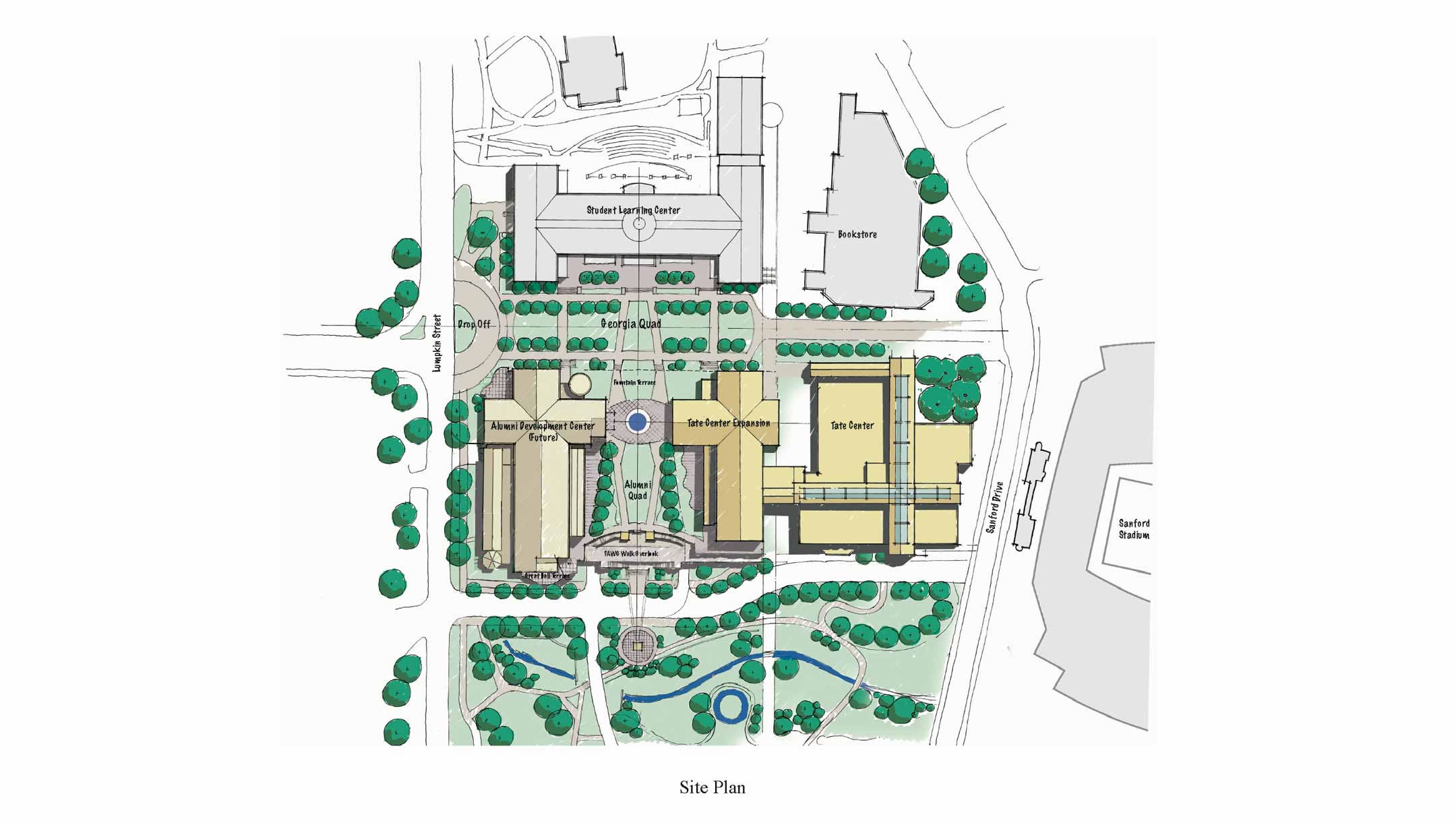
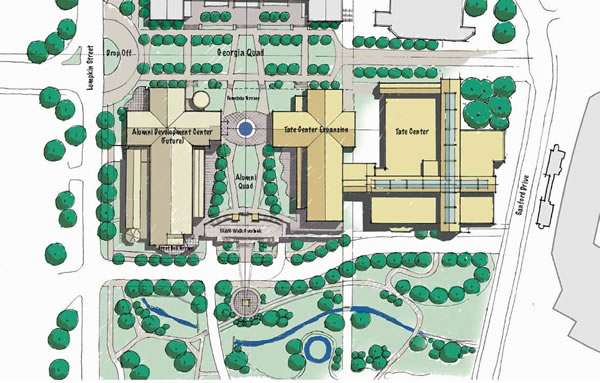
Still, for those who would like to see the tribute placed closer to the stadium rather than across the street from a Kangaroo, there is a good option. When the Tate Center Expansion is finished in a few years, there will be a greenspace leading to the stadium from Lumpkin Street. It’s not a huge space, especially on a crowded gameday, but it looks as if it could serve as Georgia’s “National Mall” where statues of Dooley and any other past greats could dot the landscape.
Wednesday February 13, 2008
Thomas Brown, Marcus Howard, and Kregg Lumpkin have received invitations to the NFL combine. According to a Buford source on the DawgVent, Mikey Henderson wisely decided that his 150 lb. body wasn’t exactly cut out for the NFL and declined an invitation.
I’m kind of surprised not to see Fernando Velasco on the list. Other seniors like Brandon Miller or Sean Bailey might have earned a spot too, but I can see how they could get passed over. Velasco was Georgia’s only senior on the All-SEC team, so you’d expect him to be at the top of the list.
An easy predicition: workout warrior Thomas Brown tests off the charts at the combine. Events like this were made for him.
Monday February 11, 2008
Chip Towers reports that…
The executive committee of the Georgia Athletics Association Board of Directors will announce Monday that it will name the athletic facilities on the south campus after Dooley, the former football coach and athletic director.
I’ll be interested to hear the details. Are we re-naming the buildings, putting Dooley’s name on an imaginary “sports complex”, or what? If we’re talking about writing over names like Woodruff, Butts, Mehre, Towns, and Stegeman, I can’t imagine this going over well. (No, that’s not what’s happening – see below.)
UPDATE: Chip has revised his article to note that “the area of South Campus that houses most of the Bulldogs’ athletic facilities will be called the “Vince Dooley Athletic Complex.” OK, that makes more sense. The real tangible change will be a statue to honor Dooley.
The plan includes the construction of a garden plaza at the corner of South Lumpkin Street and Pinecrest Drive, adjacent to Butts-Mehre-Heritage Hall and Spec Towns Track on South Campus. The centerpiece of that plaza will be 14-foot-high, bronze statue of Dooley being lifted on the shoulders of two his players during the 1980 national championship season.
Cool. Still, as someone on the DawgVent pointed out, the “Vince Dooley Complex” almost sounds like a syndrome characterized by a coach who runs the ball a lot.
Monday February 11, 2008
Larry Munson will miss this year’s Atlanta Sports Awards banquet where he is due to receive the Furman Bisher Award for sports media excellence. Hopefully this quote about his condition is as little cause for concern as him fretting about a 1-AA opponent’s long snapper:
“I’m hanging in there,” Munson said. “That’s the best I can tell you.”
Damn, Larry. Keep hanging in there.
Monday February 11, 2008
…they’d be stuck in Midtown.
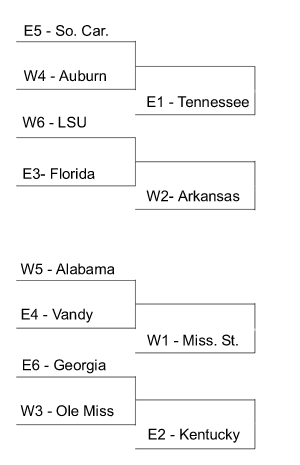
It’s pick-your-poison when you’re a low seed. Georgia seems destined to play Auburn in the opening round every year, so look for the Dawgs to move into 5th in the East and play a shaky #4 seed from the West – Auburn, Alabama, whoever.
Monday February 11, 2008
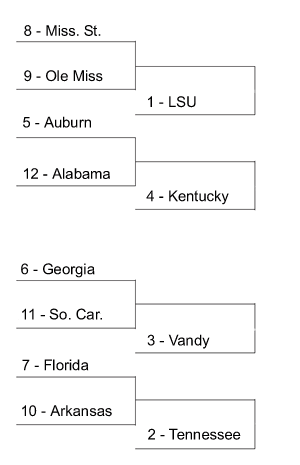
With the top three seeds all but certain to go to LSU/Tennessee and Vanderbilt, the real action is in the 4-7 spots. Kentucky looks to be in good shape in 4th, but an injury to a starter has them vulnerable. Auburn, Georgia, and Florida are bunched together, and Georgia plays each of those schools again. Looking at the bracket, the benefits to Georgia of moving into the 5th (or better, 4th) seed seem huge.
Sunday February 10, 2008
The other day I touched on the perception problem with Georgia basketball. Of course it’s ridiculous to paint the picture of a program in turmoil over a jaywalking incident, but the casual fan sees the names in the papers, sees the attrition, and wonders how far away we are from Tony Cole. (A long way, if you were wondering.)
Still, University President Michael Adams acknowledges this growing perception. “I think in that (men’s basketball) program, we’ve had too many issues of misconduct lately,” he said on Thursday. While this is a relatively lightweight statement next to some of the memos sent to Jim Harrick and Vince Dooley back in their day, it is still an indication that these problems in the basketball program are on Adams’ radar.
With the discussion about Felton’s future now moving into some very public arenas, the perception of the program is one thing that Felton must have on his side, especially as things on the court continue to look grim.
Friday February 8, 2008
Led by Tasha Humphrey’s 23 points, all five Lady Dog starters scored in double figures, and Georgia went over 60 points for the first time in two weeks in a 72-58 win at Arkansas on Thursday night.
With the win, the team avoided the program’s first 4-game losing streak under Andy Landers. The Lady Dogs are now 4-4 in the SEC.
The Lady Dogs will remain in Arkansas today, practice, and then head to Baton Rouge for a nationally-televised game on Sunday at LSU. LSU is tied for the league lead with a perfect 8-0 record, and they’ve been dominant on both ends of the court with Sylvia Fowles controlling the low post. Georgia beat LSU in Athens last season on Ashley Houts’ buzzer-beater.
|

 Another shoe drops
 Comments
 Dawg Media
 RSS 2.0