Tuesday March 4, 2025
There’s nothing like some new blood to shake things up. Two new teams, two coaching changes, and a wave of impact transfers and freshmen have challenged the recent order of things in SEC women’s basketball. This week’s conference tournament returns to Greenville bigger and less predictable than it has been in years. With conference expansion, we’re no longer destined to watch another inevitable South Carolina–LSU championship game. Of course that result remains possible, but Texas made an immediate impact by sharing the regular season title in its first year of membership. Saturday’s semifinals could easily resemble a national Final Four, and the two teams reaching Sunday’s final might view the first four rounds of the NCAA tournament as a relative breather.
The league’s expansion to 16 teams means that Wednesday is no longer merely a play-in round for the bottom seeds. Instead, a full slate of games will be on display involving half the league, and teams seeded ninth or lower will have to win five games to capture the title. With as many as 10 of the 16 teams having a realistic shot at the NCAA tournament, several bubble squads will face immense pressure in Wednesday’s opening round. A single bye into Thursday’s second round is no longer a given, and the coveted double-bye for the top four teams is even harder to secure.
By now the transfer portal and NIL are old hat, yet their effects remain as significant as ever. Entire rosters have been remade over the offseason—a team like Kentucky can leap from a 12th-place finish last year to the top four while posting their widest-ever margins of victory over Tennessee and Georgia. LSU has managed to mitigate the loss of Hailey Van Lith with the addition of Kailyn Gilbert, while other programs, notably Arkansas and Texas A&M, have seen net talent outflows that have cost them in the unforgiving SEC. Despite increased player mobility, some familiar programs have been tough to shake from the league’s very top tier.
Before the weekend’s marquee matchups, the bracket also sets up the possibility for several intra-state rivalries on Thursday—Tennessee versus Vanderbilt, Ole Miss versus Mississippi State, and Alabama versus Auburn. It wouldn’t be surprising to see at least two of those contests materialize, adding intrigue to the second round even before the top four seeds take the floor.
Georgia’s Path Through the Tournament:
Wednesday: vs. Arkansas ~1:30 pm ET SEC Network
Thursday / Second Round: vs. Oklahoma ~1:30 pm ET SEC Network
Friday / Quarterfinals: vs. Kentucky ~2:30 pm ET ESPN
Saturday / Semifinals: 4:30 pm ET ESPN2
Sunday / Finals: 3:00 pm ET ESPN
Complete Bracket Here
The Field
(LY: last year’s finish, PS: coaches preseason projection)
1. South Carolina (15-1, 27-3) (LY-1, PS-1): Two seasons ago the Gamecocks’ slight weakness from the perimeter cost them dearly in the Final Four. This year, their post play could prove to be a vulnerability. South Carolina boasts gifted forwards like Chloe Kitts, Sania Feagin, and freshman sensation Joyce Edwards—players who are long, quick, and versatile. However, in a program known for its sustained interior excellence (from Wilson to Boston to Cardoso), the absence of a dominant post presence—compounded by Ashlyn Watkins’ ACL injury in January—could be problematic.
Most teams can’t hang with South Carolina’s athleticism. Their transition game is showtime with Edwards and MiLaysia Fulwiley featuring on the highlight reel. The athleticism extends to both ends of the court: they can get into transition off a defensive rebound or turnover, and they can drive to the basket at most every position. The perimeter game is still strong, but shots are more contested without the interior presence that drew so much attention and opened things up. Sharpshooter Te-Hina Paopao is under 40% from outside for the first time in three seasons, and the team overall is down from 39.7% a year ago to a less-superhuman 33% this season.
The formula for the right opponent is there: control the boards on both ends to limit South Carolina to single shots and avoid fueling their transition, don’t turn the ball over, and force things into more of a compact halfcourt game. Easier said than done, and it helps if you have Azzi Fudd. Teams like Texas and Tennessee that can match the speed of the Gamecocks have kept things close, and LSU did what it needed to do on the glass but couldn’t shoot well enough to win. It’s hard to consider anyone else the favorite in this tournament, but it’s not as clear-cut as it’s been in recent years.
2. Texas (15-1, 29-2) (LY-NA, PS-2): Vic Schaefer is no stranger to the competitiveness of the SEC. Schaefer took Mississippi State to consecutive national title games last decade. Now in his fifth season at Texas, Schaefer has built another program into a national contender. The Longhorns earned a national #1 seed in their final year in the Big 12, and they’ve wasted no time challenging the established order of the SEC.
Any Schaefer team will be a defensive menace, and the Longhorns are right there with Ole Miss leading the SEC in scoring defense. They challenge offenses for the full length of the court, defend the perimeter well, and have the interior size to make scoring and rebounding difficult. Texas leads the SEC in turnover margin. Between turnovers and rebounding, Texas can overcome a relative lack of offensive firepower with sheer volume of possession.
The Longhorn attack starts with senior point guard Rori Harmon. Harmon can score, averaging nearly 10 PPG, but she is a skilled distributor with around six assists and under two turnovers per game. After Harmon gets things going the offense often finds wing Madison Booker. Booker leads the team in scoring and three-point percentage and is among the team’s better rebounders. Shay Holle is a streaky shooting guard who has come up big in key moments. On the interior Taylor Jones is a capable rim protector, shotblocker, and rebounder who can also score down low. Miami transfer Kyla Oldacre is an imposing forward off the bench capable of bullying an opposing frontcourt.
The Texas offense sticks to its strengths: they need to score around the basket and get to the line. Texas isn’t a great team from the perimeter. They barely shoot over 30% from outside, and that’s only because Booker is over 40% herself. Their strategy centers on efficiency around the basket rather than forcing long-range attempts—a plan that allowed them to beat South Carolina without relying on the three-point shot. It’s more important for them to earn free throws and be efficient around the basket. The Longhorns were just 5-10 from the stripe in a loss at South Carolina but got to the line 21 times in the rematch.
3. LSU (12-4, 27-4) (LY-2, PS-3): Kim Mulkey isn’t about to take a backseat to anyone, and LSU would like nothing more than a rematch of last year’s heated championship game. The Tigers have sustained a high level of play after the departures of Angel Reese and Hailey Van Lith, and it’s hard to call an overtime loss at Alabama a slip-up. They play the same frenzied, fearless, and physical style Mulkey demands of every team. This year’s Tigers though are a little more diverse on offense than they were when Reese was often the first option. The Tigers have already attempted – and made – more three-pointers than they did all of last season. They also get to the foul line less. Make no mistake – they’re still right up there with Texas in terms of free throw attempts, but it’s nothing like last year when they attempted almost 1,000 free throws and over 250 more than any other SEC school.
Flau’jae Johnson is the leading scorer and flashy superstar, but the heart and soul of the team is Aneesah Morrow. Morrow went from a complementary piece alongside Angel Reese to taking up the mantle as the SEC’s leading rebounder. It’s not that Morrow is new to dominating the paint; she averaged a double-double last season too. But it’s just her now shouldering the load down low, and she’s had to step up her production in a leadership role. She’s been up to the job. The Tigers get over 60% of their points from three players: Johnson, Morrow, and shooting guard Mikaylah Williams. Kailyn Gilbert, an Arizona transfer, has been an important addition and contributes nearly ten points per game.
In that light, the news that Johnson will miss the tournament resting a shin inflammation has to be a concern. LSU isn’t the deepest team in the league, but they’ve had just enough to overcome the bumps and bruises of the regular season. A pair of intra-league transfers, Jersey Wolfenbarger (Arkansas) and Mjracle Sheppard (Miss. St.) have provided valuable minutes. Returning reserves Last-Tear Poa and Aalyah Del Rosario have the experience, but their production has dropped this year as Mulkey has settled on a tighter rotation. Mulkey will stress the “next player up” mentality, but their first tournament game will likely be against an Alabama team that just beat them.
4. Kentucky (11-5, 22-6) (LY-12, PS-8): The Wildcats went from last place in 2023 and 12th place in 2024 to claim the final double-bye as Kenny Brooks brought his winning ways – and four important transfers – from his successful Virginia Tech program. This is a roster completely remade using transfers: you have to go seven players down the stat sheet to find a returning Wildcat (Saniah Taylor.)
It all starts with All-American Georgia Amoore. The senior guard darts around the court and doesn’t need much space to get off a shot or find an open teammate. Amoore is among the league leaders in scoring and leads the SEC in assists by a large margin. Charlotte transfer Dazia Lawrence is a capable backcourt complement hitting over 42% from outside. Clara Strack is a versatile stretch forward who can step out for a perimeter shot, drive to the basket, or post up. Strack is also an aggressive defender who leads the SEC in blocks. Frontcount mate Teonni Key has improved throughout the season and is also among the SEC’s leading shotblockers. Wing Amelia Hassett is a difficult matchup and – surprise – can also block shots. That size and speed across the frontcourt makes Kentucky one of the best interior defensive teams in the nation.
When the pieces are clicking, the Wildcats can put up a ton of points and beat good teams like Oklahoma and Tennessee. But while Brooks has maximized his transfers, it’s going to take a little longer to fill out the bench. Only five players see more than 13 minutes per game. With so much going through Amoore, it can be rough going when she has an inefficient game. Strack’s aggressiveness can also get her into foul trouble. The Wildcats can turn to 6’7″ freshman Clara Silva off the bench, but they’re a far better team when the starting five are available and contributing.
5. Oklahoma (11-5, 23-6) (LY-NA, PS-4): The Sooners got a rough welcome to the SEC. They were given a frontloaded SEC schedule and began league play with a 4-5 record. Oklahoma has found their stride and won seven straight games to close the regular season, and it largely has to do with the return to form of dominant center Raegan Beers. Beers, a transfer from Oregon State, leads the team in scoring and rebounding and seems to be playing some of her best ball since nursing an injury for a couple of weeks in early February. With Beers anchoring the middle and Sahara Williams and Skylan Vann rounding out a strong frontcourt, the Sooners are the SEC team leaders in field goal percentage and rebounding. Guard Payton Verhulst runs the offense, and, like Kentucky’s Amoore, is an adept scorer as well as a distributor. Oklahoma as a team shares the ball well: their 21.9 assists per game leads the SEC by a wide margin. That ball movement makes their offense productive (86.7 points per game) and efficient (47% shooting.) Despite their productivity, high turnover numbers have at times marred their rhythm. The Sooners average a league-worst 19.2 turnovers per game and had a -10 turnover margin in a loss at Mississippi State, their only loss to a team below the top four.
6. Alabama (10-6, 23-7) (LY-4, PS-6): There’s no substitute for experience, and the Crimson Tide are taking full advantage of having one of their veteran players. Their top three scorers, Sarah Ashlee Barker, Aaliyah Nye, and Zaay Green, have stretched college eligibility enough to pass the windowpane test. Barker and Nye are in their fifth seasons, and Green is in her seventh(!) year of college basketball. Yes, Green was a member of the 2018-2019 Tennessee team coached by Holly Warlick. Kristy Curry wisely hasn’t changed her system with that much returning production. The Tide still largely run a four-guard system with sophomore Essence Cody holding down the interior. That system comfortably leads the SEC in three-point percentage, and it’s propelled them to wins over Ole Miss and LSU. Those guards must also be active on defense and on the glass, and Barker is among the top 20 in rebounds, blocks and steals. Alabama got off to a slow 4-4 start in the league but won 6 of 7 games in February to climb the standings and put themselves in a position for a top 16 national seed if they can advance to the SEC semifinals.
7. Ole Miss (10-6, 19-9) (LY-3, PS-5): Coach Yolett McPhee-McCuin’s streak of three straight top-four finishes might be over, but that speaks more to the strength of the league than to a real downturn. This is still very much the same style of scrappy, aggressive, and relentless basketball that quickly elevated the Rebels from the SEC cellar. Their defensive pressure has them right up there with Texas and South Carolina in scoring defense and turnover margin. They favor a slower pace of play and can bog down in the halfcourt if their defense isn’t creating transition chances. Ole Miss does not shoot exceptionally well from outside and are better at midrange jumpers and drives to the basket. Senior Madison Scott is the team’s leader, but Scott and three other players – Starr Jacobs, Kennedy Todd-Williams, and Sira Thienou – all average between 11 and 12 points per game. Ole Miss dropped early games to Texas A&M and Alabama but finished strong with wins over Kentucky and LSU. Ole Miss could also turn success in Greenville into a top 16 national seed, and they won’t fear a rematch with Texas: the Rebels led the Longhorns deep into the fourth quarter in Oxford.
8. Vanderbilt (8-8, 21-9) (LY-6, PS-10): Last season Shea Ralph’s program broke through with a trip to the NCAA tournament for the first time in a decade. The Commodores have not only sustained tournament-quality basketball; they’ve added legitimate star power that makes any Vanderbilt game a compelling watch. Freshman Mikayla Blakes has quickly become one of the SEC’s most feared offensive weapons. She broke the SEC record for points in a game at Florida and then broke her own record a few weeks later with 55 in an overtime win at Auburn, scoring over 20 points in the 4th quarter alone to bring the Commodores back from a double-digit deficit. It’s not just Blakes: forward Khamil Pierre built on a strong freshman season and is herself among the top five scorers and rebounders in the league. The trick has been finding complementary pieces and help for Pierre on the interior. If someone like Iyana Moore or Madison Greene gets going, the Commodores can put up some big totals. Narrow wins over Tennessee and Alabama are the team highlights of their season. Tennessee could be standing between them and their first quarterfinals appearance since 2016.
9. Tennessee (8-8, 21-8) (LY-5, PS-7): The Lady Vols took a risk. They came within a Kamilla Cardoso buzzer-beater from the upset of the 2024 season, but that wasn’t enough to avoid a coaching change. Tennessee has been desperate for a return to its elite status in the post-Summitt era, and peaking at third place in the SEC wasn’t good enough. The program didn’t break the bank for an established coaching star or remain “inside the family” for another coach with Tennessee connections. They introduced Kim Caldwell, a relative newcomer with a single season’s experience coaching at the Division 1 level. Her relatively brief coaching career is packed with success. She led her alma mater, Glenville State, to the Division 2 national title. In her lone season at Marshall, Caldwell led the Thundering Herd back to the NCAA tournament for the first time since 1997 and earned the Maggie Dixon Award as the top first-year head coach.
The Lady Vols turned heads early in the season as the first team to make 30 three-pointers in a single game. Caldwell’s offense runs and guns: Tennessee leads the SEC in three-pointers attempted and made, and seven players have attempted at least 65 shots behind the arc. Their defense is equally frenetic, forcing over 22 turnovers per game. That exciting style has made for some high-scoring and competitive games, and Caldwell notched a signature win with an upset of UConn. They’ve found it tough to break through against the top teams in the SEC, and a pair of bad losses in the final week to Kentucky and Georgia means that a team ranked #11 nationally last week finished in the bottom half of the league and will play on Wednesday.
Tennessee women’s basketball could never be called low-profile, but relatively speaking this is a team that’s succeeded somewhat under the radar. It starts of course with the head coach who was an unfamiliar name to all but the most obsessed fans. There’s no superstar like Rickea Jackson who stands out. What Tennessee has is a well-rounded and athletic roster that’s incredibly deep. There are 10 players averaging over 13 minutes per game, and it’s not uncommon to see wholesale line changes of four or five players at a time. Leading scorer Talaysia Cooper went down with an ankle injury against Georgia, and her status is questionable for the tournament. Four other players – Jewel Spear, Ruby Whitehorn, Zee Spearman, and Samara Spencer – average double-figures.
10. Mississippi State (7-9, 20-10) (LY-8, PS-11): Sam Purcell is trying to get his program unstuck. The Bulldogs finished fifth in Purcell’s first season, but they’ve been the definition of a bubble team in the two seasons since. That’s the case again this year. Mississippi State had a solid 12-1 nonconference mark, and they have quality SEC wins against Oklahoma and Vanderbilt to their credit. Road losses at Missouri and Florida have the Bulldogs headed to Greenville at 7-9 in conference and needing to advance to Friday to feel somewhat confident about their postseason. Guards JerKaila Jordan and Debresha Powe have been multi-year standouts, and they’re joined by Kentucky transfer Eniya Russell. 6’6″ center Madina Okot has been significant addition inside. Okot is not quite the all-around dominant post that Teaira McCowan was, but she’s still second in the SEC in rebounding, a capable scorer cleaning up around the basket, and a decent rim protector. This is a good team without many glaring weaknesses other than a slight propensity for turnovers, but they’re also not excellent in any one area.
11. Florida (5-11, 14-16) (LY-11, PS-9): By handling the bottom of the league and pulling out a close home win over Mississippi State, the Gators were able to avoid the mess in the standings below them. Otherwise, though, it’s been a tough season for a rebuilt roster. Center Ra Shaya Kyle returns from an injury that sidelined her last year, and she’s been a solid scorer and rebounder. Freshman guard Liv McGill was a top 10 prospect and the highest-rated signee in program history. She’s lived up to her billing as the team’s leader in scoring, assists, and steals. Jeriah Warren has doubled her production as a senior, and Laila Reynolds has also improved to average in double figures. Florida can score, but they’re near the bottom of the league in scoring defense and can find themselves on the wrong side of a shootout. Turnovers can also be an issue on both ends of the court – they are second only to Texas A&M in lowest turnover margin. They turned it over 24 times in a bad loss to first round opponent Auburn, and ball security will be key again in the rematch.
12. Georgia (4-12, 12-18) (LY-13, PS-14): For much of the season, it seemed as if last year’s low-water mark for wins might be in jeopardy. But the Lady Dogs arrive in Greenville with momentum, coming off their best week of the year. They closed out their home schedule with a comeback win over Auburn, then capped the regular season with a stunning upset at Tennessee—just the program’s sixth-ever victory in Knoxville. Those wins provided a much-needed confidence boost and, in practical terms, marked slight but tangible progress from last season. Georgia’s four conference wins kept them out of the logjam at the bottom of the standings and secured the No. 12 seed.
Katie Abrahamson-Henderson’s roster remains a work in progress, as recruiting traction has taken time. The result is an unusual gap between a handful of veteran guards and a large group of underclassmen. The seniors have been critical. Asia Avinger is the team’s emotional leader and paces Georgia in both assists and steals. De’Mauri Flournoy is the most consistent outside threat, shooting over 41% from three. Roxane Makolo, often tasked with the toughest defensive assignments, has stepped up in recent weeks with two of her best performances of the season. Strong showings from this trio are essential—Georgia’s frontcourt lacks the depth and scoring to compensate when the guards struggle.
The freshmen, however, have been just as pivotal. Fans see this group as the foundation of the program’s rebuild. Dynamic guard Trinity Turner leads the team in scoring. Forward Mia Woolfolk has the ability to dominate inside, particularly against weaker frontcourts. Summer Davis is a dangerous perimeter shooter, while Miyah Verse provides energy on the glass, leading the team with six rebounds per game. Like most young teams, though, they have endured growing pains. Turnovers and foul trouble have been persistent issues, and it has taken time for the defense to gel within Coach Abe’s complex system. Perimeter defense has been inconsistent, and Georgia’s turnover margin has gone from +3.4 in 2023 to -1.4 in 2024, with only slight improvement (-1.23) this year. However, over the past two weeks, the team has shown meaningful defensive progress.
Georgia edged Arkansas 62-61 in their lone regular-season meeting, a game that came down to the wire. The Lady Dogs built a halftime lead, but the Razorbacks chipped away and eventually tied it, only for Avinger to win it at the free-throw line with one second remaining. Makolo did well in limiting Arkansas star Izzy Higginbottom, particularly in the first half, but Higginbottom still managed to finish with 24 points. She will again be the focal point of Georgia’s defensive game plan, but she isn’t the only concern—forward Vera Ojenuwa had 13 points and seven rebounds in the first meeting and could present problems inside. Woolfolk, who posted 16 points in the first matchup and looked unstoppable at times, will need to play a key role. Just as importantly, Georgia must stay out of foul trouble. Makolo, Avinger, and Woolfolk all finished the first game with four fouls, forcing Georgia to adjust its defensive approach late as Arkansas mounted its comeback. Higginbottom, in particular, excels at drawing contact and converting at the line, where she is one of the league’s most reliable free-throw shooters.
13. Arkansas (3-13, 10-21) (LY-10, PS-16): Live by the transfer, die by the transfer. Mike Neighbors’ run of success earlier this decade took off with the transfer of Chelsea Dungee from Oklahoma. Amber Ramirez and Destiny Slocum also joined the inflow of talent to Fayetteville complementing homegrown stars like Makayla Daniels. The portal has been less kind recently with more key pieces leaving than arriving. In just the past couple of seasons the Razorbacks have lost Taliah Scott (Auburn), Jersey Wolfenbarger (LSU), Erynn Barnum (Miss. St.), Maryam Dauda (South Carolina), and Saylor Poffenbarger (Maryland). The Razorbacks have slid from 8th place in 2022 and 2023 to 10th in 2024 and now 13th as the reloading hasn’t been able to keep up with the outbound traffic. Neighbors did stave off complete disaster with another success in the portal: senior guard Izzy Higginbottom runs the show and is the SEC’s leading scorer. Overall though the Razorbacks are just too thin in the frontcourt and shoot only about 30% from outside. Higginbottom is good enough to carry the team to a win if she gets a little bit of help, but that help has been tough to come by on most nights. A win at Texas A&M to end the regular season snapped a seven-game skid, and Higginbottom’s 27 points paired nicely with 23 points from Pheonix Stotijn and 14 from Kiki Smith.
14. Auburn (3-13, 12-17) (LY-7, PS-12): Auburn might point to some late collapses against Vanderbilt and Georgia for a lower-than-expected finish after last season’s seventh place, but the Tigers have struggled to gain traction all season. They opened SEC play with five straight losses, failed to win consecutive games, and enter the postseason with six straight losses. The record comes despite the Tigers having one of the SEC’s hottest scorers. Texas transfer DeYona Gaston has scored at least 24 points in five of Auburn’s last six games. The offense took a hit when Arkansas transfer Taliah Scott was injured just three games into the season. Johnnie Harris bolstered the roster with the midseason addition of guard Yuting Deng, and Deng quickly became Auburn’s second-leading scorer. The Tigers lack a strong inside presence, and their trapping defense hasn’t been as effective this year. They were able to handle opening round opponent Florida in January, so it’s possible for them to salvage a win in Greenville and set up an Iron Bowl in the second round.
15. Missouri (3-13, 14-17) (LY-14, PS-15): The Tigers went over a year between SEC wins, and a heartbreaking loss at Georgia made an 0-16 season a possibility. Missouri came to life with an upset home win over Mississippi State and emerged as a dangerous opponent thanks largely to the development of sophomore Grace Slaughter. Slaughter had a respectable freshman campaign averaging 11.5 points per game in 2024 but has really shouldered the load for her team through a competitive stretch of the season. Forward Laniah Randle has had her moments and led the team to a close win over Arkansas in the final week of the season. The Tigers play a difficult motion offense that’s kept them in several games, but they lack the team firepower and depth to sustain for four quarters against most teams. Missouri has already announced that coach Robin Pington won’t return.
16. Texas A&M (3-13, 10-18) (LY-9, PS-13): Things looked shaky for the Aggies after some offseason attrition cost the program much of their young talent. But they started conference play with some noteworthy wins: the Aggies upset Ole Miss and Kentucky and had a 3-3 SEC record. Joni Taylor’s teams have usually relied on defense and tempo to keep games low-scoring and within reach. That was the profile of their three conference wins: defensive struggles in the 50s or 60s which went their way as they turned it on in the fourth quarter. Those wins featured furious second half comebacks, and a team that believes it’s never out of a game can be dangerous. The loss of leading scorer and rebounder Aicha Coulibaly to a midseason injury changed the math. The tight margin that kept A&M competitive enough to pull out a handful of close games was gone, and the Aggies haven’t won a game without Coulibaly.
Thursday September 12, 2024
A truncated 10-minute fourth quarter tells you all you need to know about the one-sidedness of this game. Georgia didn’t score in the 60s or 70s like some of its SEC brethren in their guarantee games, but we should know by now how Kirby Smart approaches these games. There was a ton of situational work and early and frequent substitutions.
Georgia’s advantages in all three phases showed up on the first plays for the defense, special teams, and offense. TTU went horizontal on their first snap, and that’s rarely a good idea against the Georgia defense. Anthony Evans followed with his best punt return of the season to set up Georgia’s possession. Carson Beck immediately hit Dillon Bell on a corner route for Georgia’s first score. The Bulldogs had 14 points after running eight plays, and it did seem for a minute as if we were on our way to a score we’ve only seen in postseason games.
The scoring slowed to a trickle from the late first quarter into the second as both teams sustained lengthy drives with few explosive plays. Georgia marched down the field on a 14-play drive that took over 5 minutes but fizzled with two incompletions inside the 5. They had to settle for a chip shot field goal. TTU followed with an 11-play drive that consumed nearly half of the second quarter but advanced no further than the Georgia 38. Georgia put points on the board on their first four possessions, but the teams combining for two possessions that ate up twelve and a half minutes put the brakes on runaway scoring.
Georgia opened the second half with a pair of quick strike scores surrounding a TTU fumble, the only turnover of the game. That was enough to turn the game over to the reserves. Fans who stuck around got to see Gunner Stockton run the offense and a number of players make their Sanford Stadium debuts. It was a memorable afternoon for players like Jordan Thomas and Chris Cole, and Justyn Rhett will probably be fine with moving on to the next game.
It was fun to see Beck toss five touchdown passes, Etienne make his first appearance for Georgia, and the defense dominate. The main draw of these lopsided games to me though is the opportunity to empty the bench. For many of us it’s our first glimpses of players who drove last year’s recruiting news and who Georgia is counting on to sustain its place atop college football. Some of them will end up redshirting; others might earn more playing time as they gain experience. It’s peeking into the future – a luxury we don’t get often during the game-to-game grind.
Go-to guys
Georgia spread the ball around to 15 different receivers against TTU. Of course several of those were reserves getting playing time later in the game, but after two games we’ve seen a combination of around ten tailbacks, tight ends, and wide receivers emerge as credible targets for Carson Beck. That depth makes the Georgia offense unpredictable and versatile enough to attack different defensive approaches. At the same time, there’s one question Georgia hasn’t had to answer yet: who does Beck look to when he needs a key reception late in the game or on a big third down? The answer seems to be a work in progress. Georgia is only converting 40% of third downs so far (8 of 20.) Whether that’s a quirk of the first two games or something that will matter more in tighter games remains to be seen.
Recently of course it’s been Bowers, McConkey, or even AD Mitchell who could be expected to be targeted when the Dawgs needed a catch. Who might that be in 2024?
- Arian Smith leads the team with nine receptions. The long reception to open the third quarter is what most people associate with Smith, but Smith’s role this year has expanded beyond “go deep.” His deep threat helps him create space to break off routes for short gains, and we’ve seen him involved in screens and jet motion. His blocking has also improved which helps him stay on the field for a wider variety of plays. Smith still needs to improve after the catch and develop moves to evade the first tackler that will let him turn shorter gains into explosive plays.
- Dillon Bell won’t be lining up in the backfield this year, but his eight receptions show that he’s expected to be a bigger part of the passing game.
- Dominic Lovett is third on the team with six receptions primarily from the slot. He’s made some fantastic moves after the catch, and his veteran experience showed against TTU in tight quarters to get open for a touchdown. The combination of SEC experience and elusiveness might make him a top go-to option.
- Colbie Young has made the most of his three receptions. Young leads the team with two touchdown receptions and has been targeted several other times in the redzone. His 6’3″ frame makes him a natural target in tight quarters. There are still some timing and accuracy issues between Beck and Young.
- If you want a big catch, there were few bigger than the two third-and-long receptions by London Humphries in the opener. Humphries didn’t catch a pass against TTU, but his performance against a tough Clemson defense said plenty.
As for replacing Bowers, it’s interesting that Luckie has been the primary receiving threat from the tight end position. He has four receptions including a couple of explosive plays while Delp has just one reception through two games. Ben Yurosek got on the field early, but he’s yet to record a catch.
Extra Points
- TTU only attempted eight passes, and most of those were after halftime. Their five receptions totaled 18 yards. This wasn’t a game that featured Georgia’s secondary in much other than a run support role. There were still some individual standout moments. KJ Bolden’s sack on a safety blitz effectively forced an early three-and-out. Dan Jackson had a couple of big hits including an outstanding tackle at full speed along the Georgia sideline.
- Tackling overall though wasn’t a strong point for the Georgia defense. After lost-yardage plays hurt them early on, TTU found success up the middle in the running game that let them sustain two first half drives. It didn’t result in points, but the drives took 12 minutes off the clock and kept Georgia’s offense off the field.
- As thoroughly drilled and mentally tough an elite team like Georgia must be, focus can wander in games like this. It could definitely show up in tackling, and penalties are another likely result. Georgia’s nine penalties led to some stalled drives and ultimately TTU’s only points. On a hot day during a blowout it can be easy not to lock in and reach and grab.
- Branson Robinson ran with much more confidence than he did in the opener. That’s to be expected after working back from such a serious injury; often learning to trust the recovery is a big mental step. Watching him attack running lanes and drag defenders looked a lot more like the old #22.
- Tyrion Ingram-Dawkins and Christen Miller have flashed in each of the first two games. That’s significant with Brinson and Williams injured. Ingram-Dawkins in particular is playing with better consistency and will improve the rest of the defense.
- Did you enjoy a cold one? There was no shortage of places to grab a beer around the stadium, and many fans looked to be partaking in the novelty of alcohol sales in Sanford Stadium. It was unfortunate though that folks who just wanted some cold water on a hot gameday had to join the beer lines; more standalone water stations would have been nice given the conditions.
Wednesday September 4, 2024
Georgia’s 2014 win over Clemson is probably best remembered as the game that introduced the world to one of the most talented backfields in college football. The night belonged to Todd Gurley who added a kickoff return touchdown to 198 yards and three rushing scores. It was also the debut of Nick Chubb whose 47-yard scoring jaunt showed the speed, physicality, and determination that would define his career. Sony Michel even averaged 5.5 yards on 6 carries – not a bad start.
On the other side of the field though was a heralded freshman quarterback waiting his turn behind an established starter. Deshaun Watson saw limited time in that game and only attempted four passes. He threw Clemson’s only touchdown pass, and it was a laser down the middle of the field that showcased the range, power, and accuracy that justified the hype surrounding his recruitment. Clemson fans will never look back on a big loss to Georgia fondly, but Watson’s touchdown strike represented the start of something.
That 2014 season was a transitional year for Clemson. Watson couldn’t completely overtake Cole Stoudt for the starting job, but the future was evident. Over the next six seasons Clemson reached the playoffs five times, played for four national titles, and won twice. Georgia might have been fortunate to get Clemson early in 2014; the Tigers were on the verge of taking their above-average program on a run to become perhaps the elite program of the late 2010s.
The beginning and end of dominant eras aren’t always so clearly delineated by single games. Some very good teams don’t quite make it over the hump, and others do. Georgia fans spent the period from 2017-2021 wondering what could turn a talented and successful program into a champion. In hindsight that era was the leadup to the 2021 and 2022 titles. Georgia’s tight 10-3 win over Clemson in 2021 didn’t necessarily dethrone Clemson; it served more to demonstrate that Georgia belonged on the field with a program seen at the time as one of the best. Clemson hasn’t been to the playoffs since 2020, but they are still perennial ACC favorites and played for the conference title game 7 of the past 9 years.
Georgia’s resounding 34-3 win on Saturday, Clemson’s largest regular season margin of defeat since 2013, might let us close the door on a ten year Clemson era. The Tigers are still a good football team and might even contend for the ACC title in 2024. There was no mistaking though the difference between a team positioned to compete for a national title and just another above-average P4 team. Decline can be gradual and nonlinear, but certain results are definitive. Georgia’s depth of talent, speed, playmakers on both sides of the ball overwhelmed a team that wasn’t up to par both in personnel and execution. Some made this game into a referendum on Dabo Swinney’s reluctance to accept transfers, but it would take a lot of high-impact transfers to make up the ground between a program built with top 3 recruiting classes and one that’s struggled to land a top 10 class over the past three seasons. Clemson’s freshmen class contributed very little against Georgia: what we saw from the Tigers was the culmination of several years of recruiting and roster development by the Clemson staff, and it’s left their program at quite a different state than Georgia’s.
Welcome
On the other hand newcomers – both freshmen and transfers – factored into the outcome for Georgia. There’s always some trepidation about a season opener. We got a preview of life without Bowers and McConkey late last season, but there was uncertainty on the other side of the ball too with three key secondary players off to the NFL. It didn’t take long for newcomers to have a presence in this game. Safety KJ Bolden started things off with a clean open-field tackle on a third down pass play. Bolden’s readiness to play right away allowed the coaches some flexibility in the defensive backfield that paid off with the play of of Malaki Starks at star. Julian Humphrey isn’t new to the team, but he handled an expanded role as the second cornerback well.
The second half scoring outburst featured several of the offense’s newcomers. Colbie Young came to Georgia with the promise of being a tall weapon in the red zone, and he scored Georgia’s first touchdown of the season on a perfect back-shoulder pass from Beck. London Humphreys had to come in the game after Dillon Bell cramped up and had an immediate impact. His 23-yard catch on a 3rd and 10 at midfield sustained the second drive of the half and led to another score. Humphreys himself got in the endzone on another 3rd and long conversion that featured the speed that caught the eye of Georgia fans in Nashville last season.
Preseason hype is as much a part of summer as the heat, but if you sorted through the noise you kept hearing the name Nate Frazier. The loss of two top tailbacks for the game caused some concern about the running game, and Frazier got his opportunity. His first half was unassuming with a handful of carries, but he came to life in the second half. Needing an answer after Clemson’s field goal, Beck found Frazier out of the backfield for a 24-yard reception. Frazier finished off the drive for his first touchdown as a Bulldog. Georgia’s final scoring drive got the Frazier hype train going full speed: he started it with a shifty 40-yard run that saw him break tackles, explode across the middle of the field, and make tacklers miss en route to the other sideline. He followed that immediately with a 16-yard run that patiently bounced outside twice until he found room.
You remember when Georgia’s long line of great tailbacks had that first signature play that made you take notice. Swift’s touchdown run to clinch the 2017 SEC title. Chubb’s toss sweep romp through Clemson in 2014. Michel on a tunnel screen the next week at South Carolina. That 40-yard burst from Frazier got a lot of people outside of Athens talking, and the realization that Georgia has another weapon on offense has Bulldog fans excited. Frazier finished with over 100 all-purpose yards.
The three phases
The offense still goes through Carson Beck, and it took a while to get going. Beck admitted that nerves and anxiousness were a factor early on, and it cost a few opportunities. A red zone slant to Young sailed high, and Georgia had to settle for a field goal. Later a pass to Lovett was thrown behind the receiver, and the broadcast mentioned Beck taking ownership and needing to calm down. Beck did calm down, and the Georgia offense picked up with the help of good play design. Frequent presnap motion forced Clemson to tip their defensive alignment and made things easier for Beck. That motion and the usual dose of play-action opened things up from the second quarter. Though it took over a half to get into the endzone Georgia put points on the board on 6 of 8 drives after the first quarter.
A near-shutout of a top 15 opponent requires a total team defensive effort, and that’s what Georgia got. The Tigers were held to 46 yards rushing (none longer than 9 yards) while being unable to capitalize on just a handful of explosive pass plays. Cade Klubnik averaged a scant 4.9 yards per attempt, and the Tigers were just 4-14 on 3rd and 4th downs. But within that collective result there were individual standouts. Jalon Walker is a havoc machine lined up everywhere from middle linebacker to the edge, and it’s tough to key on him when Mykel Williams is just as difficult a matchup. The linebackers are a solid barrier side-to-side. Georgia’s secondary held its own without Aguero available, and the versatility of Starks is on par with what Bowers meant to the offense over the past three seasons.
A year ago freshman kicker Peyton Woodring got off to a shaky start. He missed 3 of his first 7 FG attempts including two misses in a close win over South Carolina. Since that game Woodring has only missed once – a 50-yarder against Alabama after a sack and penalty cost Georgia 12 yards of field position. He’s been steady and reliable from short and moderate range, and Saturday’s career-long 55-yarder shows that he can be effective from longer range now. Georgia’s edge on special teams was as evident as their advantages in the other two phases. Woodring allowed Georgia to build a modest lead in the second quarter. Thorson continually pinned Clemson inside their 20. Evans had some modest success returning punts, but most important was his effort to field nearly everything: a zero-yard return of a line-drive punt that could roll another 20 yards is just as valuable as a highlight return.
Extra points
- On a team with so many deep position groups, the inside linebackers stand out. Mondon is healthy and active. Allen always had the speed as a freshman, but he’s more instinctual now. The best surprise might’ve been Raylen Wilson. Wilson played in a reserve role in 2023 but was featured quite a bit more against Clemson and jumped off the screen. Mondon, Allen, and Wilson each finished with four tackles and shut down what Clemson wanted to do at and along the line of scrimmage. There’s more to come – Justin Williams stopped a runner dead cold in the backfield during garbage time sending a late jolt through the crowd.
- Clemson struggled to sustain much of anything in the first half, but the margin was close. Three of their five first half drives ended at 4th and 1, 4th, and 1, and 4th and 3. Georgia’s tackling had something to do with those drives coming up just short, but Clemson’s execution and routes didn’t do them any favors.
- I’m not mad that there weren’t many downfield shots to Arian Smith. We know what Smith can do vertically. To earn a spot on the field beyond those few shot plays Smith has had to develop additional skills beyond speed. It was encouraging then to see him catching shorter and more difficult sideline routes. He ended up among Georgia’s leading receivers, and the offense found a way to get him more involved than we saw earlier in his career.
- Depth along the defensive line was tested. It was thin to begin with, and Brinson’s early injury meant that Stackhouse and Miller in particular had to play more snaps than you’d usually see from Georgia. Freshman Joseph Jonah-Ajonye got on the field for some experience. Brinson and McLeod should be available soon, but it will be a position where you have to watch for wear and tear as the season progresses.
- It was unexpected but a pleasant surprise to build a large enough advantage that so many players were able to get experience in a game of this magnitude early in the season. Seven players recorded a rush, nine players recorded a reception, and 23 defenders recorded a tackle. Overall at least 62 Bulldogs saw action.
- The job of replacing Brock Bowers is one of the big 2024 storylines, and Georgia used all three of its experienced tight ends. It’s no surprise that the superhuman Bowers production was hard to replicate. Luckie caught the two receptions in the game for the TE position including a nice cut out of a slant that resulted in a long gain. Delp was only targeted once and was covered well, but Delp’s development as a blocker has continued from last season. Yurosek was thrown into the deep end early in the game and will have to continue to get up to speed with the physicality of the SEC. Georgia’s offense was finally victimized by the same defensive line stem used so often to get opposing offenses to jump, and it was Yurosek who drew the penalty.
- We heard a lot last year about “extensions to the running game” especially early in the year when several top tailbacks were injured. Georgia’s running game wasn’t dominant against Clemson the way it was, say, in 2014, but much of what Georgia did started with releases or motion out of or across the backfield. It started with Arian Smith on jet motion on Georgia’s first snap and went from there.
- Operationally it was a fairly clean game for an opener, and that’s to be expected of Georgia by now. There were some costly penalties to clean up, but there were no real visible moments of disorganization or confusion from the sideline. The Dawgs avoided turnovers and special teams mistakes, and they’ll be tough to beat if that continues.
Georgia has won 40 consecutive regular season games as an SEC team in an era of rapid roster turnover and wholesale changes to the structure of the sport. Sustaining that streak will become more difficult in the coming weeks, but Georgia’s first outing of 2024 shows that they just might have the stuff to do it.
Wednesday August 28, 2024
A few weeks ago I wondered what a postseason home game would look like. Hopefully Georgia will earn a bye and the high seed that comes with an auto bid, but the possibility of getting an at-large bid has to be considered. When Georgia has hosted NCAA postseason events in other sports, those games have often been ticketed through a separate process without much regard to how tickets were issued during the regular season. Would it be the same for Sanford Stadium if Georgia hosted a first-round CFP game? Would it resemble a true home game, or would the CFP allocate tickets themselves?
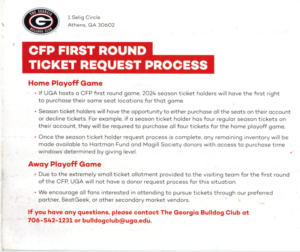
To the athletic department’s credit, we know those answers before the season starts. Season ticket holders recently received a postcard outlining exactly how it will work. Some key points:
- Season ticket holders will have the first right to purchase “their” seats for a CFP home game.
- It’s all or nothing – you either buy all of your seats or forfeit them for this game. (No buying only two tickets of a four seat block.)
- Once season ticket holders accept or decline their seats, the remainder will be available based on the priority system.
- There is no distribution process for an away CFP game. They expect the visitor allotment to be small enough not to bother with.
No surprise: there is nothing about pricing. It’s likely the tickets will be priced at usual CFP levels, and those high prices might influence whether season ticket holder with large blocks decide to opt in.
This system seems about as fair as it could be. It should be reassuring to season ticket holders who might have worried about getting pushed out of seeing a home playoff game. You’ll pay for the right to be there, but you’ll still have first say.
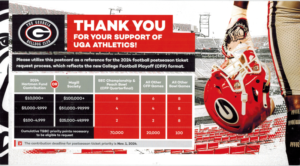
As a bonus the postcard also included the 2024 postseason donation requirements and ticket quantities. We know what it will take to qualify for tickets to the SEC championship, the CFP, and any other bowl game. Of course games held in Atlanta (SECCG and the CFP quarterfinal at the Peach Bowl) will have the highest cutoff levels. Fans have until November 1st to add to their cumulative donation.
Wednesday August 28, 2024
It’s that time of year again – Georgia’s roster is set and full. The 85 Bulldog scholarship players will come from among these 87. (Dan Jackson, a possible starter at safety, is not counted.)
It’s the final year of Covid eligibility rules. Brinson, Truss, and Stackhouse took advantage of an additional year of eligibility, so Georgia will have 12 seniors. That’s an increase from 9 seniors in 2023 and 2022, but the bigger picture hasn’t changed. Georgia had 28 juniors and seniors in 2023, and they’ll have 26 in 2024. The 36 freshmen and redshirt freshmen make up over 40% of the team – second only to the 38 in 2022. But 17 of those 38 freshmen in 2022 are no longer with the program, so Georgia only has 14 juniors this season. The Dawgs won’t have to start any freshmen in 2024 barring injury, but you can see several opportunities for playing time at certain positions.
Large incoming classes at defensive back and offensive line were needed to refill those positions which could be facing some depth issues after 2024. Georgia only took a handful of transfers this year, and they were primarily on the offensive side of the ball.
(Players are listed by class. Possible Day-One starters in a base formation are in bold – just a best guess. [R] indicates a player who has redshirted. Transfers are italicized.)
| |
ELIGIBILITY REMAINING |
| |
4 YEARS |
3 YEARS |
2 YEARS |
1 YEAR |
| QB (4) |
Jaden Rashada [R]
Ryan Puglisi |
Gunner Stockton [R] |
|
Carson Beck [R] |
| RB (5) |
Nate Frazier
Chauncey Bowens |
Branson Robinson [R]
Roderick Robinson II |
Trevor Etienne |
|
| TE (5) |
Jaden Reddell
Colton Heinrich |
Lawson Luckie |
Oscar Delp |
Ben Yurosek |
| WR (12) |
Sacovie White
Nitro Tuggle |
Chandler Smith
De’Nylon Morrissette
Anthony Evans III
London Humphries |
Dillon Bell
Cole Speer |
Arian Smith [R]
Dominic Lovett
Colbie Young
Michael Jackson III |
| OL (18) |
Jamal Meriweather [R]
Kelton Smith [R]
Bo Hughley [R]
Nyier Daniels
Marques Easley
Marcus Harrison
Jahzare Jackson
Malachi Toliver
Michael Uini
Daniel Calhoun
|
Earnest Greene [R]
Drew Bobo [R]
Monroe Freeling |
Jared Wilson [R]
Dylan Fairchild [R]
Micah Morris [R] |
Xavier Truss [R]
Tate Ratledge [R] |
| DL (13) |
Xzavier McLeod [RS]
Justin Greene
Nasir Johnson
Jordan Thomas
Joseph Jonah-Ajonye
Nnamdi Ogboko |
Christen Miller [R]
Jamaal Jarrett
Jordan Hall |
Tyrion Ingram-Dawkins [R]
Mykel Williams |
Warren Brinson
Nazir Stackhouse |
| LB (13) |
Chris Cole
Kristopher Jones
Justin Williams
Quintavius Johnson |
Troy Bowles
Raylen Wilson
CJ Allen
Samuel M’Pemba
Gabe Harris
Damon Wilson |
Jalon Walker |
Chaz Chambliss
Smael Mondon |
| DB (14) |
Kryon Jones [R]
Chris Peal [R]
Justyn Rhett [R]
Ondre Evans
Demello Jones
Ellis Robinson IV
KJ Bolden |
Julian Humphrey [R]
Jake Pope [R]
Daniel Harris
Joenel Aguero |
Malaki Starks
Daylen Everette
JaCorey Thomas |
|
| SPEC (3) |
Drew Miller |
Peyton Woodring |
Brett Thorson |
|
| 87 |
36 |
25 |
14 |
12
|
Tuesday August 27, 2024
First, get a load of the new court. Reaction has been enthusiastic – it looks as if the redesign hit the right notes. One underrated design choice was the use of the collegiate block letters on the baseline from the popular retro uniforms rather than the modernized font.
Coach Abe got some fantastic news this week with a commitment from 5’11” guard Aubrey Beckham. Beckham, a 2025 prospect from Hebron Christian Academy in Dacula, is rated as the #30 prospect in the nation by ESPN.
The commitment is significant on many levels. Most important of course is that she can play a valuable position well. She’d be the highest-rated prospect to play for Georgia in several seasons. Beckham is touted as a “floor general” who can lead Georgia’s offensive attack. With how much of Coach Abe’s offense depends on a steady player in command like Diamond Battles or Asia Avinger, it’s easy to see how a talented guard like Beckham could thrive in this system.
Beckham’s commitment also represents an important milestone for Coach Abe’s recruiting. If she takes the court in 2025, she’ll be the first Lady Dog freshman from the state of Georgia since Jillian Hollingshead in 2021. She’d be Coach Abe’s first signee from Georgia and just her second player from the state. (De’Mauri Flournoy transferred in from Vanderbilt shortly after Coach Abe was hired.) Georgia has always been a national program with greats like Katrina McClain, Saudia Roundtree, Kelly and Coco Miller, and Deanna Nolan hailing from out of state. There’s always been room though for some of the state’s best talent. Angel Robinson, Ashley Houts, Tasha Humphries, and of course Teresa Edwards were must-have in-state prospects. Those foundational players have been heading elsewhere recently.
Coach Abe had to fill a depleted roster any way she could, and her staff did not have deep ties to the state of Georgia. She leaned on the connections she brought from UCF while her recruiting operation in Georgia had to be built from the ground up. It hasn’t been easy nor fruitful. Relationships that lead to commitments can take years to develop even with prospects within the state. Take Essence Cody, a talented player from Georgia now at Alabama. Cody began receiving offers and developing relationships with programs since the 8th grade – well before Abe took over at Georgia. Making things more difficult was the inability to host camps which are invaluable opportunities to get elite prospects on campus and sell the program. The triple whammy of the Covid pandemic, the coaching transition in 2022, and Stegeman Coliseum roof construction in 2023 meant that until 2024 Georgia had been unable to host summer camps since 2019.
Perhaps the commitment of Beckham shows that things are beginning to change. Georgia was clearly on the mind of more top prospects after camp season this summer, and several will take visits this fall. Director of Recruiting Operations Brianna Patton recently returned back to Georgia from a successful stint at Ole Miss and is already paying dividends.
It’s unreasonable to put the pressure on Beckham to be the pied piper leading other elite prospects to Georgia, but she is the kind of player and leader on the court that other good players would want to play with. Georgia has added five top-100 signees over the past two years, and now they’re beginning to attract that kind of talent from Georgia. If Beckham’s commitment is a sign that Georgia is making inroads with the depth of talent in this state, the difficult task of returning Georgia back to the top of the SEC will seem much more likely to succeed.
Wednesday August 21, 2024
There are many Kirby-isms that have become lore among Georgia fans. “You’re either elite or you’re not.” “Keep chopping wood.” But one lesser-repeated line from a 2022 press conference might rise above them all to define Kirby Smart’s Georgia program.
“We built a program to be sustained.”
Following the 2021 national title season, Smart asserted during the 2022 SEC Media Days that his program wasn’t a flash in the pan. “We didn’t build this program on hoping for one-year wonders. We built a program to be sustained. This program was built to be here for a long time.”
Smart didn’t waste time backing up his words. The Bulldogs repeated as national champions and followed up with a top three finish in 2023. Now entering the expanded playoff era, Seth Emerson reflects on that sustainability when he concludes that “no college football team in America seems better positioned for the new era than Georgia.”
There’s no need to rehash the personnel and program strengths that have Georgia near or at the top of every preseason poll. (Though they should never be taken for granted either.) Georgia isn’t scrambling to find a quarterback or guys who can run, catch, block, or tackle. No team is perfect, and but Georgia’s concerns are now first-world problems at the margins of performance and mental toughness. Even as Smart sustains the program at a high level, that success at the margins can determine which seasons end with titles and which come up just short. It’s worth spending a few lines on what might threaten Georgia’s high level of success in the 2024 season.
You know what they say about “assume”
Emerson identifies a few of those threats, and the first is complacency or entitlement. The season’s slogan “assume nothing” is the response. Georgia might be set up for long-term success, but it has to be earned every year from the ground up. That’s been a consistent message from Smart even after a championship. Coming off a season that fell short of a national or SEC title, there is no reason for anyone to be satisfied or complacent. TE coach Todd Hartley illustrates how the ingrained focus on process helps to put the “assume nothing” slogan into practical terms. “When you’re not thinking about the outcomes and you’re focusing on the process, you don’t even think about (everything else)” – the playoff, the SEC, or the 12-game grind. If each game is a new test of the team’s preparation and standard of execution, there’s no point in looking down the road or being satisfied with the last result.
What do you do well?
“Assume nothing” goes beyond mindset to execution from week to week. We take certain things as givens entering the season. A Kirby Smart team will always have a good defense. The Dawgs are loaded on the edge. Carson Beck has command of the offense. There is veteran experience on the defensive line, and the offensive line should contend for the Joe Moore Award. The key to any successful season is to make sure the strengths perform like strengths while improving weaknesses. What happens when our assumptions are tested?
The offense, as good as it was all regular season, hit a wall against Alabama, literally and figuratively, because it couldn’t run the ball. That shouldn’t have been a problem in that game, but it was, and now Georgia has less experience at tailback, banking on Florida transfer Trevor Etienne and a host of sophomores and freshmen.
That observation hits on two areas. Georgia’s offensive line is touted as a strength, and it must consistently play like one. Alabama was able to control the line of scrimmage with just a four-man rush, and things only got worse once Mims was out of the game. Bama’s defensive front was talented and better than any Georgia saw in 2023, but the challenges for the offensive line are more likely to be on that end of the spectrum in 2024 given the quality of teams Georgia must face.
There’s a larger issue: explosiveness. Alabama made a coverage adjustment after Georgia’s opening scoring drive, and – aside from a 50-yard pass to Arian Smith in the 3rd quarter – largely bottled up the Bulldog offense. Yes, Georgia struggled to run the ball, but the combination of Alabama’s effective pass rush and split safeties controlling the middle of the field took away big plays in the passing game. It mattered that Bowers and McConkey, two of Georgia’s most explosive receiving threats, were hampered by injuries, and their limitations gave Alabama confidence in their adjustment.
Here’s the thing, though – Bowers, McConkey, and in total four of the top five receivers from 2023 are gone. That explosiveness will have to come from elsewhere. Dillon Bell emerged as a playmaker late in the season. We know all about Arian Smith’s speed, but can he be more than the guy who gets targeted deep two or three times a game? Dominick Lovett has been a productive receiver for two SEC programs and should have a major role. There is depth at tight end. It’s not just talent. Beck clearly had a comfort level with Bowers and McConkey. Developing that connection and instinct with a new group of go-to receivers takes work and time. Scattered practice and scrimmage reports suggest that work might still be ongoing.
Finishing the season
You’ve heard plenty about Georgia’s schedule, but it’s unusual to see a valid point that doesn’t relate to Alabama or Texas:
The part that on paper gives Smart the most heartburn is November: Florida isn’t expected to be very good, but it’s still the Cocktail Party, and then Georgia has to turn around and go to Ole Miss. Then a week after that is a home game against Tennessee, which could be problematic. It’s a month — and a season — where Georgia’s depth will be tested.
That’s not to disrespect the challenge of playing at Texas and Alabama or the need to stay focused week to week against opponents like Clemson, Kentucky, and Auburn. But think about the state of Georgia’s team last November. Bowers and McConkey were dinged up. Dumas-Johnson had a broken arm, and, as we learned later, Mondon played injured the entire season. Mims was never quite at full strength after ankle surgery and took himself out of the SEC championship game. Every team is banged up to some extent at the end of the season, and Georgia wasn’t spared. The schedule was forgiving enough for the Bulldogs to navigate the regular season unscathed, but the wear and tear of even a lesser schedule mattered in Atlanta.
Smart earlier this month addressed concerns with his team’s depth, and you’d expect those issues to begin showing up later in the season. Late-season depth concerns matter more now for teams with national title aspirations: with a potential for 16 or even 17 games due to the expanded playoff, over half of the national champion’s games will occur after November 1st. If Georgia emerges from its difficult regular season as a championship contender, in what shape will the team be entering the postseason?
Thursday August 15, 2024
Kirby Smart raised some eyebrows discussing the state of his roster this week.
“I feel like we have less depth than we’ve ever had,” he claimed. “And that’s kind of a common theme talking to other coaches I talk to. I call it the deterioration of football.”
Hearing Smart fret about depth sends many fans one of two ways. You have those who laugh it off – there goes Kirby again channeling his inner Dooley and fighting complacency. Then there’s the twinge of panic. Depth? What happened to all of those signing classes? Why don’t we have any players? Are they all busts?
It makes a little more sense when Smart explains what he means by “depth.” Of course Georgia doesn’t lack for talented athletes with high ceilings. He’s also not poor-mouthing his roster. Smart elaborated, “Every year we’ve been here, I feel like we’ve had more players capable of going in and playing winning football, and every year that (number) goes down. So, we have to keep working to increase that number….We have less guys that know and execute our system.”
In that light “depth” is the set of players Smart considers able to execute Georgia’s system to his standard (“winning football.”) In Smart’s view, that set is in danger of shrinking year over year even as the talent level remains high. That’s an important and real distinction. We saw a gifted athlete like C.J. Allen do amazing things as a true freshman, but we also saw him forced into learning on the job at times. The concern is that injuries and other factors might force a coach’s hand as the pool of players ready to perform to Georgia’s standard decreases, and that could lead to a less effective unit on the field. In other words, deterioration.
Smart suggests a few root causes. There’s the transfer portal, sure, and players transferring into a new system will always have a learning curve. But Georgia has had the luxury of being selective in its use of the portal, and those transfers aren’t often viewed as developmental projects. Another issue Smart raises is players arriving at the next level less prepared than their predecessors because “their practice regimen and practice schedule is tougher” now in high school. Certainly someone who has been at the forefront of the recruiting game for 20 years and himself grew up around the high school coaching environment would have finely-tuned insight into the development and readiness of high school prospects.
The upcoming roster limit expansion from 85 to 105 doesn’t necessarily help things. A larger pool of players at the same state of development doesn’t change the roster’s quality or give Smart the depth he’s looking for. Meanwhile the portal and NIL make it more difficult concentrate “winning football” players on a handful of rosters. That’s good for the competitiveness of the sport, but of course it makes Smart’s job more difficult. Not only is there increased competition to recruit the fewer game-ready players, there’s also a greater risk of players transferring out after putting in the work to build depth.
The “good” news, as Smart points out, is that everyone is facing this challenge – some more than others. “It’s not as much quality depth that I’m used to, but we probably have more than a lot of people.” Advantage is always relative, and Georgia’s roster is still in good relative shape even as the nature of player development evolves throughout the sport.
Monday August 5, 2024
Seth Emerson raises an issue that might snap into focus later in the season. The road to the SEC championship hasn’t just changed; it’s not even possible to define. In the past the goal was easy to define: win the division. A team played everyone else in its division, so each team had a considerable amount of control in its place in the divisional standings. With a fairly straightforward road through the SEC East over the past few years, Georgia’s seasons could be framed almost from the outset as preparation for the eventual postseason challenges. But divisions are gone, and that has implications for how each team must navigate the regular season. Now the SEC championship game will match the two teams out of 16 with the best conference records. Each of those 16 teams will have a unique set of eight SEC opponents. That eight-game SEC schedule ensures each team will only see a little over half of the rest of the conference.
As Emerson notes, that structure opens the door for some chaos in everything from determining the title game participants to which SEC teams might get a playoff invitation. Enough has been said about Georgia’s difficult schedule, but there’s enough variance in who-plays-whom for a number of teams to envision a path to Atlanta if there aren’t a pair of 8-0 juggernauts sitting atop the standings. The tidy seven-team round-robin division schedule often provided enough head-to-head tiebreakers to sort things out on each side of the conference, but there will be fewer head-to-head matchups in a larger pool of 16 teams. Emerson illustrates how murky things could get. “You may notice that neither LSU nor Missouri has to play Georgia or Texas. In fact, a number of the projected top teams don’t play each other. Alabama and Texas don’t play. Neither do Ole Miss and Texas or Alabama and Ole Miss.” Georgia will have no question about the postseason if the Bulldogs survive their difficult schedule with an 8-0 conference record. But at 7-1?
The nervous-laughter part of this is that the actual tiebreaker structure is still largely a work in progress. It’s reasonable that head-to-head will remain atop the list, but we’ll have fewer of those scenarios. After that? The season might get underway with that question unanswered. And while the eventual system will have its critics and backers, it’s not a great idea to start playing without knowing the rules. If nothing else, dragging it out opens the door to gripes about favoring certain outcomes.
UPDATE: We have a tiebreaker format! The SEC announced the procedures on August 21st. Nothing too controversial if you’ve ever paid attention to a tiebreaking process for one of the SEC’s other sports like basketball. Key point: it’s a big advantage (as it should be) to knock off a team high in the standings. It’s also interesting that scoring margin will matter if things get too far into the weeds.
One other angle Emerson raises: the CFP doesn’t care how the SEC breaks its ties. The SEC runner-up isn’t guaranteed a spot in the playoff and might not even be the second or third-best team in the league in the eyes of the playoff committee and its metrics. Just because the mechanics of a tiebreaker place a certain team atop a group with identical records, the committee doesn’t have to accept that ordering. In that event, an additional loss in the title game might push the SEC runner-up out of the playoff if it entered the postseason tied with one or two other teams.
But college football has never produced that kind of chaos before, right?
Another postseason change that won’t matter until it does: we know the first round of the CFP will be hosted by teams seeded 5-8. What I haven’t seen though is much discussion of the details. For the teams, it’s enough to say it’s a home game in their own stadiums. How about for the fans? Will each school decide its own ticketing policy? Would a school like Georgia ticket the event like another home game with season ticket holders having first shot at “their” seats? Would there be a full student section? Or would the CFP have some say in a share of tickets for visiting fans, its sponsors, or even the general public? I’m sure I’m overthinking things here, but it would be quite a shock for a fan excited about attending a home CFP game to be thrown back into the priority system used for any other postseason game. Again – it would be nice to have clarity and know the rules before we get to that point.
Friday April 19, 2024
Driven largely by the Caitlin Clark phenomenon, women’s college basketball drew unprecedented attention and interest over the past several months. Clark’s historic offensive output that led Iowa to consecutive national title games was the lead story, but there’s been much more that made this a compelling season. South Carolina’s undefeated run to the championship with a young and rebuilt roster was one of the more impressive team accomplishments you’ll see, and they needed needed a thrilling buzzer-beater in the SEC Tournament to preserve their perfect season. LSU brought the drama to their chase of back-to-back titles. The Pac 12 and Big 12 produced some of the best teams in the nation, and they’ll be heading for new conferences next season. Freshmen established themselves as the next wave of stars from coast to coast. High-profile transfers made and broke contenders. Women’s basketball, and women’s college basketball in particular, is at a peak.
This explosion of popularity builds on a legacy that goes back over 40 years to the first women’s NCAA Tournament in 1982 (and much further to the true pioneers of the game.) Georgia of course features heavily into that history. The Lady Dogs became a national power early in the NCAA Tournament era. They had a resurgence in the 1990s that saw them enter the new century as SEC champions and remain a regular Sweet Sixteen participant for the next decade. The program’s all-time great players are still familiar names among those with a knowledge of the game. Few schools can boast more WNBA draft picks than Georgia’s 24.
We see elite programs rise and fall in all sports, and it’s unfortunate bad timing that the rising profile of women’s basketball comes as the Georgia program is struggling through a relative lull. Georgia just experienced its first sub-.500 season as an NCAA program, and the 13th-place finish in the SEC was also unprecedented. This wasn’t a sudden drop-off; Georgia’s decline followed a much more gradual path. Georgia participated in 31 of the first 33 NCAA Tournaments. They’ve only played in five of the past ten, and none of those teams reached the Sweet 16. I’ve had plenty to say about the state of the program even before this year’s result, but it’s enough to say that it’s been a battle to maintain and return to the standard set by its first three decades as an NCAA program.
The urgency to return to the upper echelon of programs is greater now with the surge of interest in the sport. What is Georgia’s place in a sport whose popularity is taking off? Will they be left behind with a serious case of FOMO, or is there hope of catching up and joining the party?
The Neighborhood
A deep and cutthroat SEC schedule is nothing new. The league goes to another level in 2025 and will be unforgiving of any team unable to keep up. Consider:
- South Carolina returns depth at nearly every position from its undefeated national title campaign. Dynamic young players like MiLaysia Fulwiley, Ashlyn Watkins, and Tessa Johnson are poised to take over, and the Gamecocks welcome three top 30 freshmen.
- LSU and Ole Miss will remain talented and well-coached contenders.
- Impact transfers will continue to flow into the league while several veterans chose to return for a fifth season.
- Auburn, Alabama, and Vanderbilt returned to the NCAA Tournament and have shaken up the middle of the conference standings.
- Kentucky hired Kenny Brooks who built Virginia Tech into a regular NCAA Tournament team and reached the Final Four last season. Brooks will bring All-American guard Georgia Amoore with him.
- Finally, and most importantly, Texas and Oklahoma will join the league. We took a brief look at what that meant a couple of years ago, and the outlook hasn’t changed. Vic Schaefer turned Texas into a national contender and earned a 1-seed in the 2024 NCAA Tournament. He returns to the SEC where he took Mississippi State to consecutive national title games. In three seasons at Oklahoma, Jennie Baranczyk restored the Sooners as a top 25 program and even edged out Texas in 2024 for the Big 12 regular season title. These programs will immediately challenge for top four positions in the expanded SEC.
To sum up, earning a top four place and double-bye in the SEC will require getting through the past two national champions, an NCAA 1-seed, and the reigning Big 12 champion. That doesn’t even take into account a steady successful program like Ole Miss or rising mid-table programs like Vanderbilt, Auburn, and Alabama. Eight-time national champion Tennessee is going through their own transition but sent a message about their expectations with their coaching change. Finishing in the top half, let alone the top four, of the new SEC will require a team that can consistently beat – and not just show competitiveness against – tournament-quality opponents.
The Roster
Joni Taylor finally began to show some progress in recruiting during her sixth and seventh seasons at Georgia, but those classes fell apart when she left the program. Promising freshmen signed by Taylor transferred after 2022, and all reached the NCAA Tournament in 2024. (Reigan Richardson even became a brief sensation in March during Duke’s NCAA Tournament run.) Taylor’s final class, rated #7 in the nation, followed her to Texas A&M.
A core of upperclassmen remained at Georgia during the transition. Forward Javyn Nicholson headlined the group and developed under Coach Abe into an all-conference player by her final season. The others also saw improvement, but their production wasn’t enough to fill the gap. Excepting Nicholson, the remaining players scored 16.6 points per game in 2023 and, after senior Zoesha Smith went down early in the season with a knee injury, contributed 8.7 points per game in 2024. Coach Abe had a lot of holes to fill on her first roster. Her response mirrored Taylor’s: the bulk of UCF’s top 20 recruiting class followed Abe to Georgia, and she was also able to bring several experienced UCF players familiar with her system. Diamond Battles, Alisha Lewis, and Brittney Smith were key players to help bridge the transition. By the end of Abe’s first season this cobbled-together roster began to mesh, and Georgia finished the season on a strong run into the NCAA Tournament.
The real impact of the roster situation began to show up in year two. Abe’s UCF pipeline had largely dried up. Only one true freshman was signed, and she redshirted. Transfers once again helped but with diminished returns. Fewer players on the roster had more than a year’s experience in Abe’s system, and the outcome was a less-effective defense with few scorers capable of complementing Nicholson.
Coach Abe has had two seasons now to get the lay of the land in the SEC and understand the level of talent it takes to succeed in the league. Abe and her staff aren’t used to losing, and last season’s frustration was hard to hide at times. She now has the responsibility of rebuilding a roster that was not up to SEC – or Georgia – standards. Recruiting matters, and four top 100 prospects will join the team along with another top 100 prospect who redshirted this season. But teams are also making immediate upgrades to their rosters via transfers, and Georgia must have better results among that talent pool to avoid a prolonged rebuilding project.
Ultimately the potential of the program won’t be unlocked until Georgia reverses its fortunes with the deep talent available in its own state. Georgians feature on rosters from South Carolina to LSU to Stanford to Ohio State and across the SEC. Of course the Lady Dogs have signed quality local talent, Que Morrison and Javyn Nicholson being recent examples, but elite talent has been tougher to keep at home. Since 2005, Anne Marie Armstrong is the only Georgia Gatorade Player of the Year to begin her college career at Georgia.
Turning things around in the state has been off to a slow start. The new Georgia staff arrived without much of a presence in Georgia. Abe’s last four rosters at UCF had one player from the state of Georgia. When a top in-state prospect like Essence Cody (now at Alabama) gets her first offer before her sophomore year of high school, it demonstrates that the relationships that lead to commitments are cultivated over years. Abe’s staff, even if they do everything correctly, is playing catch-up for in-state prospects. To complicate things, Abe hasn’t been able to hold a summer camp yet at Georgia. The first few months after Abe was hired in 2022 were spent getting a program up and running. Last summer Stegeman Coliseum was unavailable due to interior construction on the roof. Camps in 2021 and 2020 were affected by the pandemic. It’s tough to establish connections with the young players around the state if you can’t get them on campus. That will begin to change in 2024.
A sub-par roster is exposed quickly in the SEC. Even teams with above-average talent and legitimate NCAA Tournament credentials can find it hard to compete at the top of the conference without elite players. Those players, for whatever reasons, haven’t chosen Georgia for some time. Reversing that situation for both prep prospects and transfers isn’t easy, but that’s the story of Georgia basketball over the past 15 years.
Still more…
So if the strength of the conference and the headwinds in recruiting weren’t enough, what else is Abe dealing with?
- NIL. There’s no escaping the influence of NIL for any college sport. If you watched the women’s tournament, you saw several players featured in national ads, and that’s tremendous. NIL has also given some athletes the flexibility to remain in school for another year, and that’s been a boon to those sports. But aside from those endorsements we’re also talking about the NIL collectives of the individual schools and the murkier realm of bidding for players. Every school deals with it, but keep one thing in mind: not only is Georgia women’s basketball competing against its peers in the NIL space; it’s also competing against a successful football program with its own voracious appetite for NIL contributions. Fans willing to support women’s basketball are also under pressure to support Kirby Smart’s loaded roster, and those fans can only be stretched so far. The women’s basketball program encouraged its fans to donate earmarked dollars to NIL rather than to the disbanded semi-independent booster club.
- Long-term vs. short-term development. Watching a player like Diamond Battles who developed over the course of a career was a treat. Experienced players whose execution of a coach’s system becomes second-nature are the foundation of successful teams. Javyn Nicholson, in just two seasons under Abe, blossomed into one of the SEC’s best players. There’s little question about Abe’s ability to develop players or that her system can work at the highest level in the sport. But in the age of the transfer portal, can you depend on players sticking it out through the full development cycle before your system bears fruit? And with the competition able to change dramatically from year to year via transfers, does a coach have the luxury of patiently developing an experienced roster before showing progress?
- Contributions from newcomers. Along those lines, freshmen have had little to no impact on the program in Abe’s first two seasons. It’s not that she is recruiting stiffs. UCF’s 2022 class that followed Abe to Georgia was rated 21st – very respectable for a mid-major program. Last season’s lone signee, Miyah Verse, was a top-100 prospect. It’s entirely reasonable that Abe would prefer players with more experience in her system. That experience will be thin next season, and Georgia will bring in another good class of four top-100 prospects. Impact freshmen were all over the women’s college basketball scene this season from Southern Cal to Notre Dame to South Carolina. Georgia might not have the next JuJu Watkins or Hannah Hidalgo, but Georgia and Abe’s success over the next one or two seasons will depend on getting more immediate production from newcomers whether they be freshmen or transfers.
It seems like a daunting task to get Georgia women’s basketball in a position to be lifted by the sport’s current rising tide, and it is. At the same time, basketball is a sport where one or two elite pieces can be added to a solid foundation and take a program to national prominence. The payoffs for getting it right are growing both in the abstract sense (media and fan attention) and the literal sense (endorsements and NIL deals for players and big contracts for coaches) – both of which can help sustain a top-level program. The risk is falling into a losing cycle of coaching changes and the inability to reap the rewards of winning that attract top prospects. It’s a pivotal moment for the sport and increasingly so for Georgia’s future in it.
Wednesday March 6, 2024
With the last two national champions earning the top seeds in this week’s SEC Women’s Basketball Tournament, it’s tempting to look ahead to a possible South Carolina-LSU meeting in Sunday’s final. The two teams met in a classic slugfest in front of a frenzied sold-out crowd in Baton Rouge. The Gamecocks played from behind for most of the game but made the big plays down the stretch to emerge with the win and reassert their status as the SEC’s team to beat. LSU shook off a midseason slump and head into the tournament playing well with eight straight double-digit wins. Tennessee’s upset of LSU in last year’s semifinal reminds us that real life doesn’t follow a script, and there’s a ton of basketball to play before the finals. The top two seeds haven’t met on Sunday since 2020.
While the anticipation of a South Carolina-LSU rematch will consume most of the oxygen in Greenville, there’s another storyline that will play out in the earlier rounds. According to ESPN’s bracketology, as many as five SEC teams are perched precariously on the edge of the NCAA bubble. Auburn, Mississippi State, Vanderbilt, Texas A&M, and Arkansas head to Greenville knowing that their performances on Thursday and Friday might make the difference in their postseason fates. Their levels of desperation vary, but none of them will sleep easy with a loss on Thursday. Arkansas and A&M might need two wins to play themselves back on to the favorable side of the bubble.
The tournament remains a microcosm of the larger college sports world. Several teams are led by experienced veterans extending their careers via COVID-era policies. (“She’s still there?!?!”) The effects of the transfer portal and NIL will be on full display; nearly every team had their roster reshaped dramatically since last season. Several teams have flourished with transfers and fifth-year seniors, but others have had less success keeping up and have dropped in the standings. Perhaps because of this roster turnover we’ve seen more mobility up and down the standings than in previous seasons. Alabama, Vanderbilt, and Auburn enjoyed their best seasons in years at the expense of teams like Georgia, Kentucky, and Missouri who are used to greater success.
Georgia’s Path Through the Tournament:
Wednesday: vs. Kentucky 11:00 am ET SEC Network
Thursday / Second Round: vs. Tennessee ~2:30 pm ET SEC Network
Friday / Quarterfinals: vs. Alabama ~2:30 pm ET SEC Network
Saturday / Semifinals: 4:30 pm ET ESPNU
Sunday / Finals: 3:00 pm ET ESPN
Complete Bracket Here
The Field
(LY: last year’s finish, PS: coaches preseason projection)
1) South Carolina (16-0, 29-0) (LY-1, PS-2): Dawn Staley had a problem. The 2023 Gamecocks rolled through the season and SEC Tournament without a blemish, but the tiniest weakness was apparent. The Gamecocks shot just 31% from outside, and that number had dipped well below 30% in several close calls. That weakness finally bit them in the national semifinal when they shot 20% on 20 three-point attempts in a shocking loss to Iowa and their sharpshooter Caitlin Clark.
Staley already had the nation’s #2 signing class lined up to replace the departing legends Boston, Cooke, and Beal. But to address her biggest need she dipped into the transfer portal. Te-Hina Paopao had already made a name for herself at Oregon with multiple All-Pac 12 honors in three seasons. At South Carolina she’s become exactly when Staley needed: the nation’s most accurate three-point shooter. Paopao doesn’t put up Clark-like numbers. South Carolina has more than enough talent to distribute the scoring load; the Gamecocks have seven players averaging between 8.5 and 14 PPG. Paopao’s consistency and the improvement of Bree Hall gives the Gamecocks a more well-rounded offense in 2024 and creates difficult decisions for defenses: how much attention can you pay the 6’7″ Kamilla Cardoso inside if the team is now shooting over 40% from outside?
South Carolina’s distributed attack has allowed them to mix veterans like Cardoso and Paopao with younger players stepping into larger roles. Chloe Kitts joined the team midseason last year and contributed off the bench, and she’s grown into a starting role bringing length and range to the frontcourt. Ashlyn Watkins has also doubled her minutes and points in her second season while adding a physical presence inside with the athleticism to get to the rim. Cardoso of course is the team’s leading rebounder and shot blocker, but Watkins isn’t far behind. RSo. Raven Johnson is the steady point guard Staley needs with nearly 5 assists and 2 steals per game and a 2.8 assists/turnover ratio. Freshman guard MiLaysia Fulwiley has been a firecracker off the bench: she can hit from outside or attack the basket and get to the line.
So with improved perimeter offense, is there a weakness? Staley has done a magnificent job of continuity with a new starting lineup and integrating new players in key roles. You’d have expected that inexperience to bite them at some point, but now they’ve played together for an entire season. The only thing you can point to is a handful of slow starts and single-digit wins in which they’ve had to overcome deficits, but they’ve found a way each time and have earned experience and confidence with each challenge.
2) LSU (13-3, 26-4) (LY-2, PS-1): All hail the national champs! LSU discovered last season that winning the SEC is as challenging as winning the national title. Kim Mulkey didn’t need last season’s run to the crown to establish her national standing, but getting the Tigers turned around and on top in two seasons would have been a remarkable job by anyone. The title also made players like Angel Reese and Flau’jae Johnson household names, and the program’s high profile made it an attractive transfer destination. That mattered as Mulkey had to replace significant production from her championship team. She was able to attract sharpshooter Hailey Van Lith from Louisville and rebounding machine Aneesah Morrow from DePaul to build a formidable and deep lineup capable of challenging for a repeat.
Of course the repeat attempt couldn’t come without drama. The Tigers lost their season opener against a good Colorado team. Reese was suspended for a stretch, and Kateri Poole left the team. They’ve had enough depth and talent to overcome those distractions as well as the loss of forward Sa’Myah Smith to a season-ending injury. The Tigers lead the SEC in scoring offense and can put teams away with quick scoring runs. They defend and rebound well at every position and look to get out in transition for easy baskets. All five starters average in double-figures, and Aalyah Del Rosario and Last-Tear Poa provide key minutes off the bench. They are near the top of the SEC in rebounding margin, offensive rebounds, free throw attempts, and turnovers created. Those all lead to a lopsided advantage in possession that fuels their offense.
It’s true that South Carolina seems to be the one remaining obstacle for Mulkey, but last season’s loss to Tennessee is a cautionary reminder to take care of business en route to a championship showdown. The Tigers have been dominant at home with only a close loss to the Gamecocks tarnishing an otherwise perfect record in Baton Rouge. But the Tigers have slipped up a couple of times away from home. Auburn and Mississippi State were able to score with the Tigers and do just enough on defense to keep LSU in the 60s and 70s. Foul trouble, especially for Reese, can be an issue. LSU typically only plays 7 or 8, and an extended period of time on the bench for a starter can be disruptive. Those issues have been few and far between lately, and the Tigers head into the tournament on a roll.
3) Ole Miss (12-4, 22-7) (LY-4, PS-4): Progress! After two straight fourth-place finishes, Ole Miss inches up to the 3-seed. With three straight years in the top four, there’s no denying what Yolett McPhee-McCuin has built in Oxford. The Rebels gained national attention last season with an upset of Stanford in the NCAA tournament. This is a confident team that certainly continues to reflect its coach’s toughness and energy, but there’s more to it than that. Coach Yo has developed veterans Madison Scott and Snudda Collins and augmented the roster with seven current or former transfers. The result is a well-rounded squad that can attack multiple ways against a variety of styles. This is still a team that does its best work inside the arc. They’re dead last in the SEC making three-pointers at a 26% clip. Smartly and self-aware, they also attempt fewer three-pointers than anyone else. This is a dribble-drive team that can hit mid-range jumpshots and crash the boards. Only LSU and South Carolina rebound better. Marquesha Davis (Arkansas) was an impact transfer a year ago, and Kennedy Todd-Williams (UNC) has joined the backcourt this year to become a dynamic scoring duo. Collins provides the best outside threat of a group that collectively shoots under 30% but can occasionally have a big night. Scott’s length and presence inside is helped by center Rita Igbokwe and forward Tyia Singleton.
Ole Miss lost two straight early in February and survived back-to-back overtime games to get back on a roll. They enter the tournament red hot winning their last four games by an average 29-point margin, and each of those four opponents was held to no more than 51 points. That Stanford win a year ago earned Coach Yo and her program some national notice, but the task now is to break through against the SEC’s two dominant programs. They were unable to stay close to LSU or South Carolina during the regular season. Their next opportunity might be a semifinal clash with the Tigers on Saturday.
4) Alabama (10-6, 23-8) (LY-6, PS-8): The Tide are the first of our overachievers in the field. Picked to slide a little after a sixth-place finish in 2023, Alabama instead moved up in the standings to their first top four finish since the 1990s. There are a couple of reasons for this pleasant surprise, but the emergence of Sarah Ashlee Barker has to be at the top of the list. Barker made the transition from role player to leading lady as a senior, and she’s now one of the few SEC players who can reliably take control of a game and carry her team. In roughly the same number of minutes she’s nearly doubled her shot attempts, three-point attempts, and free throw attempts while improving her percentages on all three. Her production has helped the team thrive despite losing the output of Brittany Davis. Aaliyah Nye was already known as a top outside scorer in the league, and she’s also increased her production this season while shooting better than 40% from beyond the arc. Jessica Timmons and Loyal McQueen have allowed Kristy Curry to stick with the four-guard approach that’s been successful for her in recent seasons. Freshman post Essence Cody has been one of the top newcomers and gives the Tide the scoring, rebounding, and defensive presence they need in the paint. Alabama hasn’t managed to break through against the top three teams in the league, but a decisive win over Tennessee is a feather in their cap. Alabama notched wins against Vanderbilt, Auburn, and Mississippi State to create some separation from a crowded pack.
5) Tennessee (10-6, 17-11) (LY-3, PS-3): Last season the Lady Vols had their best SEC finish in eight seasons and reached the tournament finals with a semifinal upset of LSU. It’s been a tough task building on that success. Rickea Jackson returns as an elite scorer and matchup nightmare for opponents. The Lady Vols welcomed back Tamari Key from a scary season-long absence battling blood clots in her lungs. Key is the program’s all-time leading shotblocker and a capable scorer inside, but her minutes have been limited. Tennessee still has good size at most positions, and they continue to rebound well. The difference might be the absence of elite guards on both ends of the court. They miss Jordan Horston. Wake Forest transfer Jewel Spear (12.8 PPG) leads the guards and is the team’s top outside shooter at 35%. There are a handful of players averaging between four and nine points per game, and the results add up to a scoring offense that’s in the top half of the SEC but well off the pace of South Carolina and LSU. The Lady Vols struggled through a typically challenging nonconference slate, but they raced out to a 7-2 start in SEC play. They’ve dropped four of their last seven games including three losses to South Carolina and LSU, and a loss to Alabama was the tiebreaker that dropped Tennessee out of the top four. They’ll likely get a chance to avenge that loss in the quarterfinals, and they’ll need much better guard play in that rematch to have another shot at a consecutive semifinal shocker.
6) Vanderbilt (9-7, 22-8) (LY-12, PS-13): It’s been a long time coming. Shea Ralph’s third season proved to be breakthrough that elevated the Commodores out of the bottom four, and they vaulted all the way to a sixth place finish. With 22 wins overall and a winning record in the conference, the Commodores have the profile of an NCAA Tournament team for the first time in a decade. They won’t feel comfortable about their position though unless they can get past the Florida/Missouri winner on Thursday. Vanderbilt is led by a pair of guards who missed last season due to injury. Iyana Moore is gaining confidence as a playmaker and scorer. Jordyn Cambridge can score but is also the team’s assists leader and one of the best defenders in the SEC. Sacha Washington is undersized but tough inside, and freshman forward Khamil Pierre has added another piece in the paint. Tennessee transfer Justine Pissott has emerged as an outside threat, and Jordyn Oliver can bring some pop off the bench. Size has been an issue against the teams above them in the standings, but they have the firepower to handle lower seeds. Vanderbilt started the season on fire with a 17-2 record, but a five-game losing streak in SEC play brought them back down to earth. They’ve recovered to win five of their last six to salvage their postseason hopes.
7) Auburn (8-8, 19-10) (LY-10, PS-12): Steady progress continues under Johnnie Harris. Losing leading scorer Aicha Coulibaly to Texas A&M was a blow, but Auburn has responded impressively with a team effort. Honesty Scott-Grayson returns as one of the league’s top scorers, and she’s helped by Alabama transfer JaMya Mingo-Young. Many teams preach defense, but few create the consistent havoc Auburn does. The Tigers lead the SEC in turnover margin, causing nearly 21 per game. The guards do a good job with perimeter defense – opponents only shoot 27% from outside. Harris has gradually built a decent supporting cast. Scott-Grayson gets over 18 PPG, but six players contribute between 5 and 9 PPG. Forward Taylen Collins has been an important addition from Oklahoma State to help absorb some of the rebounding load Coulibaly provided, and freshman center Savannah Scott is holding her own. The Tigers got off to an 0-3 start in SEC play but shocked the conference with a home upset of LSU. They finished the season winning five of seven with a pair of respectable losses at Alabama and LSU. If the Tigers get to the quarterfinals, a rubber game against LSU will be one of the day’s most-anticipated matchups. Harris and her team won’t be scared.
8) Mississippi State (8-8, 21-10) (LY-3, PS-3): It looked in early February as if the Bulldogs were ready to challenge for a top four seed, but a late season slump dropped them into the middle of the pack. Momentum was high for Sam Purcell’s team after making a surprising run into the NCAA round of 32 last year before coming up just short against Notre Dame. The return of standout center Jessika Carter and scorer JerKaila Jordan was bolstered by transfers Erynn Barnum from Arkansas and Lauren Park-Lane from Seton Hall. Sophomore Debresha Powe has built on her SEC All-Freshman debut and remains a steady scorer. The Bulldogs are near average in most defensive stats, and they don’t rely on transition to create offense; they’re just a solid halfcourt team. That reliance on the halfcourt offense has led to some inconsistency, but when it’s on it’s on. The Bulldogs got 24 points from Jordan and a combined 31 off the bench from Mjracle Sheppard and Darrione Rogers in a home win over LSU. They’ll need that kind of guard play to complement Carter in order to advance in Greenville. A win over Missouri in the regular season finale snapped a five-game skid, but that losing streak likely makes their opening game against Texas A&M a play-in game for the NCAA tournament.
9) Texas A&M (6-10, 18-11) (LY-13, PS-6): The Aggies showed brief signs of life at the end of the 2023 season with a over Kentucky at the end of the regular season and then two upset wins in Greenville to reach the quarterfinals. That momentum continued into this season as A&M jumped out to a 12-1 record in nonconference play. They’ve struggled to maintain consistency in league play. An upset loss at Georgia to open the SEC season got them off on the wrong foot, and they haven’t been able to string together more than two consecutive conference wins. Wins over Tennessee and Ole Miss show what the Aggies are capable of, but losses to Georgia and Florida are head-scratchers. Losing five of their last six regular season games leaves the Aggies needing some more magic in Greenville to salvage an NCAA bid. The Aggies’ downturn has a lot to do with the loss of leading scorer Endyia Rogers. The Oregon transfer injured her knee against Kentucky and has been sidelined since. Her status for the tournament is uncertain, and the Aggies are scoring just 59 PPG without her. Auburn transfer Aicha Coulibaly and sophomore standout Janiah Barker shoulder most of the load with Lauren Ware providing scoring and rebounding inside.
10) Arkansas (6-10, 18-13) (LY-8, PS-7): The Razorbacks can’t seem to get over the hump. Since a sixth-place finish in 2021, the Razorbacks have finished no higher than eighth. Two factors help explain their issues. The first is a repeat of what we wrote last year: the identity of the Mike Neighbors offense hasn’t changed – Arkansas attempts (and makes) more three-pointers than anyone in the conference. A decline in efficiency remains the problem. Arkansas is shooting just over 30% from outside. Familiar names Samara Spencer and Makayla Daniels lead the attack at guard. Freshman Taliah Scott has been magnificent and leads the team in scoring with 22 PPG but has missed a handful of games and hasn’t played since mid-February. The other issue is frontcourt depth. Jersey Wolfenbarger and Erynn Barnum left the program. Maryam Dauda averages nearly 10 points and 7 rebounds, but that’s not enough to keep up with the better frontcourts in the SEC. Wing Saylor Poffenbarger actually leads the team in rebounds. The result is a rebounding margin that’s last in the SEC.
11) Florida (5-11, 14-14) (LY-11, PS-10): A second-straight 11th-place finish has taken some of the steam out of Kelly Rae Finley’s impressive debut as an interim coach two seasons ago. The Gators have plenty of firepower; only LSU and South Carolina score more. But the Gators are near the bottom of the league in scoring defense and rebounding. Florida pushes the tempo, and they thrive on running out in transition. Their frenetic pace causes opponents to turn the ball over nearly 18 times per game, but Florida can also get out ahead of themselves and contribute their own turnovers. They’ve been able to play spoiler against Mississippi State and Texas A&M but weren’t able to string together enough wins to escape the bottom four. Potent scorers Aliyah Matharu and Leilani Correa key the guard-driven attack. Faith Dut is an experienced post player, but an injury to Ra Shaya Kyle left Florida thin inside. Florida’s pace might be a bit much for Missouri on Wednesday, and they played Vanderbilt closely earlier in the year.
12) Kentucky (4-12, 11-19) (LY-14, PS-14): It’s a small consolation that Kentucky improved on 2023’s last-place finish. There hasn’t been much else to cheer about. Ajae Petty provided frontcourt depth last season after transferring from LSU, and she’s elevated her play this year to average over 14 points and 10 rebounds a game. The Wildcats are largely guard-driven: five guards combine for around 46 PPG with Maddie Scherr leading the group. Overall though scoring has been tough to come by, and they are last in the SEC in points allowed and close to the bottom in rebounding. Any of the guards can get hot on a given night: Eniya Russell went for 24 in a win over Florida, Saniah Tyler scored 22 in an upset of Mississippi State, and Scherr has had multiple 20-point games. They’ll need one of those performances plus the usual output from Petty to avoid a short stay.
13) Georgia (3-13, 12-17) (LY-7, PS-9): Let’s get it out of the way: this is unfamiliar territory for Georgia. The Lady Dogs have never played in a Wednesday play-in game, and this will be the first team in program history to finish with a losing record unless they make an improbable run through the SEC and NCAA tournaments. Coach Katie Abrahamson-Henderson pieced together a roster last season with a handful of players that remained at Georgia through the coaching transition and an impactful group of transfers that included some of her key contributors at UCF. That group found its stride and made it to the second round of the NCAA tournament, nearly knocking off Iowa on their own court. Abe’s second season has been much more challenging as she rebuilds a roster that was depleted after the coaching transition. Three experienced seniors remained from the original transition (a fourth was lost early this season with a knee injury), and Abe again had to turn to transfers with much less experience in her system.
The biggest difference has been the effectiveness of the defense. Georgia went from a +3.4 turnover margin in 2023 (among the best in the league) to a -1.4 disadvantage in 2024. The offense is turning the ball over at a similar rate, but the defense is creating five fewer turnovers per game this year (19.9 vs. 14.8.) The 2023 defense averaged 10.5 steals per game, and that’s down to 7.8 this season. That decline has implications on both ends of the court: the opponent’s possession is more likely to end with a shot attempt rather than a turnover, and Georgia’s struggling offense has fewer transition opportunities to run out for easier baskets. Personnel matters. Diamond Battles and Alisha Lewis were experienced guards in this system and were among the SEC’s steals leaders, and Zoesha Smith’s length caused problems at the top of the zone. Georgia hasn’t been able to replace that defensive productivity.
Javyn Nicholson built on a strong 2023 season and has become one of the top frontcourt players in the SEC with 16.6 PPG and 8.9 RPG. She’s scored in double figures in all but one game this season and has 15 double-doubles on the year. It’s no coincidence that Nicholson has played a large role in Georgia’s SEC wins: she’s averaged 23 points and 11.7 rebounds in those three games. Opponents of course understand Nicholson’s importance, and so she’s often the focus of double-teams and compact zones that compress the space available in the paint. Georgia often hasn’t been able to find consistent complements that counter the defensive focus on Nicholson. The Lady Dogs are in the bottom three in field goal percentage, three-point percentage, and free throw attempts. De’Mauri Flournoy has taken a step forward in her second season and has become the team’s most prolific outside threat. Flournoy can set up for a three-point shot or create off the dribble for a mid-range jumper. San Diego State transfer Asia Avinger has had the difficult task of replacing Battles as the point guard and is the relentless presence on the court Abe wants at that position.
Georgia didn’t go on the late-season run of a year ago, but it wasn’t hard to see improvement – particularly on the offensive end. But this is still a team that needs to keep the score down in the 50s or 60s to have a chance. Unproductive single-digit quarters and slow starts have been the undoing of the Lady Dogs in many games, forcing Georgia to play from behind. To advance into the second round and have a shot at an upset, they’ll need another big performance from Nicholson, some timely guard play, and a locked-in defensive effort.
14) Missouri (2-14, 11-18) (LY-9, PS-11): The Hayley Frank farewell tour hasn’t gone as expected. They were 2-3 in the league after a pair of wins over Vanderbilt and Georgia, but they’ve dropped 11 straight to end the season. Frank, in her fifth season, has been as reliable as ever getting 16.7 PPG and 6.3 RPG. The team shoots often and well from outside – no surprise for Missouri. Frenetic guard Mama Dembele is an x-factor who can frustrate opponents on both ends of the court with her speed. They lack depth and presence inside. Frank, as a stretch forward, and guard Ashton Judd lead the team in rebounds, but the diminutive Dembele is third. Rebounding, as well as offense in the paint, is a committee effort. They utilize frequent cuts and motion to create lanes to the basket and open shots for their guards. It works well enough to be a middle-of-the-pack offense, but they struggle turning the ball over and creating turnovers on defense.
Tuesday February 13, 2024
Over the weekend we learned that Michael Brochstein, better known by the pseudonym “Senator Blutarsky” and author of the Get the Picture blog, passed away. The online Bulldog community lost an irreplaceable and unparalleled resource, and Georgia lost a devoted fan and partisan.
“It was the first site I checked every morning.”
I was at the women’s basketball game Sunday chatting about the game with the husband from a nice couple in front of us. His phone had the Get the Picture site pulled up on it, and he asked if I was familiar with it. After I responded that I knew it well and had heard the news, he said that it was the first site he checked every morning. I’ve seen that sentiment from several people as the news spread across the Bulldog Nation. No matter if it was during the hectic middle of the season or in the slow offseason, there was almost always something interesting, topical, and often thought-provoking waiting at Get the Picture. If there was an issue of the day that really mattered, you could count on Brochstein to wade through the glut of information, elevate the key voices, and provide his own perspective.
A few have even invoked the name of Larry Munson as they processed the news. It’s not just because the site was named after an iconic Munson phrase. Fans revered Munson because he saw games they way they did. They tuned in to go through every agonizing heartbreak or outburst of exhilaration together, knowing that Munson would put just the right flourish on the moment.
In that way I can see why some felt a similar sense of loss. If something big, good or bad, happened in a game, you wanted to know how Munson called it. If there was something in the news about Georgia football over the past 15 years, it was a good policy to first check what Blutarsky had to say about it. His prolific output made it a safe bet that he’d have something to say, but it went further than that. If Munson expressed the range of emotions we went through during individual games, Blutarsky was a must-read because the love of the sport and respect for its traditions so evident in his writing resonated deeply with us.
That doesn’t mean that he was resistant to change or turned a blind eye to the problems within the sport. His passion was more a sense of stewardship for the elements of college football that make it unique and special to us and a lack of patience with those who, in his view, were destroying the sport from within.
The unedited voice of a person
Running an individual blog almost seems like an anachronism these days. It’s easier to broadcast a quick message on social media, and you’re likely to get more reach. Even longer-form writing is favoring siloed platforms like Medium or Substack. Brochstein chose a blog in 2006 because that was the only real alternative – social media in its current form didn’t exist yet, and blog networks like SB Nation were still in their nascent phases. If you had something to say, you headed to a service like TypePad, Blogspot, or WordPress, picked a template, and started writing. The blog format – in its simplest definition as the unedited voice of a person – suited Brochstein. It didn’t take him long for his site to find its voice, and that voice was informed, clever, measured, witty, passionate, and clear.
The clarity of that voice allowed him to stake unmistakable and novel positions that resonated beyond the Bulldog fan base. National pundits paid attention to what he wrote, and he wasn’t afraid to push back against the highest-profile writers and broadcasters in the sport. They hear from the rabid fan bases of all programs, but we were fortunate to have someone with such a strong conviction and intelligent point of view to cut through the noise.
The best bloggers are curators. Brochstein’s original content was worth the visit, but most of his posts riffed on articles, columns, posts, and tweets from all corners of the college football world. He was generous with links, and through the blog you got a sense of the larger conversation around the key topics in the college football world. By amplifying voices from national pundits to anonymous tweeters he had a knack for exposing his readers to diverse, insightful, and sometimes even ridiculous viewpoints while his own comments made it clear where he stood.
On a personal note…
I can’t imagine how much effort went into the site. Even just the process of collecting links and adding a few words takes time, and having a few of those published nearly every day with the occasional longer-form observations posts took a discipline that I can’t comprehend. I’ve maintained this site off and on for almost 30 years writing when I’m able and motivated, and I know how much time just an individual post can take. I just have a tremendous amount of respect for anyone who is able to do it with that frequency, consistency, and of course quality.
His site is also a big reason why I’ve kept plugging away here. His posts were often excellent jumping-off points that got the wheels turning, and so many posts over here have built on or responded to posts of his. I’m also grateful and proud that he saw fit to read and share posts of mine over the years. That back-and-forth was energizing and something I looked forward to. Any post that caused me to think about things differently or challenged how I saw things kept this hobby fresh and enjoyable. And it wasn’t just his posts; the breadth of the content he shared through his blog opened our eyes to all kinds of viewpoints and issues that enriched our own experiences as fans.
I never met Michael, and I wish I had. We’ve corresponded, and we’ve bantered back and forth through our blogs. He shared so much of his fandom and love of pursuits like live music that we felt we knew him better than we did. I hope his grieving family finds some solace knowing that he and his project meant so much to so many. He will be missed and remembered.
Tuesday January 2, 2024
To begin with: Saturday’s result wasn’t a referendum on the merits of FSU – or Georgia for that matter – for the College Football Playoff. Those cases were made over a season of 13 games and, for reasons debated elsewhere, were found lacking. All the Orange Bowl represented was a matchup of two teams at the end of December very different from what they were at the beginning of December. It was about how each team dealt with and adjusted to those differences.
Also: I struggle to see transfers and opt-outs as some sort of moral failing. I can’t imagine making weighty decisions at that age balancing preparation for the NFL Draft and the life-changing amounts involved with feelings of obligation and loyalty to my teammates. I also agree that the state of things isn’t a good look for the sport. Everyone has their pet solutions, but when it comes to bowl games and opt-outs the answer might simply be financial. Bowls pay out a good chunk of money, and those payouts often go into the pool of money distributed by the conferences. If it’s important to continue the bowl system outside of the playoff and to have rosters be as complete as possible, use the incentive that seems to drive every other decision in college athletics.
Finally: Georgia needn’t think twice about the lopsided outcome of the game. You play the team put in front of you, and how you choose to approach that challenge is up to you. We saw how Georgia’s players chose to put the disappointing Alabama loss behind them and regroup to end the season on a better note. In doing so they made a statement about the culture of the Georgia program.
What do we mean by a victory for the program’s culture? It’s easy to take that as a condescending results-oriented coping mechanism of a fan base full of itself. Take it instead as an appreciation, even in a season that fell short of the ultimate goal, of Kirby Smart’s vision for the program summed up in the summer of 2022: “we built a program to be sustained.” What does that look like?
Recruiting and roster management: The focus was on FSU’s high-profile opt-outs, but Kirby Smart had some personnel issues of his own. Between transfers and injuries Georgia was without well over 20 scholarship players. The biggest difference in the game was Georgia’s mature and fruitful recruiting operation versus Florida State’s emerging but fledgling operation. That’s not a knock on Mike Norvell – he’s rebuilding his program from a very low point just a few years ago. He’s beginning to have some success: the 12th-ranked recruiting class was FSU’s best result in years. But the four classes that proceeded it were ranked 26th, 20th, 27th, and 20th. That’s not horrible, and it’s certainly enough to outclass most ACC programs. But it’s not the profile of an elite CFP contender. FSU has had to supplement its roster with productive and impactful transfers: Jordan Travis, Keon Coleman, Jared Verse, and Jaheim Bell among others were home run additions who transformed the program. Norvell’s effective use of transfers allowed him to flip the Seminoles from 3-6 in 2020 and 5-7 in 2021 to 10-3 in 2022 and 13-1 this year.
Removing the veneer of the FSU transfers revealed a thin roster that wasn’t able to match up with Georgia’s reserves, let alone Georgia’s starters. Building quality depth is hard, hard work and something that comes over time with sustained effort in recruiting. There are no shortcuts. Even elite teams have their depth tested at the margins when facing their peers in the postseason: the slightest drop-off or inexperience at receiver or tackle or linebacker can make the difference in a competitive game. But these weren’t two similarly built teams. Georgia has had top five recruiting classes since 2017. Certainly that talent has been augmented with a handful of transfers, but Georgia’s broad foundation was built on Signing Day after Signing Day.
We saw that difference pay off repeatedly in the Orange Bowl. Brock Bowers sat out as expected. Oscar Delp had perhaps his finest game of the season, and Lawson Luckie and Pearce Spurlin played often and well. Dillon Bell wasn’t buried on the depth chart, but the absence of Rara Thomas and limited action for Ladd McConkey gave Bell an opportunity to step up into a larger role, and he made the most of it. Anthony Evans became more than just the guy with the nice punt return against Alabama. Georgia was without the inside linebackers that began the season, but CJ Allen continued his development into the next Georgia ILB standout. Daniel Harris had one foot in the transfer portal but did his job at cornerback. Kendall Milton was dominant early and then handed things over to Roderick Robinson. Georgia went with a familiar offensive line combination to start the game without Mims, but we soon saw Freeling and Fairchild. Of course Georgia’s starters set the stage and big plays by Beck, McConkey, Milton, Edwards, and the defense put the game out of reach. It didn’t take long though for Georgia’s massive depth advantage to assert itself. The reserves didn’t just hold ground; they continued the onslaught. While Stockton capably led the offense, Georgia’s young defensive backups held FSU to 24 second half yards.
Again, this isn’t a criticism of how Norvell built his program; FSU at full strength had the talent to win its first 13 games and finish out an undefeated regular season without its starting quarterback. He set his team up well to accomplish its goals, and he showed the year-over-year progress he needed to show. The next challenge for FSU is continuing to strike gold in the transfer portal while gradually building that team-wide depth through higher-rated signing classes. It’s not yet a program built to be sustained. On the other hand, the performance of Georgia’s reserves suggests that Georgia’s talent is holding up as another top-rated signing class heads to Athens.
Playing the long game: Even one-year transfers can assimilate into a program and even become leaders. Where would the 2016 season have been without Maurice Smith or the 2019 season without Lawrence Cager? There are potential downsides though to relying on multiple transfers. Jordan Travis was technically a transfer but played all but one of his six seasons at FSU. There was no questioning his leadership or the team’s identity with him at the helm. Other shorter-term transfers might not have developed the bond and sense of team that you see from a group that spent years building and reinforcing a program’s identity.
Kirby Smart uses the word “connection” as one of his core principles. The opportunity to send Georgia’s senior class out with 50 wins was identified early in bowl preparations, and the team seemed to rally around that significant milestone. They felt that those who had invested in turning the program into a multi-year champion deserved their teammates’ best effort. “Just playing for that will give us a purpose to play for, and we definitely have a spark,” said freshman offensive tackle Earnest Greene III. That connection from the freshmen on up to the seniors is what Smart is after and shows how the program’s culture is passed to the next group of leaders.
Consistency: It was mentioned during the broadcast that Georgia prepared for this game in the same way as the Ohio State playoff semifinal a year ago. “We’re in the same routine. We’ve tried to make it the same sense of urgency,” explained Smart during December. That shouldn’t be a surprise. We should know after 7 seasons that Smart doesn’t change his approach much from opponent to opponent. “We’re going to go up there, meet, do the same thing we were doing if we were playing in the Playoff. It’s a routine for us.” It was the same for the players. “We’re approaching it the same way as any other week,” Tykee Smith said.
That’s easier said than done; no coach or player is going to admit to giving a bowl game less than their full attention. When a program wins seven straight bowl and CFP games you listen a bit more closely about its preparation and approach to the postseason. The unpleasant memory of the 2019 Sugar Bowl loss stuck with Smart, and since then Georgia has ended the season with wins whether there was a title at stake or not.
Bowl preparation is also the first opportunity the staff has with the incoming class, and it’s also the first opportunity to imprint the culture on the next wave of players. With the majority of freshmen now enrolling early, their first exposure to the program in December sets the standard of what’s expected over the next nine months as they prepare to contribute to Georgia’s sustained success. Inconsistencies in bowl preparation wouldn’t just send the wrong message to the newcomers and interrupt the connection between newcomers and returning players; it would also require valuable time in spring practice to reestablish standards and expectations.
Georgia’s game-to-game consistency in preparation doesn’t guarantee results – the same process that led to a blowout of FSU had the Dawgs shut out of the playoffs after losing to Alabama. It is though a key contributor to maintaining the level of talent and the connection from year to year which allows Georgia to sustain its high level of success and remain in contention over the long term.
Tuesday October 10, 2023
Two big concerns had Georgia fans eyeing the 14-point spread with healthy skepticism:
- Georgia’s slow starts on both sides of the ball had been slow to shake after five games.
- Kentucky’s running game, especially Ray Davis, came to life against Florida the same week Georgia gave up over 200 yards on the ground to Auburn.
It turned out that these two birds could be killed with one stone. Georgia’s offense leaned into its strengths in the passing game and scored on each of its first six possessions. That early success forced Kentucky away from Davis and a possession-oriented ground game and put the game on the less-capable arm of Devin Leary. Davis finished with just 15 carries (only six coming in the second half) and 59 yards. Leary completed just 10 of 26 passes and was sacked three times by a Georgia defense who, in possession of a large lead, knew what was coming.
Carson Beck has admitted to starting games too tightly wound, but he came out of the gate on fire in this game. He started 13-of-13 and led Georgia to touchdown drives on their first three possessions. The playcalling helped Beck get into his groove. The first pass was a swing pass out to Edwards. Then he found Rosemy-Jacksaint on an easy short pass against the Kentucky zone along the sideline. Another short pass to Lovett got the ball to midfield. Beck helped himself with a scramble on 3rd-and-3 to move the chains. With the juices flowing, Beck was ready to let loose and perfectly placed a crossing route into the hands of Rosemy-Jacksaint for a 40-yard touchdown.
Beck looked downfield earlier and more often than he has this season, and Georgia’s receiving talent is starting to show itself. Brock Bowers of course remains the standard bearer and had another 100+ yard game. Mike Bobo’s game plan took advantage of two Kentucky defensive traits: aggressive linebackers willing to bite on play fakes and a cover 3 look from the secondary that could be exploited. Georgia used motion frequently to create mismatches and confusion against the Kentucky zone, and Beck was able to hit open receivers. It wasn’t just Bowers: Rosemy-Jacksaint got the scoring going and nearly finished with 100 yards himself. He had a fantastic comeback catch on a free play that Beck heaved down the sideline to set up the third touchdown. Rara Thomas is also becoming a dependable target and had perhaps the highlight catch of the season so far. With the experienced Lovett and McConkey yet to reach the endzone this year, it’s doubtful that the passing game is close to its ceiling yet. Protection remains solid – Beck had lots of time to throw thanks to a good game from the line and a scheme that used play-action to create hesitation. It won’t always be this clean or successful, but this was the Georgia offense leaning into its best identity in 2023.
The defense only gave up a single score in each half, and the second touchdown came after a long interception return. It might seem like coach-speak for Kirby Smart to be less-than-thrilled with the defense at halftime, but he had a point. Kentucky opened the game with two respectable drives that were derailed not by anything the Georgia defense did but by penalties and poor Kentucky passing. Georgia let a Kentucky receiver get behind them on an early 3rd-and-long, and only a Devin Leary overthrow prevented a stunning touchdown that would have answered Georgia’s opening salvo. Georgia held Kentucky to 128 yards through the air and just 55 on the ground. A lot of that had to do with Georgia’s ball control and early lead forcing Kentucky to throw the ball. The Wildcats only ran 50 plays. Smart realized, though, that a handful of breaks that went Georgia’s way ended two early scoring opportunities for the Wildcats.
Flag Day
Penalties are a part of every game, but the flags had a fairly pronounced impact on the early flow of this game. The Wildcats responded to Georgia’s opening score with a quick march into Georgia territory, but a holding penalty stopped the drive cold. A 36-yard completion on Kentucky’s next possession once again had the Wildcats approaching the red zone. A personal foul moved the ball outside of field goal range, and another opportunity to put points on the board was wasted. Georgia’s third possession looked to fizzle out after a third down pass was tipped, but an inexplicable blindside hit after the play gave the Bulldogs an automatic first down. With new life, the Dawgs drove 95 yards for their third touchdown and put the Wildcats in a deep 21-0 hole early in the second quarter.
Georgia’s own miscues contributed to Kentucky’s only scoring drive of the half. A questionable roughing the passer call on Warren Brinson moved the Wildcats inside the Georgia 35. The Bulldogs held and forced a fourth down decision, but Georgia’s presnap action was flagged for “disconcerting signals” and made the distance to go much more reasonable. Kentucky converted the fourth down and scored a few plays later.
Extra Points
- Ray Davis wasn’t a huge factor due to the flow of the game, but you saw flashes of what he might have done in a closer game. His first two carries went for 19 yards to help Kentucky drive across the 50. Most impressive might have been his burst and movement on his touchdown reception. He knifed through Georgia’s defense on a short screen and made Everette miss badly.
- Chaz Chambliss had a pair of standout plays. He had an early tackle for loss on Davis that kept Kentucky on their heels after a personal foul penalty and forced a long third down. Later Chambliss showed his coverage skills by sticking with a tight end out towards the sideline and making a clean deflection.
- We’ve seen some shaky two-minute possessions heading into halftime – on both sides of the ball – but Georgia handled the last five minutes of the first half as well as they could. After a Woodring field goal, Georgia notched a sack and forced a punt that was followed up by a quick five-play touchdown drive. Kentucky couldn’t move the ball in the final minute and punted with 30 seconds left. With the ball at midfield and in control of the game, Beck took a shot downfield and earned a pass interference penalty. After a few identical dump-offs to Edwards gained a quick 23 yards, Georgia was in position for a makeable 42-yard Woodring field goal at the buzzer. It was a smooth 20-second series that moved the ball from the Georgia 38 to the Kentucky 24 in three safe but effective plays.
- Terrence Edwards posted 1,004 receiving yards in 2002 and is the only Bulldog ever to crack 1,000 yards in a season. Brock Bowers has 545 yards through six games and needs 76.5 yard per game the rest of the way to match Edwards. Bowers has averaged 136 yards over the past three games. At that pace, he’d end up with over 1,300 yards.
- Did Georgia’s success throwing the ball open things up for the running game? The Bulldogs ran for 173 yards and 5.6 yards per carry. Even accounting for Vandagriff’s 27 yards, it was a solid performance. Edwards was his usual reliable self with some tough yardage. Milton ran as well as he has all season and finally looks to be in top shape. Five different ballcarriers had runs over 10 yards, but the breakaway run still eludes the group. We know that longer runs are more of a team stat with downfield blocking, and turning some of this tough yardage into breakaways is the next step for the running game.
- As important as Edwards has been running the ball, he was unusually active in the passing game plan. Edwards turned the first pass of the game from a possible loss into a hard-fought moderate gain to get the opening drive going. Edwards also had two receptions to move the ball into field goal range just before halftime. He finished with 6 catches – second on the team only to Bowers. He’s not James Cook or Kenny McIntosh yet, but we’ve seen how valuable a receiving threat out of the backfield can be in this offense.
- Kentucky threw at Kamari Lassiter more than most teams have. He was in coverage on Kentucky’s longest pass play of the game – 36 yards – but that play was over a quarter of Kentucky’s passing yardage in the game. Lassiter won his share of plays and probably could have had an interception on a well-defended pass down the sideline.
- Georgia’s tight end depth doubled for this game. Luckie has been itching to get on the field and started mixing it up right from the opening kickoff. Spurlin is back from injury and had a nice 25-yard reception late in the game. The coaches won’t rush either into extended playing time, but it’s nice to have the depth now for some situational substitutions. In particular we’re looking to see if Luckie is as capable of a blocker as the preseason chatter made him out to be.
- McConkey only had one reception in limited time, but what a nice play to set up a first-and-goal. The pass itself was 7 or 8 yard to the sideline, but McConkey made a smooth turn to get underneath the tackle and turn it into an 11-yard catch. That little effort to get a few extra yards and a first down rather than 3rd-and-short showed the value of having a veteran playmaker like McConkey available down the stretch.
- It’s been an up-and-down season for Dumas-Johnson, but there’s still nothing like watching him finish off a blitz.
- Do you think Jalon Walker wants more playing time? Georgia’s reserves have given up a couple of late scores this season, but thanks in large part to guys like Walker Kentucky punted on their final three possessions – including a pair of three-and-outs.
- It’s a small detail in a blowout like this, but Georgia did well to answer both Kentucky scores. The Cats put together a long drive to cut the lead to 21-7, and an early out by the offense would have put a tired Georgia defense back onto the field. Instead Beck found Bowers right away for a 49-yard gain, and the Bulldogs were right back in the red zone. Even though the drive ended there with a field goal, the three points once again made it a three-possession game, and Georgia recaptured momentum to finish the half with 13 straight points. Kentucky wasn’t likely to mount much of a comeback even after a long interception return and quick score early in the second half, but Georgia made sure of it with a long 7-minute drive to tack on another field goal. Kentucky didn’t cross midfield again.
- Woodring now has five straight makes in a pair of SEC games. Hopefully he’s shaken off the nerves from earlier in the season and will continue to be dependable as the stakes increase.
Tuesday October 3, 2023
I had a flashback to 2014. Fresh off a 29-point loss to Missouri that left them with a 3-3 record, Florida entered the WLOCP as double-digit underdogs to #11 Georgia. The Gators benched struggling quarterback Jeff Driskel in favor of unproven freshman Treon Harris. The Gators entered the game getting a decent 179 yards per game on the ground, occasionally breaking 200 yards here and there. What happened in Jacksonville was unexpected and horrifying. The move to Harris signaled an intent to go all in on the running game, but Georgia could do nothing to stop it. The Gators ran for 418 yards at nearly 7 yards per carry. Harris only passed six times and completed three. Florida ran away with the 38-20 upset. The win got Florida to bowl eligibility, and it ended up costing Georgia the SEC East title.
The enduring memory of that loss was the helplessness. Florida was as one-dimensional as an offense could get (even Tech’s option offense attempted more passes), but it didn’t matter. I had twinges of that same pit in my stomach during Saturday’s game at Auburn. The Tigers had quarterback issues, hadn’t thrown for over 100 yards in an SEC game since last season, and would rely largely on their ground game to move the ball. We knew that. Watching another one-dimensional offense put the Georgia defense off-balance was something unfamiliar and unsettling. Georgia’s first three Division 1 opponents currently all rank in the bottom 25% in rushing yardage, so our perception of the job Georgia was doing in taking away the run was skewed.
Auburn didn’t run for 400 yards on Saturday, but a Kirby Smart defense giving up over 200 yards on the ground felt about the same. It wasn’t just one area of the defense that Auburn exploited. The line didn’t allow many big gains up the middle, but there wasn’t much of a push to disrupt the RPOs that caused enough hesitation that allowed plays to develop. Linebackers were overaggressive and vulnerable to misdirection. The secondary took bad angles and allowed plays to get outside for big gains. Complicating things was the threat of Auburn’s quarterback to run. Robby Ashford was supposed to be the “running quarterback”, and he did run for 8.3 yards per carry in limited action. Payton Thorne’s contributions on the ground were less anticipated. His long rumble down the sideline on Auburn’s second possession was eye-opening, but perhaps more significant was a pair of runs on third and fourth down that led to Auburn’s first touchdown. Having to account for the running quarterbacks – who accounted for over half of Auburn’s rushing yardage – only placed additional stress on Georgia’s befuddled defense.
Maybe because of Georgia’s overall talent level and defensive pedigree or maybe because Auburn truly was one-dimensional, the Bulldog defense avoided complete collapse and made enough plays to keep the score manageable. Auburn’s two touchdown drives both began in Georgia territory after turnovers. If Georgia could get Auburn to third down, the Tigers were only 2-for-12. That wasn’t all long-yardage passing situations; the Georgia defense made some key stops on running plays in short yardage. They recovered after Thorne’s long run to get a red zone stop that forced a field goal. Consecutive stops on 3rd-and-1 and 4th-and-1 at the Georgia 12 helped preserve a tie game headed into halftime. Red zone defense had been a weakness for Georgia, but three of Auburn’s five scoring opportunities ended without touchdowns.
Auburn’s ability to run the ball might have been a bit of a shock, but it wasn’t surprising to see them play physical, hard-hitting defense. Georgia seemed to approach their offense with caution – perhaps too much caution. Yes, Carson Beck was making his first road start. The Bulldogs only had one downfield pass on their first possession – a third-down conversion to McConkey. Three straight runs at midfield which failed to move the chains might have looked like a team trying to be more physical, but it wasn’t the sign of a confident team on the attack. The second possession might have seemed to vindicate a cautious approach with Beck – he missed an open Delp streaking down the middle for a likely touchdown and then threw an interception.
But Beck responded on the next drive to answer Auburn’s touchdown with Georgia’s first score of the game. Georgia mixed some short completions with steady gains on the ground, and Edwards was able to punch it in. The passing game opened up after forcing an Auburn 3-and-out. Beck found Lovett for 13 yards and then Rosemy-Jacksaint for 26 to get into the red zone. A pair of incompletions intended for Brock Bowers forced a field goal, but Georgia was looking downfield more – and targeting Bowers – towards halftime.
Beck and the passing game took on a larger role in the second half as Georgia fought back from behind. The Bulldogs scored on three straight possessions to turn a 7-point deficit into a 7-point lead. Key third down conversions to Thomas and McConkey moved the ball to midfield, and a pass across the middle to Bowers set up another Edwards touchdown. Two more long gains by Bowers resulted in a field goal that gave Georgia their first lead. The final scoring drive started with moderate gains by Rosemy-Jacksaint and Bowers to move into Auburn territory, and Bowers finished off the drive with the kind of run after catch that’s become his trademark.
The Beck-to-Bowers connection has taken off in the past two weeks. The question, and it’s a serious one, is how to get that going earlier in games. Georgia’s slow starts have been a curiosity of the first month of the season – and it’s across the board, not just Beck. We’re seeing though in conference games how risky a slow start can be. It’s not just a question of winning more impressively. If the defense is going to be merely really good instead of elite, the offense has to have more of a role in taking control of games. Additionally, a slow start gives opponents more time to stick to their game plans and probe Georgia for weaknesses. If Georgia jumped out 14-0, would Auburn have been as patient with the running game, or would they have to begin taking chances throwing the ball? Teams that get out in front are able to make opponents predictable and uncomfortable. It’s to Georgia’s credit that they’ve maintained composure through those early deficits. Not many teams can do that, but Georgia hasn’t asked that of many opponents yet.
It’s excellent that Carson Beck and the Bulldogs have shown that they can take a punch and respond, especially in a tough road environment like that. It would be nice now to throw some punches of our own.
Extra points
- Bowers’ touchdown is deservedly the highlight, but another play deserves mention. After Everette’s crucial pass breakup forced a punt, Georgia was pinned at their 2 yard line. The next play turned out to be Georgia’s longest run of the game. Georgia lined up with Delp tight to the left side of the line and Bowers next to him. The left side of the line held their own with a linebacker blitzing over left guard. Bowers picked up pressure from the outside. Delp was able to get the second level, and Edwards found a nice hole between Delp and Bowers. The 16-yard run earned the offense some breathing room and started them on an important 98-yard drive to tie the game.
- Another important play? Facing 3rd and 7 in the second quarter, Auburn sent pressure. Edwards didn’t pick up the blitzing linebacker, and Beck barely got off a pass before he took a hit. Rara Thomas had to make a juggling catch coming across the field to get the first down and keep the scoring drive alive. Edwards scored two plays later.
- Welcome back Ladd McConkey. Georgia’s most dependable receiver didn’t just have four receptions that often sustained drives; he also was frequently paired alongside Bowers. Georgia’s top two receiving threats on the same side forced Auburn to make some tough choices, and it led to some important receptions.
- Three of McConkey’s four catches moved the chains on third down. Georgia was an impressive 8-13 overall on third down in a tight road game. Even more impressive, they were 5-7 in a tense second half. Beck converted 4 of Georgia’s final 5 third downs.
- Ten of Georgia’s 13 third downs were 3rd and 5 or longer. Auburn had no sacks but eight tackles for loss in the game.
- Beck’s best incompletion? On a 2nd and 2 on Georgia’s first scoring drive, Auburn didn’t flinch on a play-action bootleg. Beck, with his back to the oncoming defender, somehow sensed the pressure before he was hit at full speed and managed to throw the ball away. Instead of a 10-yard loss (or a turnover), Georgia lived to convert a short third down and sustain the drive.
- Bowers’ touchdown makes the question moot, but I was beginning to wonder how Kirby Smart would have approached the situation had that drive stalled somewhere between the Auburn 40 and 30. It was still a tie game with around 3 minutes left.
- This was the first time all season Georgia has forced a three-and-out on an opponent’s opening drive. Unfortunately this wasn’t an omen of the Bulldog defense getting off to a better start.
- Edwards ran tough and had some of Georgia’s longer runs. Again, there’s no one I’d rather have the ball in the red zone. Bell though had some quick bursts for good yardage and ended up with over 6 yards per carry. Georgia ran out of some backfield formations we hadn’t seen, and even Bowers was shifted into an offset fullback for one short-yardage conversion. There’s clearly some thought going into how to use players like Bell and Bowers from the backfield. It just hasn’t yielded much fruit yet.
- Each team had an interception in the game on similar plays. Safeties made good reads on contested balls across the middle. Neither pick was really the receiver’s fault, but you’d also like to see MRJ fight for a 50/50 ball.
- Not that we care, but did Auburn err by not playing Ashford more in the second half? He carved up the Georgia defense after Edwards’ fumble. If Auburn saw that they could do what they wanted on the ground, why not lean into the running quarterback?
- Special teams was better this week but still not flawless. We take Thorson for granted. His first punt gave the defense every chance to have an early impact on the game. Any miss by Woodring would have been deflating in a game this close, and it has to have been a good shot of confidence that he converted both of his attempts in his first road game. Mews wasn’t able to do much with five Auburn punts and had a near-disaster trying to field a long punt over his shoulder. But he had three decent kick returns including a 41-yard return that gave the offense a short field for its first touchdown drive. Auburn, too, was able to return a couple of kicks. Keep the touchbacks coming.
- I wasn’t thrilled with Georgia’s playcalling just before halftime. They got the ball back on their own 12 with 1:18 left and three timeouts in hand. I understand not risking a turnover given that field position, but a short run on first down should have been the end of any ambition for a quick scoring drive. An incomplete pass on second down allowed Auburn to use its timeouts and force a punt deep in the Georgia end. Thorson got another good punt away, and nothing came of the return or the subsequent Auburn possession. Still, if Georgia isn’t going to come out attacking in that situation (and why would they?), just run three plays and take it to the half.
- The stop-gap SEC schedule released for 2024 has Auburn slated to come to Athens. Beyond 2024 though is still up in the air, and there’s only room for one permanent rival under the eight-game schedule. This might be the last time Georgia visits Jordan-Hare for several years.
|

 2025 SEC Women’s Basketball Tournament Preview
 Comments
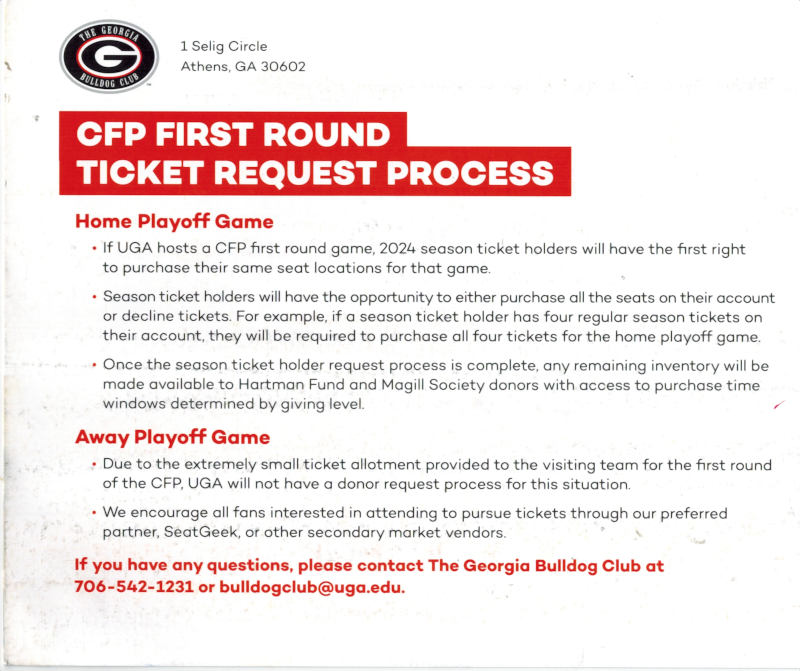
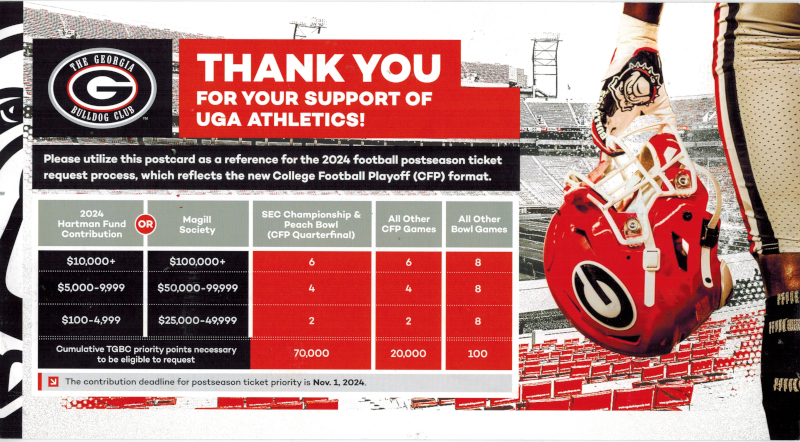
 Dawg Media
 RSS 2.0