Thursday June 19, 2008
It’s looking a bit like 1990 – Georgia and Stanford will meet with a trip to the College World Series championship round at stake. The Cardinal looked really, really tough dispatching #1 and top-seeded Miami 8-3 last night. Dominant Stanford pitching got out of early trouble and kept the potent Miami offense at bay until the Stanford offense with eight runs from the third through sixth innings.
Monday night showed us how hard the Dawgs will have to work to advance, but they do have the advantage of needing just one win while the Cardinal would have to beat the Bulldogs twice. It took that extra rubber match for the Dawgs to advance in 1990, but hopefully they can take care of things on Friday and rest up for Monday’s championship opener. The challenge will be on Georgia’s bats to create some runs against Stanford’s formidable pitching and defense.
Trevor Holder, who started Saturday’s first game against Miami, will get the nod again on Friday.
Georgia vs. Stanford: Friday, 2 p.m. ET, ESPN2
Wednesday June 18, 2008
An updated summer depth chart is out, and there are definitely some things worth noting.
Just be careful of reading too much into those “official” heights and weights…
“I don’t think it’s a big deal,” (Beasley) said of being measured at 6 feet 7 inches, three inches shorter than his listed height at Kansas State. “Other than it’s a little disappointing to me that I found out I’m actually a midget.”
Wednesday June 18, 2008
Georgia football signee Xavier Avery is off to play professional baseball. We wish him a long and successful career, and it’s great to see that his contract provides for his education.
Wednesday June 18, 2008
That’s the case so far in Omaha. #1 seed Miami and #2 seed North Carolina will have to work back through the loser’s brackets while the Georgia Bulldogs and Fresno State Bulldogs enjoy a 2-0 advantage in their respective groups.
Tuesday’s action in the College World Series had no impact on Georgia’s half of the bracket, but LSU continued this year’s theme of ninth-inning drama with a comeback win over Rice. Fresno then continued their improbable postseason run by handing UNC their first loss of the entire NCAA Tournament.
Things get going in Georgia’s bracket this evening as Miami and Stanford meet with elimination on the line. The winner gets another shot at Georgia on Friday afternoon. We know from experience that both Miami and Stanford are quality opponents, but I think most Georgia fans would rather face Stanford again rather than the #1 team and their offense. Whatever happens tonight, I hope it lasts about 23 innings with each team running out of pitchers.
While you’re waiting for Friday, head over to the Georgia Sports Blog for an interview with 1990 hero Mike Rebhan (part one | part two). I mentioned Rebhan the other day while looking back at Stanford’s role in Georgia’s 1990 national title, and pwd got some great insight out of the Cardinal conqueror.
Tuesday June 17, 2008
The
Senator asks an interesting question this afternoon.
I keep wondering the degree to which Stafford’s completion percentage/efficiency
rating is important, not so much in regard to his personal legacy, but rather
in the context of Georgia’s offensive scheme.
Good question. Just what’s so important about completing 60% versus 55%? I’ll
put in my two cents here.
Let’s get the drops out of the way. Every team has them, so Stafford isn’t
going to get some Drop Correction Factor (even in the South Carolina game).
I’m not going to analyze every pass from 2007, but it was my belief that drops
were more or less down in 2007 and on par with most teams.
If you grant that Georgia has a run-oriented scheme, you’d expect that the
quarterback’s most important role would be to sustain drives when the running
game can’t. Even allowing for the occasional first and second down throws to
keep the defense honest, third down is what most of us would consider the passing
down. So the third down conversion rate seems like a pretty important performance
indicator for the quarterback in an offense like Georgia’s.
As you might expect and hope, the Bulldogs were better on third down last season
than they were during Stafford’s freshman campaign. Georgia was 8th in the SEC
in 2006 with a 39% conversion rate on third down. In 2007, the Bulldogs had
improved to 4th in the conference with a 44.8% conversion rate. In absolute
terms, the difference is also impressive: Georgia converted 20 more third downs
in 2007 than in 2006. It’s kind of a self-perpetuating system. Because Georgia
was able to convert third downs at a higher clip, they kept drives going and
had 15% more third down opportunities in 2007.
OK, you say, we did better on third downs, but how much of that was because
of some good tailbacks, and how much can we credit to an improved Stafford?
It’s hard to tell, but we do know that the run-oriented Bulldogs got more first
downs through the air than on the ground last year. But here’s the important
takeaway:
63% of Georgia’s completions came on third down.
That stands out, but it’s not a huge shock because, again, third down
is generally a passing down even for run-based teams. The point is that incremental
increases in pass efficiency will pay the biggest dividends on those all-important
third downs. Here’s how.
Using Stafford’s attempts from 2007, an improvement to a 60% completion rate
represents just 15 more completions over the season. That’s little more than
one more catch per game. It doesn’t seem like a lot – one pass not dropped here,
one better throw there. But using last season’s results as a rough guide, that’s
potentially ten more third down conversions through the air. Ten more third
down conversions in 2007 would have put Georgia over 50% on third downs – second-best
in the SEC behind only you-know-who.
So, for what it’s worth, that’s my guess as to why efficiency is such a priority
(other than "more completions = good"). Even with a star tailback
and quality quarterback, the Georgia offense is still middle-of-the-pack in
the SEC. Stafford’s additional completions are likely to be ones that keep drives
alive, and an offense that is converting third downs close to 50% is likely
to be very productive.
(By the way, how important was third down to LSU last year? The Tigers converted
104 of 223 third downs – numbers which, even considering their 14-game schedule,
dwarf the rest of the SEC. Their conversion rate of 46.6% was good enough for
top 3 in the league. That’s an awful lot of chances though, and it’s to their
credit that they were able to keep grinding out drives and converting. Les Miles
probably still went for it half the times he didn’t convert on third down.)
Tuesday June 17, 2008
I’ll be honest – recruiting hasn’t gone well for Andy Landers over the past few years. The rising junior class that had three freshmen all-SEC performers was solid, but last year’s class didn’t have much of an impact. It doesn’t help that the top recruit from that class, Brittany Carter, struggled on the court and in the classroom and will transfer. The current incoming class isn’t particularly heralded, though transfer Porsha Phillips is expected to be a key contributor. With some high-profile prospects headed out of state, you get articles like this pointing out the difficulty of the situation when you’re not UConn or Tennessee.
But a coach as successful and driven as Landers doesn’t take setbacks without responding, and a very positive sign came today with the commitment of Wesleyan rising senior Anne Marie Armstrong. Armstrong, considered the top prospect in Georgia for the 2009 class, won the state’s Miss Basketball honor as a junior while leading her team to the Class AA state title.
Armstrong, at 6’3″ is a versatile wing with good size. If you had to compare those attributes to a recent Lady Dog, think Megan Darrah. Hopefully this commitment is just the start towards what could be a very strong 2009 class.
Monday June 16, 2008
I don’t know that I’ve ever been this drained just from watching a game.
If Georgia’s grueling 4-3 win over Stanford Monday night at the College World Series was this intense for fans, I can’t imagine how the players held it together.
Georgia football fans – remember how you felt leaving Vanderbilt’s stadium last year or leaving South Carolina in 2002? The thrill of victory alternated with bouts of nausea, and the net effect was relief and exhaustion – and we didn’t even play the games.
After tonight’s game, it’s easy to understand how unseeded Stanford upset Cal-Fullerton and FSU to get to this point. They are tireless fighters, make few mistakes, and force you to work for every scrap you can get against them. Nothing came easy for Georgia tonight, not even the final outs, but somehow here they are 2-0 and in the driver’s seat of their half of the CWS field.
Stanford jumped out 3-0 on three extra-base hits in the third inning including a two-run homer by standout catcher Jason Castro. Though starter Nick Montgomery pitched well otherwise, he yielded to Stephen Dodson in the 4th inning.
If there’s a story developing thus far for Georgia, it’s been the bullpen as a whole. They’ve allowed only one run in two games, and Alex McRee atoned for Saturday’s homerun pitch with a perfect performance against the Cardinal. In fact, the Georgia bullpen allowed only one hit after Montgomery left. Dodson, McRee, and Fields held Stanford in check and gave the offense room to mount the gradual comeback.
Getting back in the game was like pulling teeth. The Dawgs missed a chance to get on the scoreboard in the 3rd when Lyle Allen doubled but was inexplicably held at third base on a David Thoms single to right. Neither Peisel nor Olson could bring in Allen, and the Dawgs missed a golden scoring opportunity.
The first run came in the 4th – Matt Cerione doubled in Gordon Beckham, but Cerione was stranded. Georgia again inched closer in the 6th when Robbie O’Bryan drew a bases-loaded walk that scored Rich Poythress. Still, Georgia could do no further damage with the bases loaded and just one out.
The Dawgs finally got on top in the 7th when Gordon Beckham started a two-out rally with a single. Poythress walked, and Massanari was hit by a pitch to load the bases. Matt Cerione laced a single to center field plating Beckham and Poythress for Cerione’s second and third RBI of the day. O’Bryan popped out to end the rally, but Georgia now held the lead.
McRee pitched an incredibly efficient 8th against the heart of the Cardinal lineup, and you had to like Georgia’s chances with Fields pitching to the bottom half of the Stanford order in the 9th. Nothing was easy in this game, though, and Fields certainly made things interesting by walking and then hitting a batter to put the go-ahead run on base with one out. He worked deep into the count against pinch-hitter Colin Walsh before enticing Walsh to hit a ground ball that was fielded by Beckham and turned into a textbook 6-4-3 double play to end the excruciating game.
Georgia has earned the mixed blessing of three days’ rest before playing again on Friday. Everyone should be fresh and rested, but that’s a long time to stew during a championship run. The good news is that Georgia needs just one more win to advance to next week’s championship round. Stanford must play Miami in an elimination game, and the Bulldogs will have two cracks at the winner of that game.
Georgia will play the winner of Wednesday’s Stanford/Miami game at 2:00 p.m. on Friday (ESPN2). If Georgia wins, they advance straight to the championship round which begins Monday. If Georgia falls, they’ll face a rematch with Friday’s opponent on Saturday to determine who advances.
For a complete schedule and stats and recaps from the CWS, visit this page over at ESPN.com.
And with that…I’m going to go collapse into bed.
Monday June 16, 2008
When Georgia
meets Stanford this evening in the College World Series (7:00, ESPN2), it
will be a rematch of sorts of one of the biggest battles along the way during
Georgia’s 1990 national title run. Georgia will technically be favored against
the unseeded Cardinal tonight, but it was Georgia’s underdog performance against
top-seeded Stanford that put them into the national title game.
While Stan Payne’s 2-1 victory over Oklahoma State clinched the 1990 national
title for Georgia, the Bulldogs’ shot at the championship was set up by three
battles over six days with top-seeded Stanford. Georgia crushed Stanford in
the first meeting sending the Cardinal to the loser’s bracket. The favorites
worked back through the bracket and topped Georgia to force a winner-take-all
rematch.
Stanford turned to ace and future MLB star Mike Mussina who had been roughed
up by Georgia in the first meeting. The Bulldogs countered again with senior
Mike Rebhan. Though fatigued, Rebhan pitched a complete game as the Bulldogs
eliminated the Cardinal 5-1.
There’s a great account
of this 1990 meeting over on UGASports.com. The transformation of Mussina
from a dominant pitcher to someone throwing batting practice turned the first
meeting. Stanford struck back with a freshman beating Bulldog All-American Dave
Fleming. Rebhan turned the tables in the final showdown, and teammate Bruce
Chick reflected on how important that performance was. "He had two children
and he knew he wasn’t moving on," says
Chick. "Mike pitched the game of his life and it wound up being the
last game he ever pitched."
Tonight another relatively unknown Bulldog pitcher will step on the Rosenblatt
Stadium field with a chance to make his own splash against Stanford. Nick Montgomery
wasn’t one of Georgia’s three weekend starters during the regular season, but
since his outing against Georgia Tech at Turner Field Montgomery has been one
of the most consistent and outstanding Bulldog starters. He already has wins
over Georgia Tech and N.C. State in this NCAA Tournament, and the Bulldogs are
counting on him to move them one win away from their first trip to the championship
round since 1990.
Wednesday June 11, 2008
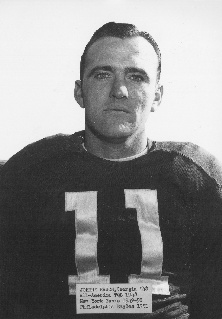
Before Fran Tarkenton, Buck Belue, Eric Zeier, David Greene, Matthew Stafford, and all Georgia quarterbacks in between, there was Johnny Rauch. Rauch set the standard for quarterbacking for college football in the late 1940s, and he went on to a successful career as a pro quarterback and as a coach. He passed away on Tuesday at the age of 80. From the obituary at georgiadogs.com:
Former University of Georgia All-America quarterback John Rauch, who started every game for the Bulldogs from 1945-48, passed away in his sleep on Tuesday at his Oldsmar, Fla., home. He was 80.
Rauch came to Georgia in 1945 after excelling in three sports in high school in Pennsylvania. He didn’t arrive with much fanfare, however, and was discovered by then-Coach Wallace Butts while playing in a flag football game.
After accepting an invitation from Butts to come out for football, Rauch started every game (45 in all) of his college career from 1945-48 and became the first player in NCAA history to start four consecutive bowl games. He passed for 4,044 yards, then the NCAA record for career passing yardage.
Rauch led the Bulldogs to a 36-8-1 record, including the Williamson poll’s national championship in 1946 and two SEC titles. He was an All-American and the SEC Player of the Year his senior season.
Rauch was the No. 1 player taken in the 1949 NFL draft by the Detroit Lions and he went on to a four-year playing career. Rauch then entered the coaching ranks, serving several schools, including Georgia from 1955-58, as an assistant coach.
Rauch returned to the NFL as an assistant for the Oakland Raiders under Al Davis in 1963 and was promoted to head coach in 1966. He guided the Raiders for three seasons, compiling 33 victories and leading them to Super Bowl II. Rauch, whose assistant coaches included John Madden and Bill Walsh, was named AFC Coach of the Year in 1967 after the Super Bowl appearance. Rauch also was the head coach of the Buffalo Bills in 1969, O.J. Simpson’s rookie year.
Rauch completed his coaching career in 1985 after stints with Philadelphia, Atlanta and Tampa Bay of the NFL, Toronto of the CFL and Tampa Bay of the USFL.
Rauch was inducted into the College Football Hall of Fame in 2004. He also was chosen for the Georgia-Florida Hall of Fame in 2000 and Georgia¹s Circle of Honor in 2001.
His grandson also posted a nice note on the DawgVent. Our thoughts go out tonight to the family of one of Georgia’s best.
Wednesday June 11, 2008
Everyone’s favorite weatherman/commentator Bill “Hurricane” Curry will leave the broadcast booth to try the Howard Schnellenberger route and build a new program from the ground up in the twilight of his career. Curry will head the new Georgia State program in Atlanta which will begin playing 1-AA football in 2010.
The Panthers had good luck with their last high-profile athletic hire. Under legendary basketball coach Lefty Driesell, Georgia State advanced to the second round of the NCAA Tournament and finished 29-5 in 2001.
I’m also glad to see Curry out of the broadcast booth, but what will really be interesting is the Tech reaction. Things are all chummy now – Tech alum and former coach coming back to town – but make no mistake: Tech is the competition. Competition for fans, media attention, even some recruits – everything. If Tech has issues selling season tickets now, things will only be tougher with another program in town. I don’t see Tech losing its hold as the city’s top football program, but can they continue to claim the best college coach in town?
Wednesday June 11, 2008
If you’re like me, you missed out on the early feeding frenzy on airline tickets for the Arizona State game. Maybe you weren’t sure if you were going. Maybe your group was dragging its heels making arrangements. Maybe you were betting on the price of oil to crash and send fares plunging. Good luck with that.
Anyway, here you are in mid-June, and fares for non-stop flights are pushing $450 and not budging. You’ve listened to Paul Westerdawg and Kanu and have your social agenda in order and possibly even have tickets taken care of. But you’re still procrastinating about a flight.
AirTran has come through with a flight option that checks in at just over $300. I have to credit my lovely wife with finding this one. She affects the outcome of the Florida game, and she finds good deals to road games. What a catch. Here are the details:
- Outbound: AirTran flight 1940.
Leaves 8:40 p.m. on Thurs. Sept. 18, arrives 9:45 Phoenix time
- Returning: AirTran flight 1941.
Leaves 10:40 p.m. on Sun. Sept. 21, arrives 5:17 a.m. Monday morning
Yes, those are some late flights, but they come with some advantages:
- If you’re up for it, a night out in Tempe isn’t out of the question on Thursday. If you’re staying near Tempe, you’ll probably be off the plane and checked in by 11:00.
- You have all day Friday, Saturday, and Sunday in town. Having Sunday to recover from gameday won’t suck.
- If your work vacation time is tight, these flights give you the option of working Thursday and Monday if you’re reasonably close to Atlanta. I know turning around and going into the office on Monday after a red-eye and a football weekend isn’t the most appealing option in the world, but it’s there if you need it.
Again, those flights check in at just over $300 for the round trip after taxes and fees. I don’t know how long these prices will hold, so jump on it. I doubt you’ll find anything cheaper as we get closer since most of the seats on other flights are already booked. You might be able to do better if you are willing to forgo the non-stop flight, but be cautious of booking with Frontier as the future of the airline is uncertain. If you want to continue to hold out, I second Kanu’s recommendation of kayak.com.
If you’re still looking for a hotel, you might try the Hyatt Place Tempe / Phoenix Airport. It’s no more than two miles from both the airport and Sun Devil Stadium. They also have 42″ flat panels in the rooms which any sports fan should appreciate.
Wednesday June 11, 2008
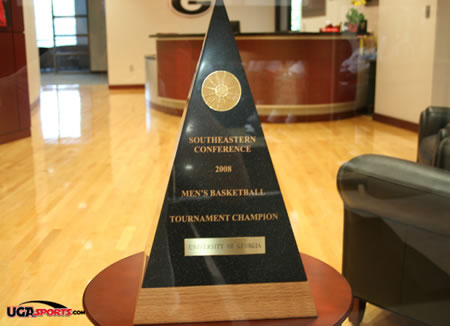
The Coliseum Practice Facility has been open for about a year now. For fans who haven’t toured or taken a look yet inside the facility, UGASports.com has a photo feature up taking you inside the men’s basketball area. I’ve written about how the facility measures up nationally, but don’t take my word for it…
One parent of a high profile prospect said, “My son and I were at the Dean Dome(UNC) last week, and this place beats that hands down!”
Tuesday June 10, 2008
Mitchell Boggs was a key relief pitcher on the 2004 Georgia squad that reached the College World Series. Now with another group of Bulldogs on their way to Omaha, Boggs is set to record another personal milestone. He will make his first major league start on Tuesday night for the St. Louis Cardinals against the Cincinnati Reds. Boggs made his MLB debut on Friday out of the bullpen and gave up one run in two innings of work.
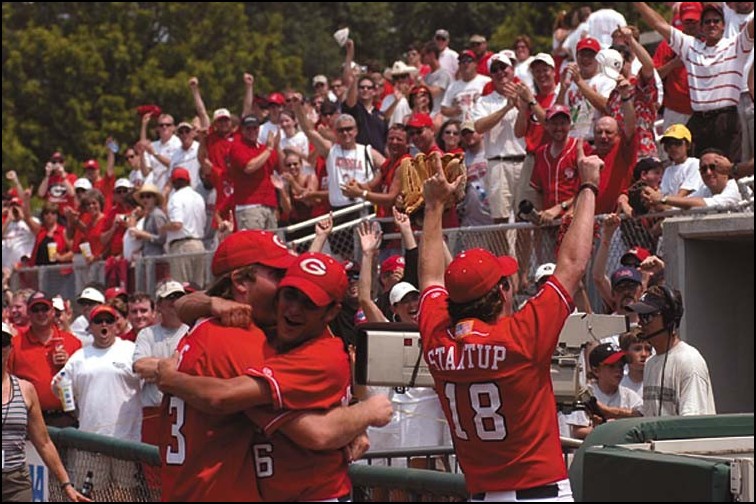
Mitchell Boggs and Josh McLaughlin celebrate after beating Georgia Tech in the 2004 super regional. Photo: Red & Black
Tuesday June 10, 2008
Some nations require years of residency and an exam for citizenship. In Russia,
all it requires is a professional basketball contract.
Olympic dreams are commonplace for elite athletes. In many sports the Olympic
gold medal is the summit, and you’d be hard-pressed to find an athlete who hasn’t
been inspired along the way by watching one of his countrymen excel at the Olympics.
But spots on the Olympic team aren’t as commonplace, so the dream of playing
for one’s country never becomes a reality for most. Because of lineage or birthplace,
dual citizenship is an option for some. For others, Mother Russia is willing
to help.
Three WNBA players – including two former Georgia Lady Dogs – have
made the 24-member preliminary squad for the Russian national women’s basketball
team. How can native-born American citizens play for the Russians? ESPN
explains in the case of WNBA star Becky Hammon,
Under Russian league rules, (Hammon) was able to obtain a passport and become
a naturalized citizen because she had never appeared for another country in
a FIBA-sanctioned event. In other words, she was still eligible to compete
for Russia internationally.
Hammon’s papers were approved quickly by the highest levels of the Russian
government, just as they were for former Bucknell guard J.R. Holden, who hit
the game-winning shot last summer to help Russia win the 2007 Eurobasket Championships.
Holden, too, will compete for Russia in Beijing.
Kelly Miller and Deanna Nolan are the former Georgia players on the squad.
Both played for Russian club teams in the WNBA offseason and acquired Russian
citizenship as a result. Neither was selected for the American national team
(a questionable decision in Nolan’s case), so playing for Russia might be their
only shot at playing in the Olympics. 20 years ago, this news would have been
scandalous – if not impossible. How about now? Does it bug you that American
athletes would take Russian citizenship in order to participate in the Olympics,
or do you respect the decision to chase their Olympic dreams any way they can?
Monday June 9, 2008
It’s been a busy offseason when it comes to the leadership of the BCS conferences
and schools.
The Big 12 named
Dan Beebe its commissioner less than a year ago. Though Tranghese and Hansen
will continue on for another academic year, we’ll still see a turnover of more
than half of the BCS leadership between 2007 and 2009.
Will this sudden turnover have much effect on things like the BCS and college
football postseason? I doubt it. It’s important to remember that conference
commissioners serve at the pleasure of the presidents of the conference’s schools.
Though there is plenty of room for each commissioner to make his mark on his
conference, major policy decisions are likely to be guided by those presidents.
In other words, if the Pac-10 presidents as a group oppose a playoff (and it
seems as if they do), Hansen’s replacement is likely to share that view.
Still, it will be interesting to see what new blood brings to the table and
if any of the newcomers become polarizing figures in their own right.
Mike Slive (2002), John Swofford (1997), and Jim Delany (1989) are now the
elder statesmen of the BCS conferences. In case you’re wondering who might be
next to retire, Delany and Swofford both turn 60 this year, and Slive is approaching
68.
|

 Stanford it is
 Comments
 Dawg Media
 RSS 2.0