Another key piece of the future of Georgia’s passing game was added today when Calhoun (Ga.) receiver Da’Rick Rogers gave his verbal commitment to Georgia. Rogers, at 6’3″ and 206 lb., is currently rated as the #4 receiver and #22 overall prospect by Rivals.com. He’s currently the top-rated prospect according to Rivals.com at any position from the state of Georgia.
The commitment is significant on several levels. Of course landing top Georgia prospects is a big priority for the coaching staff. The receiver position still isn’t incredibly deep, but the talent level is starting to pick up to a level that can match the quarterbacking talent that will be in place. Rogers was also an important target because of Georgia’s lukewarm interest in Markeith Ambles, another highly-rated Georgia receiver prospect. Other schools are reportedly backing off of Ambles which sheds a little light on Georgia’s lack of interest, but that strategy put all the more pressure on getting Rogers.
More information:
Rogers’ other offers included Alabama, LSU, Florida, FSU, Ole Miss, and West Virginia.
As a high school junior, Rogers caught 66 passes for 1,300 yards and 11 TD.
Calhoun HS is also the home of redshirting Georgia receiver Kris Durham.
In 2008 Calhoun reached the class AA state championship game before falling to Buford. They’ve won their region every year since 2001.
OK, I can buy that Mark Richt and Damon Evans have different takes on the appropriate strength of schedule for Georgia football. There’s certainly nothing approaching a consensus among the fans, so it’s understandable that Richt and Evans might not see exactly eye-to-eye. Fine.
But to take this ABH article about the nonconference schedule at face value, I find myself having to ask these two questions: does Mark Richt really have limited input as to his own team’s schedule, and does the dismissive “I’ll listen to his opinion” comment really sum up Damon Evans’ view of the coach’s role in setting the schedule?
Sure, football is a different animal than the other sports. A single nonconference game can carry a commitment of almost one million dollars of athletic department money, so of course some oversight and due diligence is necessary. Most nonconference games, especially against quality opponents, are now set years in advance, so annual tweaking isn’t really possible. Football is also your biggest product with fewer discretionary games and opportunities to showcase the program than any other sport. I realize why Evans would want to be involved in the process.
Still, regardless of our personal preferences as fans, the coach needs to be the one who drives the scheduling philosophy. It’s not something to be handed down from on high by the athletic director. Saying “I’m sure (Richt) has some valid points” is way too late in the game to have a meeting of the minds about the schedule. At the same time, knowing how involved the coaches are in determining the schedules for Georgia’s other sports, I’m skeptical that Richt has had as little to do with setting the schedule as it seems.
Since it’s
all about Phil Steele this week (Rivals subscribers can check out a
more focused look at Georgia by Steele that can be summed up as "Georgia
is undervalued"), here’s a look at how well he’s done pegging the Dawgs
during the Richt years versus the consensus (numbers courtesy of Chris
Stassen’s invaluable site). Of course Steele (and most everyone else) makes
his predictions before many of the developments (injuries or otherwise) leading
up to the season take place, so attribute the results to serendipity or skill
as you like. I love his preseason annual, and his
track record speaks for itself.
If there’s anything resembling a trend, it’s that it took a few years for Steele
to jump on the Richtwagon. No problem there…a lot of our own fans had the
same issue. Of the three times he’s varied significantly from the consensus
on Georgia, 2008 was the only time he came out ahead.
Just for thought…what does it mean when Steele has mostly praise for Georgia and Richt, thinks Georgia will be better than most expect, yet predicts a finish at
#13 that would be below the median for Richt’s teams? Have the (national) expectations
fallen that far? We’ll find out as the consensus builds, but Athlon
ranking Georgia at #14 isn’t exactly a sign that Steele’s going to be the
outlying contrarian this year when it comes to the Bulldogs.
The University of Georgia officially opened the Tate Center Expansion this week, and the building promises lots of additional meeting and event space, services, and amenities for students (at a $60 million price tag). A more formal ribbon-cutting will take place later in the summer.
That’s great for the students, but as selfish alums and football fans, what’s in it for us? Several things:
Lots of additional indoor space near the stadium in which to hang out on game day. Large open areas seem ready-made for a large crowd waiting for a football game. “The Tate addition is so football-friendly, one student exploring the expansion wondered out loud if the building were designed with football Saturdays in mind.”
While you’re inside staying cool or just killing time before the game, check out the 24-foot projection TV screen in the third-floor lobby. If you can’t make it into the game, they’ll be showing it on this screen. Yes, 24 feet of Gameday goodness.
Several hundred parking spaces were lost when this construction took away the better part of the Stegeman Hall parking lot, but this facility includes a 508-spot parking deck that will surely be used for premium (and perhaps handicapped) parking on game days.
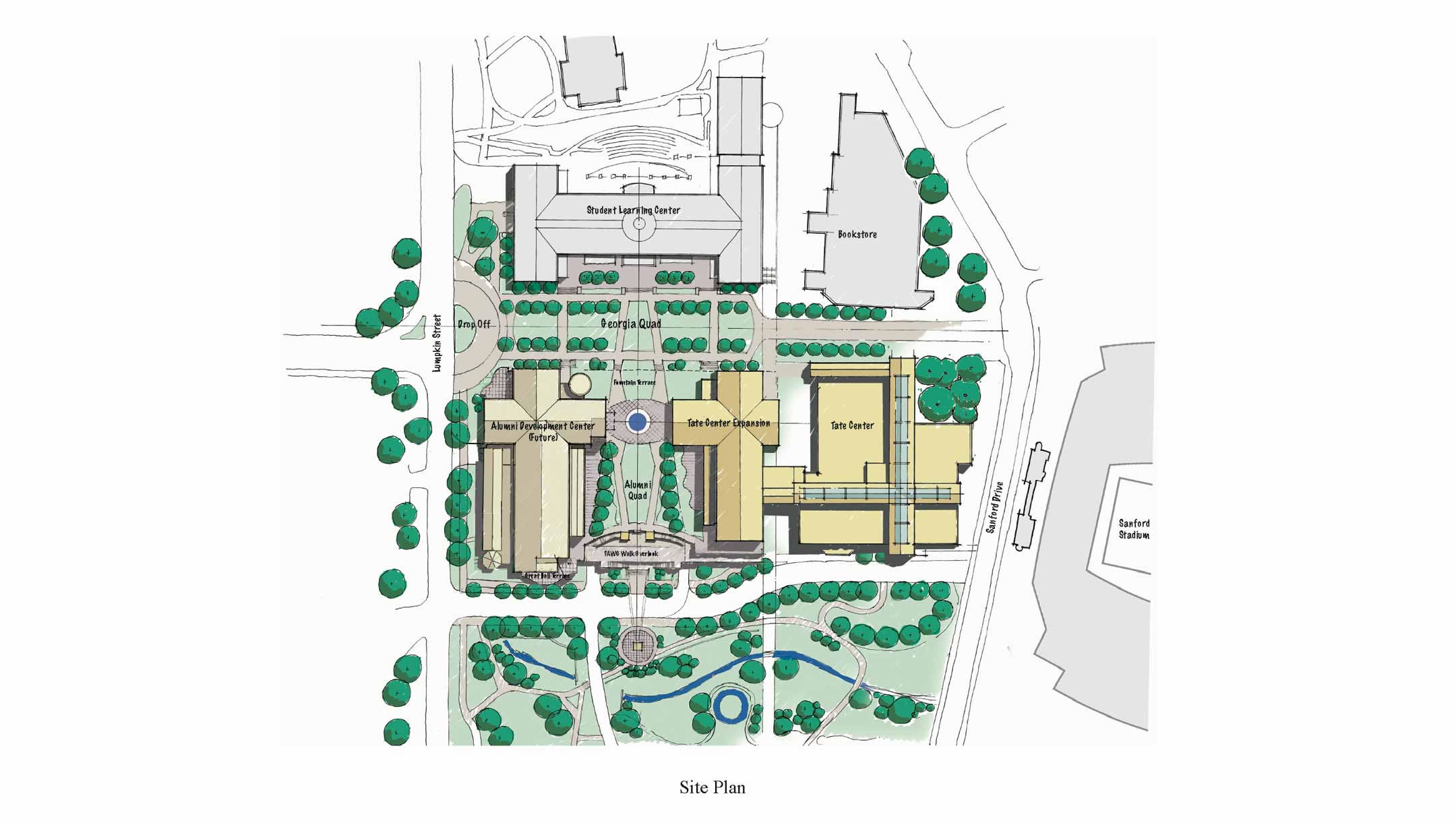
One other effect of the Tate expansion will be to refocus the Dawg Walk. We’ve looked before at how this building will play a role in the continued revitalization of the central campus. Though the project is nowhere near complete, a future Alumni Development Center between the Tate Center and Lumpkin Street as well as an “Alumni Quad” between the two buildings will form the heart of a central campus park complete with a Dawg Walk Overlook. The sketch below shows where this is (tentatively) headed.
The national broadcasts will still be on CBS, ESPN, ESPNU, and ESPN2. Think of it this way – instead of WATL 36 or wherever else you used to look for the regional JP games, they’ll be on Peachtree TV now (only at noon instead of 12:30 – oy). The enhanced basketball coverage is especially welcome. It’ll be a double-header every Saturday during the conference schedule as well as one game each Wednesday (in addition to national games on ESPN as before).
Peachtree TV is available in standard and high definition format on major cable and satellite providers in Atlanta. Keep in mind this is for the Atlanta area only – Peachtree TV is a local channel and not a superstation or national network. Fans in other markets will find the games on different stations or as before on Gameplan. We’ll be happy to post those stations here as deals are announced – just send word.
The Chicago White Sox have called up Gordon Beckham just a week after he was promoted to AAA ball. This time last year, he was preparing to lead Georgia into the College World Series. Now he’s in the majors and will join the circus that is the Ozzie Guillen clubhouse.
“I talked to Gordon and he’s excited. It’s obviously quick but if anyone I’ve ever coached can handle it it’s Gordon. He’s had something special about him from day one. From a maturity and a talent standpoint he is definitely ready, and I am looking forward to watching him.”
According to UGA, Beckham will be the fourth Bulldog to take the field for a major league team this year, joining Jeff Keppinger (Astros), Clint Sammons (Braves) and Mitchell Boggs (Cardinals).
More Bulldogs will start down the path to the big leagues next Tuesday June 9th when the 2009 MLB draft gets underway.
(As an aside, Braves fans will recognize the player Beckham is replacing on the Sox roster: Wilson Betemit.)
Here’s where the Bulldogs ranked among the SEC in kickoff coverage over the past few seasons:
02: 4th
03: 6th – first year after Kirouac
04: 3rd (though the stats here seem incomplete)
05: 4th
06: 9th
07: 9th
08: 11th
If you listen to a lot of fans, the directional kick has been the scourge of Georgia football since Richt and Fabris took over in 2001. For the first several years, it was actually pretty effective at least in the coverage unit’s place among the SEC.
Obviously something’s been different since 2006, and as Robinson notes, the rule change from a 2-inch tee to a 1-inch tee went into effect that year. Does that explain the drop to the bottom half of the conference rankings? Possibly. It’s also possible that the kickers (Bailey, Coutu, Walsh) over that time haven’t been the best at kickoffs.
The staff is hedging towards the belief that maybe it *is* the kicker. They’ve used a valuable scholarship to add a third scholarship kicker solely for what he can bring to the table on kickoffs. Will he reverse the trend that’s headed downward since the shorter tee was introduced?
But is it all about the kicker or even the hated directional kicks? We talked about this during last season. Plenty of attention has been paid, thanks to Robinson’s post, to the actual kicking, but not much has been said about the makeup of the 10 guys heading downfield to get to the returner. If you want your difference between Georgia and the better coverage units, look at the field position where we first engaged the blockers.
If the kick coverage improves this year, I expect a good bit of the improvement will come from a larger and (hopefully) healthier pool of younger defensive players. It’s a point Richt made certain to emphasize during the Road Tour. If you look down the roster at the back seven positions on defense, the number of players unavailable last year due to injury or redshirting could almost make up a coverage team of their own. Robinson, Rambo, Dewberry, Pugh, Commings, and Banks are just a few who could give the unit a shot in the arm this year. Even true freshmen like Branden Smith could help, and I expect you’ll see them out there.
The story of Robert Dozier is pretty well known among hardcore Georgia basketball fans. He signed with Georgia, was denied admission, and ended up at Memphis. It wasn’t exactly a secret that irregularities with Dozier’s SAT score were the source of his trouble getting into Georgia.
Both the softball and baseball teams wrapped up their seasons on Sunday, but the tone with which the seasons ended couldn’t have been more different.
The softball team fell 9-3 on Sunday night to Washington, assuring the Huskies of a spot in the championship series against Florida and ending an exhausting run of four games over two days for Georgia. Along the way the Dawgs eliminated Missouri, upset Big 10 champ Michigan, and pushed a strong Washington team to the brink of elimination by lighting up one of the best pitchers in the game.
Though the two departing seniors were important pieces of the team, the story you couldn’t avoid over the weekend was that everyone else will be back for at least two more years. Finding a new pitching ace will be critical to the team’s future, but the powerful offense will be more or less intact.
All that is no guarantee that the team will be able to go as far or even deeper in the coming years, but you’ve got to like their chances. There’s no question though the Georgia softball is firmly on the national map now, and the underclassmen have a taste of what it will take to win it all.
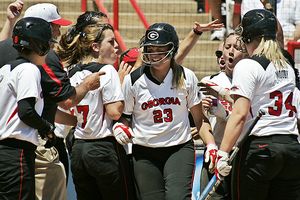
At the very least, Georgia softball won themselves a lot of new fans from the Super Regional comebacks through the WCWS run. I’m one of them. They were entertaining to watch, played loose even under the incredible pressure of the moment, and love playing for Georgia – how can you not like a player who knows the significance of wearing #34 at Georgia? Names like Schnake, Schlopy, Hesson, and Goler were on the radar of even the football-only crowd this weekend, and they’ll have a lot more people tuning in to see how they follow it up next year.
The outlook was far less sunny for the baseball team after it fell to Ohio State 13-6 in the elimination game. First was the embarassment of losing to a team that set records for futility its two regional losses. But more troubling was the way in which Georgia lost the game. Three errors. Baserunning blunders. Less-than-acceptable effort from an upperclassman starter. I guess you can credit Ohio State for not collapsing after falling behind 5-0 to a team that routed them on Friday, but the loss is as much on Georgia as it is for the Buckeyes rising to the occasion.
During the team’s 2007 CWS run, the team certainly leaned on veterans Beckham, Peisel, and Fields. When players like Massanari, Lewis, Cerione, Poythress, and Weaver turned it up in the postseason, the result was a solid team built for a deep run. But absent those 2007 stars, the returning veterans couldn’t carry the team down the stretch and into the postseason.
Will next year continue the even-year success that Georgia has enjoyed this decade? Certainly there’s a strong core of rising sophomores returning, and there’s another strong recruiting class coming in (subject to the draft of course). But who will be considered the leaders of the team? Poythress is surely going to be drafted. Cerione will be a senior, but can a guy who “just can’t handle his emotions” (according to Perno) be looked to as a leader? After he was pulled from the game and Perno’s postgame comments which accused Cerione of “jump(ing) into the fence just to jump into the fence”, part of me wondered if Cerione had played his last game at Georgia. Joey Lewis looks to be the sole everyday player who you’d feel comfortable about as a senior leader, and he might be drafted too.
David Ching has some thoughts and additional information about next year’s roster. Pitching (and especially the bullpen) is a whole other can of worms. McRee’s disappointing season might make him a less-attractive draft pick this year, but can he find the control to go with his pro-quality stuff and emerge as the ace? Can Weaver shake off a woeful end to the season and reestablish himself as the go-to guy in the bullpen?
I predict it won’t take but a year or two until some enterprising coach gets accused of playing fast and loose with the new rules. After all, the NCAA already limits teams to 25 signees per year. The new SEC rule is a response to the back room accounting that developed as a way to get around the NCAA’s limit. Oh, him? He counts towards last year’s 25.
One thing I haven’t read yet is how this new rule will deal with grayshirting. That’s when a freshman agrees to delay enrollment for a semester with the understanding that he’ll be on scholarship thereafter. Will these marginally-qualified prospects who brought up the rear in the oversigned classes still commit and just be encouraged to wait a semester instead of signing a Letter of Intent?
Knox played in 12 games as a redshirt freshman and only recorded 8 tackles, but he was going to be counted on to make a bigger contribution this year as a hard hitter pushing Georgia’s starting safeties. He started against Tech last year as a response to the option, and he had four tackles and even added a reception at G-Day this year.
A transfer to GMC sometimes leads to a return to Athens, but not many of those were academic transfers. Knox was a borderline qualifier to begin with out of HS, and the demands of academic life at Georgia might have proved too much to handle.
You visit me six or seven times a year, and I’ve caught you driving past me on the bridge more than once just to peek inside. I’m old, but I’ve aged well and kept up with the times. Your parents or grandparents might have even introduced us.
I don’t mean to brag, but, well, I’m kind of a big deal among college football stadiums. There aren’t many bigger. My symmetrical architecture is as classic as the city I call home. (Oh, I know the new upper deck throws off the symmetry, but who doesn’t get a little out of shape as we get older?) Playing “Between the Hedges” means only one thing to college football fans. ESPN’s Doug Ward wrote,
Sanford could not have found a more idyllic setting for a college stadium; it sits squarely in the middle of Georgia’s campus, as if it were the university’s beating heart.
I’m blushing. But I’m empty for the next 106 days or so without much to do but read the news, and I have to admit I’m feeling a little jealous and unappreciated this morning.
I know the Georgia Dome is attractive, especially after its recent makeover to replace the color scheme with good ol’ red and black. There are plenty of days this time of year I wouldn’t mind some air conditioning myself. A lot of teams seem to want to play there these days, and I really hope the Dawgs get a game there in early December. I could use some more SEC championship bling.
If there’s one gripe I have, it’s that I don’t get to host a lot of interesting nonconference games. Sure, there’s been the occasional Clemson or even BYU, and I’m looking forward to seeing Arizona State this year. Yale was cool back in the day. But those are few and far between, and it’s usually the same old Directional Louisiana or cupcake teams to open the season. You and I know there’s nothing better than the UGA campus on a fall day with a big late-afternoon or night game in town.
So when I read talk about Georgia and North Carolina playing in the Dome, I have to wonder what it has that I don’t. A neutral game in Atlanta would split the tickets for a smaller stadium, so over 10,000 of my own season ticket holders would either have to scalp or stay home. Teams want to play in Atlanta to help their recruiting in Georgia, but you have an advantage they don’t. You can’t host recruits at the Dome. When Georgia plays a game here at Sanford you get to show off the whole package – stadium and all – to this state’s prospects.
Is it the home-and-home thing? I don’t mind – really! I can appreciate a good-looking stadium, and Kenan Stadium – in its own way – is supposed to be a great place to catch a game too.
Somehow the coaches’ poll survived for years without transparency, and I imagine that it’s not exactly going to be the Wild West doomsday scenario now that the transparency has been taken away. It’s not a move in the right direction of course, but it’s not the end of the world either. If bias is a concern, and it probably should be, maybe the two highest and lowest votes for each team could be discarded.
Anyway, the coaches’ poll isn’t the only imperfection among the BCS components. The Harris poll has its own problems, and the various computer polls operate under their own shroud of obscurity. The idea of a selection committee to seed the BCS has been floated before, and that might be the best solution to put polls back into the trivial role they play in other sports. A selection committee would have its own affiliations and biases of course, but they’d at least be sorting out the teams face-to-face.
I understand why Mike Slive wants the SEC football coaches to play nice. His product is the SEC, and real dollars are at stake these days. But as much as “we’re all in this together,” the livelihood of those 12 coaches depends on their ability to outperform the other 11. The pressure to find and exploit an advantage is tremendous, and self-preservation can be a powerful motivator. Slive’s threat of a fine might drive the sniping out of the public eye, but it will just continue to simmer underneath the surface in the underworld of recruiting where negative recruiting is a way of life.
I kind of liked having the tension bubble up into the public eye. Of course it was good fodder for fans, but on a more serious level a peer calling out another coach brought to light some of the tactics and outrageous behavior that goes on in recruiting and elsewhere behind the scenes. If transparency is good for the polls, it can also counter and shame coaches behaving badly. The “pumping gas” row was a great example – it forced a coach out from the shadows to address and defend his recruiting methods in a way the media never could. Those derogatory comments will still be made to recruits, but the ability to confront something like that in a direct way has been diminished.
If there’s one lesson from this Memphis cheating scandal (other than Calipari’s ability to stay one step ahead of trouble), it’s the absolute mockery made of the one-and-done rule. In order to become eligible and get that one year of college at a high-profile program, Rose allegedly not only had someone take his SAT but also had grades changed at his Chicago high school. It might be to the detriment of the college game, but these one-and-done guys have no business in college, and it’s ridiculous that the NCAA – with all of its PR about the “student-athlete” – would be a party to it. Let them go pro, head to Europe, or commit to a college for three years.
Every time I see an article about a “Rooney Rule” coming to college sports, I ask myself, “don’t these colleges already have hiring procedures in place?” Our institutions of higher learning pride themselves on their diverse faculty and student bodies. If anything, they’re sometimes criticized for going too far in the interests of promoting diversity. So to me this seems like an issue of capitulation on the part of college administrators. If diversity in the coaching ranks is a priority, administrators should hold their athletic departments responsible for following the same hiring process as the academic side where you hear much less complaining about a lack of minority representation. Or maybe it’s easier to wait for action to be taken at the conference or NCAA level so that the administration doesn’t run the risk of being seen as meddling in athletics.
Video highlights from the competition are below. Stafford and Massaquoi and about a dozen other rookies also make appearances. It’s worth it just to see Stephen McGee’s awkwardness.
But what else would you expect from the man who made celebrating an art form at Georgia…

 Rogers gives UGA a key receiver commitment
 Comments

 The softball team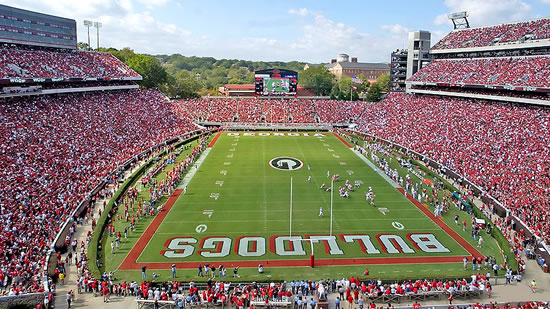
 Dawg Media
 RSS 2.0