You’ve read the previews and probably have a good idea what to watch for in terms of matchups and stars. An opener against a quality opponent like this can give you a pretty good read on your team in a hurry. That said, several of the things I’ll be watching for tie in to some of those offseason themes and should serve to let us know how different the team will be from the group that took the field against Georgia Southern over a year ago.
1) Leadership put to the test. If there’s been one overarching theme this offseason, it was leadership. From Cox to Owens to Curran, Georgia’s had no shortage of guys saying and doing the right things. If you like, you can hold up Georgia’s relatively clean offseason discipline record as evidence that all of the talk isn’t just so much bluster. Even Vince Dooley is impressed by the team’s apparent unity.
But of course the ultimate test of what’s changed will come on the field. How does unity and leadership hold up on the road under adversity? Does Joe Cox stay cool and in control after a sack or, God forbid, a turnover? Now that’s he’s facing the flu, will the team avoid being rattled?
This is still, going by the numbers, a team with a lot of young guys in key positions. The leading receiver, tailback, and the cornerback that will often line up opposite Dez Bryant are all true sophomores. The offensive line, with two juniors and three sophomores, look like grizzled veterans by comparison. Even Cox himself is getting his first start since 2006, and it’s a road start against a top 10 opponent.
2) Take away Bryant and Green. Who’s left? Dez Bryant and AJ Green will surely get plenty of attention from the other team’s defense. It’s doubtful that either will be completely shut down, but both teams are going to have to get production from elsewhere, and neither has the strongest of supporting casts. Oklahoma State doesn’t have many experienced returning receivers, and the loss of their starting tight end won’t help. Georgia has just six scholarship receivers, and that includes just one upperclassman. Georgia’s tight end position includes a starter with all of three receptions a year ago who will be backed up by two true freshmen.
3) Hidden yards and points. Georgia’s 2008 issues with penalties, kick coverage, and generating turnovers have received plenty of attention during the offseason. The Dawgs risked a scholarship on a kickoff specialist, and they’ve placed practice emphasis on reducing penalties and creating turnovers. Oklahoma State’s new defensive coordinator likewise is “preaching” a focus on turnovers.
In two games last night we saw sloppy fumbles, interceptions, botched kicks, and even a safety. Georgia’s 2007 win over Oklahoma State started with a short scoring drive following a muffed punt after the Cowboys’ opening drive. Points from these areas weren’t a Georgia point of pride last year; in fact, it amounted to about a touchdown per game advantage for Georgia’s opponents. The OSU offense is good enough without getting help from Georgia’s offense and special teams.
4) Return of the injured. A couple of Georgia’s perceived strengths this year depend on the recovery of key players. On the offensive line, both Sturdivant and Davis (and Vance) have had surgery. Ben Jones missed most of last week with an ankle injury. Then you have defensive lynchpin Jeff Owens whose 2008 injury shook up the defensive line. Defensive end Rod Battle was slowed by injury most of last season, and Reshad Jones was one of many who missed time this August with minor nuisance injuries. They’re all good to go, but any impact of lost practice time and conditioning will be apparent against a quality opponent. Still glad to get them all back, and the Dawgs have to feel fortunate to have had a preseason relatively uninterrupted by injuries. The absence of Kris Durham or Caleb King notwithstanding, it’s a far cry from last August when the team had a single healthy defensive end with which to practice. Perhaps most importantly, the offensive line has been able to work together as a unit for much of the summer and preseason. Remember – they might be experienced individually, but this starting offensive line combination has never taken the field together in a game.
5) The Russell Okung factor. A good left tackle can’t be overvalued (think back to Sturdivant and his injury), and Oklahoma State has perhaps the best in the nation. That’s one of the bigger differences from the game two seasons ago. The zone reads and speed options will rely on Okung to lead the way to the outside. He’ll also be the key to pass protection on a line that only gave up 16 sacks a year ago. Georgia should have the advantage inside, but how heavily can the Cowboys lean on their star tackle?
6) What’ve we got, exactly?
I’ll admit this has been one of the hardest Georgia teams to get a read on. On one hand you have some significant holes to fill. Much of the improvement is expected to come from a lot of the same players and coaches who couldn’t get it done last year. At the same time, there’s a confidence and cohesiveness about this team. As I said up top we’ll find out how that holds up in a real test, but you couldn’t ask for a better preseason in terms of discipline, health, and attitude. That confidence must be catching on, because I don’t get where this comes from:
In some respects, though, Georgia fans almost have to be waiting for the other shoe to drop — it seems more likely a question of which of the first five games the Dawgs will lose than whether they will fall.
It might be due to my own echo chamber, but I haven’t heard that sentiment from any Georgia fan, nor have I seen much analysis that concludes that a loss in the first five games is an inevitability. I grant that none of those five games is a clear-cut win, but Georgia has every reason at this point to be confident in their chances to compete in and win all of those games. Last year was full of shoes dropping; this year, not so much so far.
Does that mean a better team or a more satisfying season? Not necessarily. It’s entirely possible that the questions facing this team will be answered with a big, “NO”. As much as any opponent during this first month has an even-money shot at beating Georgia, I wouldn’t be surprised at all to see this team undefeated heading in to October. Maybe it’s just a matter of being conditioned to sailing through September with relatively easier schedules. The cold reality of Sunday morning might require a major reevaluation, but for now it’s full steam ahead.
I saw this post on an economics site titled “Is the S.E.C. More or Less Scary Today?.” It took me a second to realize that they were discussing the government agency.
Thankfully the week’s biggest tempest in a teapot has ended with the correct outcome: there will be no pregame handshake between Georgia and Oklahoma State.
Shaking hands after the game is fine. Some teams even meet at midfield for a postgame prayer. Hand out orange slices, shout “2! 4! 6! 8!” all you like, and tip your cap to the other guy for a game well played. But leave the pregame mingling to the captains.
“I don’t think it’s necessary. I think you prepare all week to play an opponent, you play, and then you show sportsmanship at the end of the game…The last thing you want to really do before a physical game like football is go shake hands with everybody.”
Mixing 150+ testosterone-dripping college students at the height of emotion and preparation before a violent game like football has never seemed like the best idea to me. But in the interest of fairness, we have this compelling logic from the NCAA’s Marta Lawrence:
Perhaps if there was a pregame handshake before last year’s game against Boise State, (Oregon QB Jeremiah) Masoli might not have suffered a concussion on a late hit in the heartbreaking 37-32 loss to the Broncos.
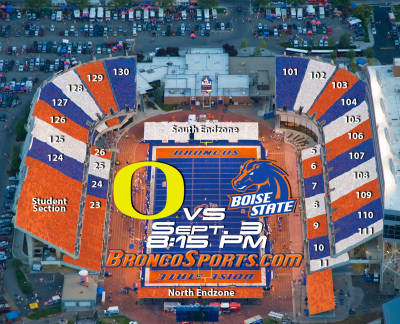
…you’ll love how the Boise State stadium will look on Thursday night. As if the blue turf wasn’t enough. Kudos to them if they pull off anything closely resembling this.
All 12 SEC teams will be in action this weekend, and all 12 games will be televised in some form. This is mostly a note-to-self, but someone else might find it useful. Or we could all just bookmark this page.
Thursday:
7:00: South Carolina at N.C. State (ESPN-HD)
That’s right – the SEC and ACC are the opening acts for the west coast headliners. South Carolina has enjoyed this opening Thursday slot several times lately, but it’s usually been some ugly football. No matter…hook up the IV and let the football drip…drip…drip…
10:15 PM: Oregon @ Boise State (ESPN-HD)
Few teams have as much on the line this weekend as the Broncos. The national title game is out of the picture regardless, but a win here could still be their gateway to another BCS bowl.
Saturday:
10:00 AM: College Gameday (ESPN-HD)
Everything about the show is beyond parody now, but you’ll still watch it. The crappy intro, cartoonish hosts, predictable storylines, crowd trying too hard, and of course the obligatory Tebow human interest story – it’ll all be there, but we’ll all be tuned in. I can’t think of another major sport that has a single this kind of hold on the sport’s collective conscious. The Gameday intro, whether performed by Bubba Sparxxx, Kenny Chesney, or the Wiggles, is the shrill factory whistle letting us all know that it’s business time. You’ll be too busy watching for milliseconds of your team’s highlights in the opening montage anyway.
Noon: Kentucky vs. Miami of Ohio (ESPNU-HD)
Not much reason to watch other than it’s the first SEC game of the day.
Two debuts here: Kiffin’s debut against WKU is all well and good, but it’s also the first broadcast on the new ESPN Regional network that will be taking the place of the weekly Jefferson Pilot game. Tune in to see how the broadcast survives with only one Dave.
3:30 PM: Georgia @ Oklahoma State (ABC-HD)
3:30 PM: Jackson State @ Mississippi State (ESPNU-HD)
Um…OK. If you’re at a bar with 700 TVs, you might ask to turn one to Dan Mullen’s debut in Starkville and peek at it between commercials.
7:00 PM: BYU vs. Oklahoma (ESPN-HD)
You can tune in to see if college punters can get as much elevation as their NFL counterparts, but the game itself features two teams looking for a bit of legitimacy. An Oklahoma loss would do a lot of damage to their chances of producing consecutive BCS and Heisman finalists. BYU has an outside shot at playing for the national title if they run the table, but none of that happens without a win here.
If this game loses your interest after, say, the first minute, you can always stay on the lookout for the elusive I-formation.
7:00 PM: Louisiana Tech @ Auburn (ESPNU-HD)
Two more debuts: the Chizik experiment and ESPNU’s Saturday evening SEC game. Make it a game: will there be more Florida touchdowns or Auburn completed passes?
7:00 PM: Missouri State @ Arkansas (PPV/Gameplan)
Realize that this is Arkansas’ only game until Georgia visits in a few weeks.
7:30 PM: Western Carolina at Vanderbilt (CSS)
Don’t mistake this for a repeat of the high school game CSS shows on Friday evenings.
8:00 PM: Alabama vs. Virginia Tech (ABC-HD)
Bama launched their 2008 season with a win over an ACC team in Atlanta. Their most recent trip to the Dome wasn’t as pleasant.
10:30 PM: LSU @ Washington (ESPN-HD)
Lookit! SEC! Travel! West coast! Distance! Will they finally love us? I know…I’ll probably be asleep by then too.
Sunday:
3:30 PM: Ole Miss @ Memphis (ESPN-HD)
The Snead Stampede gets going with a rivalry game. It’s Sunday, the NFL won’t start for another week, so you’ll watch.
Monday:
4:00 PM: Cincinnati @ Rutgers (ESPN-HD)
Rutgers seems to be as good of a choice to win the Big East as anyone. Fortunately we’re past the point where that comes with national title hopes. Still, they’re at a critical stage of building a program: the first wave of program-changing talent has moved through. Now do they regress back to historical results or can the next wave of players sustain and improve on what they have?
8:00 PM: Miami @ FSU (ESPN-HD)
I think “pity†is now the default frame of mind in which to watch this game.
As if this week’s off-the-field distractions weren’t enough for Oklahoma State, we learn this afternoon that starting MLB Orie Lemon, a senior, will miss the season with a torn ACL. Lemon was the team’s third-leading tackler in 2008, but it sounds as if he brought everything from pass breakups to blocked field goals to the table.
Georgia fans know too well how much of a kick in the stomach this can be to a player and his teammates, so we wish him all the best and the strength to make a complete recovery.
Here we are on the eve of the 2009 season and we just can’t let go of 2008 yet. We’ve looked at the hard numbers. We’ve looked at the hidden numbers. At this point it takes something out of the ordinary to take our focus off of the game just five days away and go back over the tired corpse of 2008, but Year2 over at Team Speed Kills has one last post about 2008 worth reading.
He takes on the statistic of scoring defense which blindly counts any opponent points against the defense, and he “corrects” the numbers by removing things like opponents’ defensive and special teams scores. (It’s like an ERA for football defense.) You can argue whether or not it’s appropriate to discount drives that start on the defense’s side of the field, but he does it. It’s stats-heavy stuff for sure, but taking apart a stat like scoring defense has implications for the entire team.
Read the whole post for context and how the adjustment applies to the rest of the SEC. The relevant bit for Georgia:
The Bulldogs gave up an average of 24.83 points per game as a team. However, their adjusted points per game allowed was 15.58, a full 9.25 points lower than its team average. That to me suggests that there is a grain of truth in the claim that Georgia might be better off without Matthew Stafford if Joe Cox throws a lot fewer picks. I’m not saying that’s 100% true, just that there’s at least one piece of evidence to back it up. In total, UGA’s defense gave up 20+ adjusted points five times. Against the top six SEC defenses, Georgia scored 21.40 a game and an adjusted 19.60 a game for a difference of 1.8 points per. That shows that for all that the Bulldogs gave up in the way of non-standard points, they were almost completely unable to get some back via big special teams and defensive plays themselves.
No one is excusing the defense from some pretty rancid play at times last year. They still “gave up 20+ adjusted points five times.” It’s also the defense’s job, as Coach Martinez has admitted several times, to respond when placed in a tough situation like having the opponent start a drive on your half of the field. That said, those numbers put a point value on what PWD likes to call “team meltdowns”. You see it all there – turnover margin, kickoff problems, the short field, and, yes, the defense…it all added up to nearly a 10 PPG swing, and it truly took a team effort.
There’s another side to the numbers. As Year2 notes, “(Georgia was) almost completely unable to get some (points) back via big special teams and defensive plays.” Aside from Prince Miller’s punt return against Alabama or the glorious interception returns at LSU, the Georgia defense and special teams were typically not able to create points or set up the offense. We went much of the season with the defensive line recording more interceptions than the secondary. It’s not enough for the offense to avoid turnovers or hope Joe Cox throws fewer interceptions. Generating points is a team effort also.
If you had to point to the defining moment of Florida’s 2008 championship season, I’d bet that most would say Tim Tebow’s promise. They have the monument to prove it after all. But Florida’s offensive stats weren’t a great deal better in 2008 than they were the year before. There was a slight shift in balance from passing to rushing, but that’s about it. Giveaways dropped from 15 to 13. To be sure, it was a high level of performance in both years. But what turned Florida from a 4-loss team to a national champion?
Defense
2007
2008
Points/game
25.5
12.9
Yards/game
361.8
285
Red zone chances
104
39
Takeaways
20
35
Passing yds/game
258.5
179.9
The defense improved across the board. 35 takeaways fueled a +22 turnover margin. Opponent trips into the red zone decreased by over 60%! Opponent points per game were cut nearly in half, and that’s before Year2’s adjustments. Back over to Year2 to put a point value on those defensive improvements. Combine Florida’s insane number of takeaways with great special teams play, and you get this:
Everyone knew that Florida’s opportunistic defense and special teams were good, but against the best defensive teams in the conference, they were worth an entire extra two touchdowns per game.
That’s right: last year Florida’s defense and special teams spotted Florida’s already-potent offense an additional 13 points against the SEC’s top defenses. Not to take away from the accomplishments and contributions of Tebow and his teammates on offense or the potency of the spread option, but what Florida’s defense and special teams were able to accomplish takes hidden yardage and points to the extreme.
Think life would be easier for Cox and company with anything approaching that level of contribution from the defense and special teams?
So within the past few days Oklahoma State has had to deal with a couple of personnel issues.
Senior starting defensive back Perrish Cox was arrested last week for driving with a suspended license. He won’t miss the opener (“We handle all of those things internally,” said coach Mike Gundy), but that’s not unusual for a simple moving violation. It’s not like he was caught with drugs or anything.
Now starting tight end Jamal Mosley has left the team. Mosely is the same player who was arrested for marijuana possession over the summer and also wasn’t suspended. Now Gundy doesn’t have a choice – it’s on to plan B at tight end.
Does Mosely’s departure really matter? He only tallied five receptions last year, but he was expected to step in for NFL-bound Brandon Pettigrew. It’s worth noting that in Oklahoma State’s 2007 game in Athens, the most productive OSU receiver was the tight end. Does it matter that the position now turns to a player who recorded a single reception (for four yards) to replace an NFL-quality tight end? Much (or nearly all) of the buildup to this game talks about Georgia’s challenge in defending Dez Bryant, but as good of a receiver as Bryant is, he’s still not going to be the target on every pass attempt. Chris Brown, in his overview of the OSU offense, cautioned that “with Big 12 defenses focused on Bryant, it will be up to the run game — and the other receivers, and the playcallers — to find ways to succeed without lobbing it up to No. 1.” Just five days before the opener those OSU playcallers are dealing with a shakeup at a position that they’ve leaned on for a good bit of production over the past couple of years.
Oklahoma State ($100)
Arkansas ($45)
Arizona State ($60)
Tennessee Tech ($45)
All Oklahoma State tickets ordered can be picked up at the Gate N-12 at Boone Pickens Stadium in Stillwater, Oklahoma, starting at 1:00 p.m. (CT) on the day of the game. When picking up Oklahoma State tickets at Will-Call, please present a photo ID to claim your tickets.
All other single game tickets ordered will be mailed out the week of September 7-11.
For more ticket information, please contact the UGAA Ticket Office at 1-877-542-1231.
From Mark Richt’s comments about the heat in Jacksonville to the hot conditions that gripped the south-central US for much of this summer, the role of weather has been a very minor storyline during the offseason.
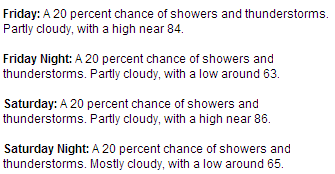
Fortunately the summer heat has broken on the plains, and Stillwater is currently enjoying a nice preview of fall. Temperatures are expected to remain in the 80s this week with a very reasonable 86 degrees and only a slight chance for a summertime storm forecast for Saturday. Forecasters are expecting that temperatures “will remain below (normal) late week and probably into the Labor Day weekend.”
Of course forecasts 5 days out can change dramatically, but the early read is that the weather should be just fine for the game and certainly nothing too extreme or out of Georgia’s comfort zone.
An article this week in Tulsa World reports on Oklahoma State’s season ticket sales but avoids bringing up a reasonable conclusion: there seem to be over 11,000 unsold tickets for the Georgia-OSU game.
Oklahoma State has sold 41,593 season tickets so far. According to Tulsa World, that includes 8,668 student tickets.
“(AD Mike) Holder has predicted that OSU may reach a final (season ticket) total of more than 44,000.”
Georgia received an allotment of 5,000 tickets.
Are you with me so far? Even if OSU meets Holder’s expectations of 44,000 season tickets (again, including students), we’re at 49,000 tickets sold in a stadium that holds 60,000+. PWD guesses that 8,000 or so will be Georgia fans. Here’s the thing:
The Georgia date is designated by the OSU athletic department as this season’s premium game, meaning that OSU fans may attend only if they have purchased a season ticket. Except for the 5,000 tickets allotted to the University of Georgia, no single-game tickets are available for Georgia-OSU.
Granting that there will comp tickets for guests, band, and recruits and so on, dumping thousands of tickets still seems like a tall order in a week. Will OSU cave and make the single game tickets available to the public? Will T. Boone Pickens buy up the rest and distribute them to local charities? Or will OSU hold firm to its “premium game” policy and accept that its new showcase stadium will be at least 10% empty in front of a national TV audience? Somehow I expect those seats to be filled one way or another.
The ABH catches up with former Bulldog offensive lineman Chester Adams. Adams, finishing up his degree at UGA, is the new offensive line coach at North Oconee HS. The feature goes into more detail about the circumstances and connections that led Adams to his coaching break, and it’s worth noting that Georgia’s Ray Lamb ended up making the match.
“I can’t imagine myself doing anything else,” Adams said. “It is something that you love to do. And now that you are older, you want to come out here and show them how to do it.”
The preseason AP poll came out over the weekend, and I doubt anyone was suprised to see the Dawgs ranked #13. After all, #13 was Georgia’s position in the coaches poll released earlier this month. Even Phil Steele, who’s occasionally gone against the grain when it comes to Georgia’s outlook, pegged the Dawgs at #13. Georgia’s ranking in Chris Stassen’s preseason consensus, which annually aggregates the various preseason polls, is – wait for it – right there between #12 and #14.
What does #13 mean? Georgia’s #13 finish a year ago meant a 10-3 record, a second-place finish in the SEC East, and a New Year’s Day bowl in Florida. A year ago that was considered a disappointing result relative to the preseason #1 ranking.
Do you agree with the consensus that Georgia will finish 2009 in the same place they ended up last January? If the consensus is correct, Georgia’s three losses in 2009 would come against Oklahoma State, LSU, and of course Florida. Would that be a disappointment? Of course those aren’t the only three teams on the schedule capable of beating Georgia. Even Tennessee and Auburn, though down and sorting things out, are rivals with plenty of pride and firepower to present a challenge.
A 10-3 season might sound about right to a lot of people, but Kyle doesn’t buy it. I get where he’s coming from – the mid-teens isn’t really going out on a limb – but I also don’t see it as a given that the season will swing in one of two very different directions.
What is more likely to swing one way or the other are the expectations within the season.
Blutarsky had a great point a few weeks ago: if Georgia wins the opener, all bets are off. The Dawgs will have beaten a top 10 team on the road in front of a national TV audience. As much as many fans (and sadly even some coaches and players) would prefer to avoid the attention, pressure, and expectations of a year ago, there won’t be anywhere to hide should the team rise to the challenge in the first game.
Similarly, it’s pretty easy to guess how fans would react to a loss in the opener. Fire this coach or that (we can guess who’s likely to be at the top of the list). There would almost surely be a quarterback controversy. The South Carolina game would become a toss-up, and we’d see dire forecasts for a long, long season.
Either way, the preseason ranking and expectations are out the window as soon as we kick off next week.
I swear I’m knocking on a wooden bookshelf as I type this, but I have to chuckle a little bit when I read dramatic headlines like 6 key Dogs miss practice and discussions about an “epidemic of strained and pulled hamstrings.”
Last night we found out that starting center Ben Jones got a scare with an ankle injury. X-rays were negative, and it’s just a sprain. Jones wasn’t the only starting Georgia lineman battled injury – tackle Clint Boling had a few nervous days over the weekend before finding out that his wrist injury was also a sprain. Boling’s already back at practice.
Not to tempt fate, but the way things went last year Jones’ and Boling’s x-rays and MRIs would have come back with a break or a tear if this were 2008. So far the most serious injury suffered during camp seems to be a three-week knee injury to safety Quintin Banks. I don’t mean to make light of hamstring pulls and sprains – which can linger into the season and become chronic problems – but the news on the inevitable preseason injuries has been pretty damn kind to the Dawgs so far. Just the fact that we have more than one or two healthy defensive ends with which to practice is a big improvement.
When you consider Arkansas losing starting cornerback Isaac Madison for the year or Texas losing four tight ends to season-ending injuries or even Georgia’s own situation a year ago, it could be a whole lot worse. I got that same sick feeling we went through time after time last year when I first heard about Boling and Jones, and news of their favorable results brought a big sigh of relief.
I’m holding my breath for the next two weeks just like the rest of us, but I’m not going to lose any sleep over some hamstring pulls and a few sprains. If things can somehow keep up this way, we’ll see a lot of these green jerseys start to disappear the week before the season.
The 1980 national championship game was on ESPN Classic the other day. Someone on the message boards remarked how it seemed as if Georgia got all the breaks that day. No one was complaining, but it was true that most of the balls bounced Georgia’s way en route to the win over Notre Dame. The Dawgs were outgained and completed but a single pass, but good defense and a couple of opportunistic scores made the difference. “We’ve been a team of good fortune,” said Vince Dooley leading up to the Sugar Bowl, and that good fortune continued to the end.
Mark Richt’s standing after eight seasons has been a favorite topic this offseason. His accomplishments speak for themselves, but what’s ahead? Is that elusive national title still to come? Is he, as some have suggested, closer to the hot seat than we might admit? Some of the discussion I’ve seen chalks the talk about the lack of a national title up as a matter of luck and circumstance. Georgia’s had seasons under Richt just as good as those of teams that have gone on to play for the title, but the timing was just wrong.
Luck and circumstance can definitely play a role in a national title. Dooley tipped his cap to good fortune in 1980. We all remember Clint Stoerner’s fumble that contributed to Tennessee’s 1998 title. Florida plays in the 2007 Sugar Bowl and not for the national title without a huge upset of USC by UCLA. And of course there’s the avalanche of events at the end of the 2007 that allowed LSU to lose its regular season finale and still win the national title with two losses.
It’s one thing to grant the frequent role of luck and fortune in a championship season, but I hope that doesn’t lead us to just shrug off the pursuit of a national title as a whimsical spin of the wheel of fortune. In many cases this decade, the Dawgs have had the opportunity to make their own luck. Sometimes they have, and sometimes they haven’t. While the Dawgs haven’t had the best of luck getting to the national title game, they’ve still had plenty of breaks go their way during the Mark Richt era.
2002
Why Georgia was unlucky: The one-loss season remains the best result from a Mark Richt team, and it’s true that several teams have made it to the BCS Championship with similar or worse records. But in 2002 Miami and Ohio State made it through the regular season unscathed, and Georgia had to “settle” for its first BCS bowl and first trip back to the Sugar Bowl in nearly two decades.
Why Georgia should consider themselves lucky: Really, this should be plenty:
Without that single play, Georgia doesn’t even win the SEC East. Much of the 2002 season went that way. We remember 13-1, the long-awaited SEC title, and how close Georgia came to a perfect season, but how close was Georgia to a much more ordinary season?
You can start with the very first game. Clemson, kicking against the wind, came up just short on a game-tying field goal. A week later, South Carolina fumbled just yards away from a winning touchdown. Then it was on to Alabama where a late Crimson Tide interception put Georgia behind and required a last-chance drive culminating with Billy Bennett’s heroics. Even the win over Tennessee, hardly something you’d credit to luck, was closer than many of us remember. The Dawgs raced out to a lead but had to hold on as the Vols took all of the momentum in the 4th quarter. Richt rolled the dice and pitched to Tony Milton on a late 4th down gamble to seal the win.
Auburn and even South Carolina fans might have felt as if the Dawgs had plenty of luck in 2002. Even though they came up short against Florida, what was remarkable about the season was how many times the Dawgs came out on top in close games. Credit Richt, Greene, a cultural change, or whatever you like – after losing those kinds of close games to South Carolina, Auburn, and BC in 2001, many more went Georgia’s way in 2002 than didn’t.
2003
Why Georgia was unlucky: The Dawgs had a really good shot at knocking off eventual national champion LSU in Baton Rouge. A Georgia win would’ve put the Bulldogs down the same path that LSU took to the national title. It also would’ve put Ole Miss in position to win the SEC West and give the Bulldogs a more manageable opponent in the SEC Championship game. Though Georgia outgained LSU 411-285 and passed for 314 yards, three Georgia turnovers and three uncharacteristic missed field goals from Billy Bennett kept Georgia out of the endzone until Tyson Browning’s dramatic late game-tying touchdown on a 93-yard screen pass. A poor kickoff and a busted coverage gave LSU the opening to win a close 17-10 game.
Why Georgia should consider themselves lucky: It’s hard to consider good fortune in a three-loss season, but just getting to the Georgia Dome was a small stroke of luck in 2003. The Bulldogs finished deadlocked in the SEC East standings with Tennessee and Florida. With all other tiebreakers unable to settle the issue, Georgia’s higher BCS ranking earned them the trip to Atlanta. The quirk of that BCS-related tiebreaker made season-ending nonconference games with Georgia Tech and Florida State mean as much for Georgia and Florida as any conference game. Only after Georgia beat Tech and Florida narrowly lost to FSU did the Dawgs emerge as the SEC East’s representative to the conference championship game.
2005
Why Georgia was unlucky: Even with Darren McFadden’s flashes of brilliance and 190 yards, Georgia’s midseason game against Arkansas seemed destined to be a boring midseason win for the #4 Bulldogs. A second quarter knee injury to quarterback D.J. Shockley made the game one of the pivotal points in the season. The Dawgs held on to beat Arkansas, but they’d drop their next two games and fall out of the national title picture.
Why Georgia should consider themselves lucky: Even with the injury to Shockley and a shocking end to the Auburn game that resulted in a home loss, the Dawgs won the SEC East and rebounded to win the conference title. They still needed help to win the division, and that help came from a very bitter foe. Georgia’s loss to Auburn on the heels of the earlier loss to Florida would have given the division to the Gators. It took Steve Spurrier’s Gamecocks to knock off Urban Meyer’s first Florida team and hand the Gators their third conference loss. The Dawgs made the most of their chance to win another SEC title, but they had to back in to the opportunity.
Even if Georgia had finished 2005 undefeated, the odds were slim to none that they’d vault past either Southern Cal or Texas for a shot at the national title. The eventual result – a conference title and a BCS bowl bid – was about as good as it was going to get.
2007
Why Georgia was unlucky: Few teams in the nation finished the 2007 as well as Georgia. The Dawgs plowed through rivals Florida, Auburn, and Georgia Tech before providing Hawaii with a brutal reality check. The Dawgs rose so high that the remarkable chain of events during the final weeks of the regular season had Georgia in position to play for the national title if the final poll remained consistent. The pollsters insted vaulted SEC champions LSU ahead of Georgia and into the BCS Championship. It was a pipe dream for a two-loss team that hadn’t won its conference to play for the national title, but 2007 wasn’t your typical season.
Why Georgia should consider themselves lucky: A season that finished so strong nearly fell apart before it got going. On the heels of a shocking blowout loss at Tennessee, it was all Georgia could do to stay in the game at Vanderbilt and avoid a consecutive loss to the Commodores. Vandy built a 17-7 lead and held on for much of the game, but the Bulldogs drew even with just over 6 minutes remaining. Vanderbilt responded with an impressive drive, and for the second year in a row Georgia didn’t seem to have an answer as Vanderbilt drove for the game-winning score. The Bulldogs forced a season-saving fumble on their own 7 yard line and put together a drive for their own before Brandon Coutu won the game with a field goal at the final whistle.
Think about that point in the 2007 season had Georgia dropped to 4-3 with a loss to Vanderbilt and Florida still to come. Put it in the context on the heels of a 4-loss 2006 season. It’s simplistic to point to a fumble as the turning point which brought the team from the brink of a meltdown to a national title contender in less than two months, but that’s the way the breaks go in this game, isn’t it?

 Georgia @ Okla. St.: What I’ll be looking for
 Comments

 Dawg Media
 RSS 2.0