Tuesday July 31, 2007
A limited number of single-game Georgia football tickets are still available for upcoming home dates against Oklahoma State (Sept. 1) and Kentucky (Nov. 17).
Beginning on August 1 @ 8:00am, these remaining tickets can be purchased online www.georgiadogs.com or by calling the Athletic Association’s ticket office toll free 1-877-542-1231. There is no limit per order.
Tickets are $40 each plus a processing fee and orders will be mailed out beginning August 20.
Tuesday July 31, 2007
Last night’s Atlanta
Bulldog Club meeting was the typical preseason pep rally, but the nagging
topic of Florida naturally came up.
Coach Richt didn’t back down to the challenge and matter-of-factly stated that
the Gators stood in the way of Georgia’s goals. "If we are going to win
an SEC East title, and that is our plan – to win it, we are going to have to
beat them," he explained. "If they are in the way, then so be it."
That sounded great until the
topic of the venue came up.
"Do I truly think it is a neutral site?" Richt said. "No,
I don’t. That doesn’t feel very neutral to me. If you want to have a neutral
game, let’s have a neutral game in Atlanta. I would not be against rotating
the thing around."
Forget about defending the tradition of the Cocktail Party for a second. We’ve
got a bigger problem.
Florida is a tough enough opponent without things like the location becoming
a mental block for the head coach. In a game of this magnitude with not only
a rivalry but often an SEC East title on the line, that’s not good news. When
the Top Dawg gets off the plane thinking, "neutral my left toe," you’re
at a disadvantage before the game is ever played. The game has been decided
by a touchdown or less in the past five meetings, so you can appreciate the
significance of the mental advantage when two pretty evenly-matched quality
teams play.
I don’t think it’s a reach to suggest that this mental block has manifested
itself in Georgia’s offensive performances in Jacksonville. For all of the attention
paid to Spurrier and Meyer and their offenses, Georgia’s biggest impediment
in Jacksonville has more often than not been on the other side of the ball.
In Richt’s six games against Florida, the Dawgs have scored 10, 13, 13, 31,
10, and 14 points against the Gators. It hasn’t exactly taken Norm Chow on the
other sideline to beat those meager point totals, and it’s not an accident that
Georgia won in the only year in which they broke 20 points. Mike Bobo was under
center for a big loss and a big win in Jacksonville, and we’ll see if his promotion
to coordinator can do anything to snap Georgia out of this funk on offense.
Maybe I’m wrong for dwelling on this point on a night where Richt confidently
praised his quarterback and said "I don’t think we are too far away"
from bringing a national title to Athens. It’s just that any national title
run in the near future is going to go through Jacksonville. The Dawgs need a
dose of that same mental toughness that they bring to Columbia, Knoxville, and
Auburn, and dwelling on the neutrality of the site isn’t a positive first step
towards building that attitude.
Richt is resigned to play the game in Jacksonville for the time being, "Whatever
Damon says goes. The bottom line is we have got to win the game." That
conclusion, while true, doesn’t inspire a lot of confidence when we’re reluctant
to be there in the first place.
Tuesday July 31, 2007
One of the themes coming out of the Georgia camp from SEC Media Days was the
relative absence of Bulldogs in preseason media honors. As Ching
wrote,
The Bulldogs were shut out of the first-team balloting for the first time
since the Media Days event started in 1992. Only two Georgia players –
place-kicker Brandon Coutu and linebacker Brandon Miller – earned second-team
honors, tying Georgia with Mississippi State and Ole Miss for the fewest all-conference
players in the league.
Georgia was the only SEC team without a first-team player. Sounds pretty ominous,
right? Yet the same
media also picked the Dawgs to finish third in the tough SEC East, and they
were a lot closer in the voting to second place Tennessee than they were to
fourth place South Carolina. That apparent incongruity could mean any or all
of these:
- The press is going out on a limb that a proven coach like Mark Richt will
put a good team together despite the lack of stars.
- The press believes that the Dawgs have a lot of above-average-but-not-quite-great
players.
- The press acknowledges that Georgia doesn’t have many all-SEC players based
on previous production, but they expect a few to emerge this year.
- Georgia will be hurt by their lack of star power, but the press isn’t ready
yet to move teams like South Carolina or Kentucky into the top half of the
division.
Take your pick – you could make a case for any of them. If you ask Coach Richt,
the answer might be the third option. "Whether we rise or not is the big
question,” he admitted at Media Days. “But I believe in this team.
I think we’ve got a chance to do as well as any team that we’ve
had since we’ve been here.”
The Dawgs are facing a double-whammy: not many teams have fewer
returning starters, and those returning starters are either young or have
had average production to this point. Florida, on the other hand, has only eight
returning starters, but six of their key contributors are on the preseason all-SEC
team. To illustrate the point, think back to 2003. Georgia’s offensive line
was decimated after 2002 and gave up over 40 sacks in 2003. At least the Dawgs
had a stout defense with proven playmakers on which to lean. In 2007, Georgia
has no such glaring strength to carry the team. Instead of Pollack, Davis, Thurman,
and Jones, the 2007 Dawgs will lean on guys like Stafford, Massaquoi, Lumpkin,
Sturdivant, Owens, Miller, and Johnson.
Those guys are hardly stiffs, but almost all have inexperience to overcome
or have spent careers out of the spotlight to this point. Richt’s "whether
we rise" question hits the story of the 2007 season dead on. Some talented
guys will be thrust into key roles by necessity, and Georgia’s fortunes will
turn on their ability to turn preseason anonymity into postseason glory.
Thursday July 26, 2007
Though most of the NFL spotlight was focused on Michael Vick today, the NFL announced that Odell Thurman’s request for reinstatement to the league was declined. Thurman missed the entire 2006 season after missing a drug test and an arrest for DUI.
After two seasons on the shelf, one wonders if Odell Thurman will ever see an NFL field again.
Thursday July 26, 2007
Rivals.com is reporting that Wake Forest men’s basketball coach Skip Prosser has died after collapsing during a jog. Prosser rebuilt Wake into a top 10 program and was in the middle of assembling one of the nation’s best recruiting classes. Our thoughts are with the Wake Forest fans this evening.
Georgia coach Dennis Felton joined Prosser this spring as part of Operation Hardwood in Kuwait, so we’re almost certain to have a comment soon from Coach Felton.
Thursday July 26, 2007
It’s that time of year when you begin going through the garage and taking inventory
of your tailgate supplies. The chairs probably have to be dusted off. Menus
must be planned. The generator might need some oil. You might even need a new
tent. Yesterday the Georgia
Sports Blog highlighted the latest in tailgating toys – a giant, inflatable
canopy dwarfing anything you have at your tailgate now. Nice, huh? I can’t get
past the fact that 1) it looks like a spider and 2) anything inflatable reminds
me of that insect they have filling empty seats in Atlanta. I have no idea how
that bee kept deflating during games in the early 1990s.
They take a slightly
different approach to tailgate preparation in Iraq (h/t Deadspin):
Iraqi fans have been stocking up on gasoline and ammunition in preparation
for their national soccer team’s Asian Cup semi-final against South Korea.
Outstanding. Those Iraqi fans must’ve done their postgraduate work at
N.C. State.
Thursday July 26, 2007
It’s not necessarily a good feeling to look at the Georgia wide receiver depth
chart and alternate between "he’s a senior now?" and "he’s
still on the team?"
When we last left the receivers: It wasn’t exactly a banner
year for Georgia wide receivers. Blame whatever you like – coaching, talent,
new quarterbacks, or the granite bulldog – Georgia receivers had a grand
total of four touchdowns last year. Four. Mohamed Massaquoi
and Mario Raley had two apiece, and no other Georgia receiver found the end
zone. You can point to a diverse offense that spread the scoring to tight ends
and even fullbacks, but only Ole Miss and Mississippi State had fewer receiving
touchdowns last year. The stigma of drops and a lack of big plays continued
to haunt the position.
What’s happened since: The biggest news at the receiver position
is the return of two upperclassmen from injury. Sean Bailey
tore his knee after a two touchdown performance in the 2005 SEC Championship
game and missed the entire 2006 season. Demiko Goodman was
finally starting to turn it on late last year before suffering a season-ending
knee injury at Kentucky. Senior T.J. Gartrell is also back
after missing 2006 with a torn patella tendon. Gartrell has yet to find his
place, but as a senior he could have a limited but productive role similar to
Raley last year. Mikey Henderson stood out in spring – enough
to rocket past most others on the depth chart and challenge for a starting spot.
What to look for in preseason practice: The Dawgs have a lot
of upperclassmen receivers, and at times you want to make all of them and none
of them a starter. The depth chart and rotation is very much up for grabs. Massaquoi
is the most likely starter, but anything could happen after that. Will Bailey
step back into a prominent role? Goodman was pushing the starters before his
injury last season; will he pick back up at that level?
You also have the question of some veterans who are hanging around, occasionally
making plays but never quite breaking through. We’ve touched on Gartrell. A.J.
Bryant came into the program as the #1-rated "athlete" in
the nation, but his success at receiver has been spotty and slowed by injuries.
Kenneth Harris likewise has had his moments but has not been
a consistent standout. You’d like for one of these upperclassmen, especially
Bryant, to make a move forward before their eligibility runs out.
There are also a group of younger guys looking for playing time. Kris
Durham made a name for himself with several clutch catches as a true
freshman. Michael Moore also looked decent in his first season.
Tony Wilson looks to join the fray this year after being named Most Improved
Receiver in spring practice.
While the receiver class of 2008 is already building hype, we forget that Georgia
signed two good receivers last February. Israel Troupe was
probably the best receiver in the state and will play for Georgia despite being
selected in the 2007 Major League Baseball draft. Walter Hill
is a football/basketball star recruited for both sports. At 6’4", he’ll
be a tall talent with great leaping ability. Last year Durham made an impact
as a true freshman. Unless there is improvement from the upperclassmen, Troupe
and/or Hill could likewise see time in 2007.
Concerns? Optimism? Challenges? With so many names listed
above, you’d think that Georgia has more than enough depth to field a decent
or even above-average receiving corps. So far, the production hasn’t matched
the recruiting hype. Massaquoi began to shake off his sophomore slump in the
Tech game, and that must continue. The opportunity is there for any receiver
ready to step out of the shadows. The good news is that Georgia’s receivers
have one of the best passers in the league under center. The stability at the
quarterback position should help a great deal.
Since the departure of Gibson and Brown in 2004, the Georgia receiver position
has been largely anonymous. Massaquoi emerged quickly as a fan favorite, but
the praise hasn’t resonated far beyond Athens. With the window of opportunity
in the Matthew Stafford era entering its prime, the receivers must step up to
keep up.
Wednesday July 25, 2007
It began earlier
this month when Stewart
Mandel wrote,
USC and LSU have to play for the national championship this season. It is
no longer possible to envision any other satisfying conclusion.
Now the ESPN
pundits have picked it up and are fully on board. (h/t Get
the Picture)
On the inaugural edition of “College Football Live” on ESPN last
night (featuring the same 3 gentlemen), we were told to expect a “national
title” match up between USC and LSU.
Of course picking Southern Cal and LSU to play for the national title isn’t
left-field analysis. They’re both good teams and reasonable picks. Just understand
that you’ll be sick of Les Miles by August 22nd…if you’re not already.
Two storylines will collide on September 8th. This inevitable SoCal – LSU national
title express meets the Virginia Tech sackcloth
and ashes show. Heathers indeed. Surely the Tigers won’t be so
insensitive as to actually try to win that game?
Wednesday July 25, 2007
There’s an interesting discussion going on about the influence of ESPN in the
college football world. We’ll pick it up with Kyle’s
post here and then see responses here
and here.
Interesting stuff, mostly.
I have to admit that it’s good sport to watch the nascent sports blogosphere
interact with the sports media. I can understand how the blogs which really
began to hit their stride two years ago think that this is new ground, but it’s
not. The first generation of online writers in the mid-1990s also butted heads
with more traditional media, and we saw much of the same friction. If there’s
a difference it’s in the competitive marketplace. Print journalism was (and
still is) competing directly with a lot of these online sites. Innovations we
take for granted on modern newspaper Web sites such as multiple daily updates,
deeper online photo galleries, and even comments and discussion spaces were
pioneered first online and adopted by print media in the fight for eyeballs.
Inch-deep coverage wasn’t going to cut it as the predecessors of Rivals.com
and Scout.com changed the marketplace.
Blogs have taken the interaction to a more granular individual level. Smarter
journalists are jumping in with
both feet and have built their own personal brands. Newspapers like the
AJC have beat blogs with more frequent, brief, and informal updates from their
journalists on the news beats. Several professional
pundits have embraced the interaction and earned places as authorities and
discussion leaders. The competition here has to do with insight, interesting
ideas, and access. Unless Ivan Maisel offers compelling content, why read him
instead of an interesting blog? We’re all just writers hoping that someone will
find our content worth reading. Some do it better than others, and some stake
their livelihoods on it.
With ESPN television, it’s a bit of a different story. There simply isn’t the
competitive pressure. We have to differentiate between the ESPN punditry and
the network itself. The pundits, from Simmons to Schlabach and on down, face
the same competition in the marketplace of ideas as any other "print"
journalist. But in terms of SportsCenter or Gameday or live coverage of games
themselves, the competition (if any) comes from CBS, FOX, and other networks,
not from Deadspin or DawgsOnline.
ESPN Gameday might be cheesy, overdo the Virginia Tech story, or go to the wrong
game. Who cares? We’ll watch anyway. Eyeballs and ratings
– not well-crafted blog missives – are what drives ESPN. When someone carries
more games or provides a better alternative to Gameday, the competition will
tell the tale.
We complain about the influence of ESPN in college football, but what we might
have seen is the Law of Unintended Consequences at work after 20 years.
Prior to 1984, the NCAA
had strict control over which schools appeared on television:
Under the old NCAA plan, which had been in effect since 1952, teams were
limited to six appearances during two seasons.
Schools which attempted to organize their own deals were threatened with banishment
from the organization, and it wasn’t until Georgia and Oklahoma successfully
sued the NCAA in that landmark 1984 case that things began to change. The CFA
replaced the NCAA as the distributor of television coverage, but even that proved
too restrictive for the membership. The moves by Notre Dame (NBC) and the SEC
(CBS) in the early 1990s brought control of television deals down to the conference
and even the individual team level.
But while NBC and CBS settled on those valuable broadcast rights, ESPN attacked
with breadth. So CBS has the best SEC game of the week; ESPN will take the second-best…and
the fourth-best. It’ll also add another game on ESPN2. They might even convince
a couple of SEC teams to play on Thursday night. Combine that with the national
and regional reach of ABC, and you have quite a network. NBC will have their
Notre Dame game, CBS will have one or two games, but there’s a lot of action
left over and a lot of demand for college football. Spread it beyond Saturdays,
and there are even more opportunities to broadcast games with programs willing
to sacrifice the tradition of Saturday afternoon for national exposure.
Think about what some of this additional coverage has meant to the game. Back
in the days of few networks and NCAA limits on television appearances, would
stories like Boise State or Rutgers ever catch on? Would anyone have seen all
but a glimpse or two of the West Virginia backfield? It’s likely that a displaced
fan in Oregon can somehow catch the UConn-Pittsburgh game. Through broadcast
networks and pay-per-view, almost every Georgia game is available on television.
Were such things even imaginable 25 years ago?
Increased coverage has done its part to make things more democratic. With more
and more games showing up on television, there are fewer and fewer excuses for
pollsters and the punditry to be provincial. Even more, it’s easier and easier
for the college football fan to catch the BS and have their own informed opinions
about the national landscape.
This widespread availability of games has come with a cost, and obviously networks
are not bringing us more games out of altruism. Without the oversight and restraint
of the NCAA or even the CFA, television networks can dangle some pretty juicy
plums in front of conferences. Teams, particularly those mid-level programs
who will do anything for a little more exposure, have begun playing on all days
of the week. It’s hard for me as a fan of a program with plenty of exposure
and cash to criticize this development, but I wouldn’t like my team taking a
spot in one of those games.
There is a concern that ESPN is crossing lines in brokering out of conference
games. Arranging games is nothing new. It’s how college football’s most
cherished tradition and most
valuable brand came to be. The
Senator is nervous (with good reason) that the media conglomerate might
take a greater role in the evolution of the college football postseason, yet
we hold on to a postseason where matchups are already brokered well in advance
by conferences and local chambers of commerce.
College football has brought a lot of the current state of affairs on itself.
The 1984 decision gave greater negotiating power to teams and conferences, but
it also transfered power from the NCAA to the networks. Some
suggest that we’d have the same breadth of televised games regardless due
to the growth of cable and satellite television, but I have to think that at
some point the NCAA would have put a stop to things like Friday night college
football. It could be argued that such limits would be to the detriment of smaller
programs, but that’s a moot point; the CFA ship has sailed a long time ago.
We also fret over ESPN crossing over the news/entertainment line, but that’s
not as big of an issue with me. I rarely rely on ESPN as a news organization.
I never watch EOE productions. I watch sports. If ESPN has too much influence,
it’s the tradeoff we make by giving media opinion such a prominent role in college
football’s ultimate prizes. Again, media influence is hardly a new development.
In recognition of that long-standing fact, ESPN and the AP withdrew
from their participation in the BCS.
So what are we left with? A self-promoting media organization that brings us
dozens of good college football games. Of course they have some awful commentators
and analysts; that’s kind of unavoidable anywhere these days. I’ve had my criticisms
of the coverage before, but it’s because I want a better product to watch and
not because ESPN/ABC is leading us all down the path to prepackaged hell. I
will close with this: with the NCAA more or less hands-off when it comes to
the college football postseason, someone else will guide the process. The networks
and their sponsors already have a large role in the BCS, and it shouldn’t surprise
anyone to see them at the forefront of future changes.
Tuesday July 24, 2007
UGA has now officially announced the cutoff levels for 2007 football tickets. Florida and Tech cutoffs are still unknown at this point (though we expect denim cutoffs for Florida).
The University of Georgia Athletic Association Ticket Office has released the following cut off score requirements for the 2007 season.
Renewable Season: Contributors who ordered and have a cumulative score of 1,991 or higher will receive adjacent renewable season tickets.
Non-renewable/Regular Season: All orders will be refunded.
Oklahoma State, Troy, and Kentucky: All contributors who ordered will receive tickets.
Western Carolina: All contributors with a cumulative score of 9,000 or higher will receive tickets.
Mississippi: All contributors with a cumulative score of 12,000 or higher will receive tickets.
Alabama: All contributors with a cumulative score of 23,500 or higher will receive tickets.
Tennessee: All contributors with a cumulative score of 22,200 or higher will receive tickets.
Vanderbilt: All contributors who ordered Vanderbilt tickets will receive tickets.
Cut-offs for Florida and Georgia Tech will be released as soon as determined.
All refund checks for unfulfilled orders will be mailed by August 15.
Monday July 23, 2007
A few of the more popular phrases people used to reach this site last week:
“georgia bulldog quotes”: Happy to help. Georgia linebacker (and now Chicago Bear) Danny Verdun-Wheeler gave us a great one last week:
“Everyone is different, but the smartest decision you can make as a prospect is to stay in state if you are from Georgia. If a guy comes from Parkview, Thomson, or anywhere, the best thing that he can do is to be a Dawg. Everybody will know you, and it is such a big thing to play for the University of Georgia.”
“atlanta bulldog club”: Yep. It’s that time of year. The meeting is next Monday July 30th, but the location has been changed this year to the Cobb Galleria Centre.
“caleb king arrest”: Yes, he was arrested for driving (a moped across campus) with a suspended license. No big deal, and no one expects his playing time to be affected at all by this story.
“les miles comments on usc”: It’s the molehill that keeps growing. I finally decided to adopt a certain approach to these kinds of statements.
Now for some random search phrases:
“state farm bastards”: Wow. Someone’s unhappy with their good neighbor. I’m not. Great insurance company as far as I’m concerned. Thanks for the dividend check!
“penalties for fake id – misdemeanor ohio”: Sorry, kid. You’re on your own.
“ole miss eric zeier hit ware”: The “Ware” in this search is not Danny Ware but Cassius Ware. Cassius Ware was the ringleader of the defense that made me wonder who Georgia’s backup quarterback was in 1993. I have personally sat through three Georgia games in my life where I felt that the quarterback’s future might be in serious danger:
- The 1995 Alabama game where Hines Ward in his first career start was sacrificed to the Crimson Tide defense.
- The 2003 Alabama game where Georgia put not one but two Crimson Tide quarterbacks on the DL.
- But that 1993 game at Ole Miss was something you can never forget. Eric Zeier took punishment from the Joe Lee Dunn defense from the opening kickoff. By the end of the night, Zeier had been sacked seven times, hit countless others, and the Dawgs took a 31-14 beating.
Monday July 23, 2007
With just a couple of weeks before the start of preseason practice, it’s time
to leave the offseason blog parlor games for a moment and focus back on the
sport itself. We’ll go position-by-position through the Georgia team, recap
the current status of things, and then look ahead to some questions that need
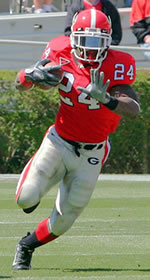
answers before the season begins. We’ll start with the running backs.
When we last left the running backs: The "three-headed
monster" took its lumps and was down a few heads by March. Danny
Ware decided to try his luck in the NFL. Thomas Brown’s
2006 season ended abruptly with a knee injury against Vanderbilt. Kregg
Lumpkin went into spring as the only returning tailback with significant
game experience. At fullback, there was no doubt about Brannan Southerland’s
firm grasp on the position.
What’s happened since: Lumpkin held on to the starting role
during spring, but one story from spring practice was the emergence of redshirt
freshman Knowshon Moreno. Moreno poured kerosene on the fire
at the G-Day game with some impressive runs. Though many expected (or hoped)
that Thomas Brown would use a redshirt season to completely recover from his
knee injury, Brown has been cleared and will try to play in 2007. As he works
his way back into the mix, Brown will have to compete with Lumpkin as well as
some younger talent for carries. Redshirt freshmen fullbacks Shaun Chapas
and Fred Munzenmaier had good springs, but neither established
himself as a clear backup to Southerland. Last year’s utility fullback, Tripp
Taylor, moved to the defensive line.
 |
What to look for in preseason practice: The Dawgs have another
potential logjam at tailback. Lumpkin is the incumbent starter, but he’ll be
pushed by the return of Brown and two newcomers. Moreno will also earn carries.
The wildcard will be the arrival of true freshman phenom Caleb King.
King doesn’t intend to redshirt, but few freshman really do until reality sets
in sometime in August. But King has been mentioned as a possible first-year
contributor throughout the recruiting process, and he’ll join the team completely
recovered from a leg injury that ended his high school career last fall. Even
if King doesn’t rocket to the top of the tailback depth chart right away, he
might be versatile enough to see time as a receiver out of the backfield (think
Tyson Browning – only better and with hopefully more plays than just the screen
pass).
In a much less-hyped area, will Chapas or Munzenmaier make a move toward the
backup fullback position? The days of capable but walk-on fullbacks like Wall
and Thomas are gone. Georgia has not one, not two, but three scholarship fullbacks.
Will the position take a slightly higher profile? There are already the inevitable
but premature calls to move one of the freshmen to linebacker.
Concerns? Optimism? Challenges? I’ve said before that the
appearance of a glut of tailbacks isn’t typically a good thing. You want a standout,
and Georgia still doesn’t have one. You’ve heard this every summer since 2003,
but this year’s crop of tailbacks seems even more talented than the last, so
will a clear starter emerge?
Few running games can excel without quality blocking, and Georgia’s new offensive
line coach and inexperienced line will have a big say in the production from
the Georgia running game. With a depth chart to sort out and some creative blocking
challenges, how will the running game be used in offensive coordinator Mike
Bobo’s 2007 offense?
Monday July 23, 2007
As we get closer to the mailing of season tickets, news from Athens about Hartman Fund (formerly GEEF) point cutoffs for away games is starting to trickle out.
Please keep in mind that these are unconfirmed and unofficial, but I have word that these will be the cutoffs for two road games:
Tennessee: 22,000 points
Alabama: 23,500 points
Though I haven’t received word yet, I expect that Vandy tickets will have little to no cutoff while Tech tickets will have a higher cutoff (if only because of scarcity). If you really want tickets to the Tech game, consider sucking it up and ordering from the source.
Friday July 20, 2007
- Congratulations to Martrez Milner who signed
his contract with the Atlanta Falcons this week. Milner, who credits teammate
Alge Crumpler with helping him get up to speed, says
that "it is a blessing to be able to still be playing football."
- UGASports.com had
a feature earlier this week ($) looking at the progress of Danny Verdun-Wheeler
and Tony Taylor in the NFL. As free-agent signees, they face a tough road
ahead as they compete for roster spots. So far, the news is good. Taylor is
trying to remain on with the Falcons, and he has the benefit of playing again
for former Georgia coach Brian VanGorder. He’s earned praise from new Falcons
coach Bobby Petrino, "(Taylor is) very smart, he can get everyone lined
up, and he understands blocking schemes. He has been very well coached and
we can see that. I think he’ll definitely be here competing."
Verdun-Wheeler, meanwhile, is getting comfortable in Chicago. He feels that
his experience of playing multiple linebacker positions in college will help
him at the next level. Danny also had some words of wisdom for younger players.
"Everyone is different, but the smartest decision you can make as a prospect
is to stay in state if you are from Georgia," he said. "If a guy
comes from Parkview, Thomson, or anywhere, the best thing that he can do is
to be a Dawg. Everybody will know you, and it is such a big thing to play
for the University of Georgia."
- By the way, it’s been a common complaint that the Falcons haven’t done enough
to draft Bulldogs (going back to Hines Ward and even Rodney Hampton). UGASports
points out that now "the Falcons have six Georgia players on their roster,
which is more than they have from any other school. They are Fred Gibson,
Josh Mallard, Nic Clemons, D.J. Shockley, Martrez Milner, and Taylor."
- I’m sorry to be a bit of a wet blanket here, but I see disappointment coming
for Dawg fans who think that the Vick news this week means that you’ll see
D.J. Shockley on the field this year. To begin with, it’s very possible that
Vick will play unless prevented by the legal system (see Kobe Bryant). Even
if he is unable to play, the moves
to pick up Harrington and Redman indicate that Shockley won’t feature
in quarterback plans beyond the backup role. At least he seems certain to
remain with the team. I appreciate DJ for his contributions at Georgia and
even more for being an outstanding representative of the University. It just
might not be his time to step into a starting NFL job.
Thursday July 19, 2007
In advance of the SEC media days next week, the league has announced the coaches pre-season all-SEC football team. You’ll have to look hard to find the Georgia representatives.
Brandon Coutu and Mikey Henderson from special teams were Georgia’s only first-team honorees.
The Dawgs had just one offensive player on first, second, or third teams: offensive lineman Fernando Velasco was on the third team.
Georgia’s two defensive representatives were on the second team. Safety Kelin Johnson got the nod entering his senior season. Surprisingly, linebacker Brandon Miller was named to the second team before he’s even played a down at his new middle linebacker position.
I can’t quibble with much. Maybe Brannan Southerland should have been on there somewhere. But most of Georgia’s playmakers from last season have either graduated or left for the NFL. And there’s an awful lot of Georgia’s depth chart that hasn’t had enough playing experience to merit much recognition…yet.
I do expect the Dawgs to have a few more names on the lists that matter at the end of the season, and part of the fun of this year will be watching who emerges as those standouts.
The media should have their preseason honors next week.
|

 Limited tickets remain for Okla. St., Kentucky
 Comments
 Dawg Media
 RSS 2.0