Thursday April 16, 2009
Things are still quiet during the spring signing period for new men’s coach Mark Fox, but Andy Landers yesterday added two players plus a walk-on to a group of four signed during the early period. It was already considered a top 10 class based on the four from the fall, and the newest three add some important depth and roles to the roster.
That’s seven incoming players added to a roster that’s only losing one senior and one transfer. If the numbers hold, the team will go from six scholarship players to twelve. The biggest weaknesses of the team last season were depth up front and production from the wing, and this class definitely addresses those issues. The team will still be led by its core of four upperclassmen (Houts, Marshall, Robinson, and Phillips), but the infusion of talent should give the team many more options and – call me crazy – might even let them rest Ashley Houts every now and then.
A quick overview of the incoming class:
Armstrong: A versatile 6’3″ wing
Hassell: A 6’2″ pure power post
James: A 5’9″ guard with a reputation as a scorer and defender
Willis: An aggressive 6’2″ post with mobility
Criner: A guard who can pull up or slash to the basket
Jones: A 6’2″ post project with a volleyball background…a leaper who can block shots and rebound.
Williams: Walk-on guard with a good perimeter shot
Wednesday April 15, 2009
Pete Carroll is right: every team in America might now be able to break down Georgia film now and study how the Dawgs run the same few vanilla plays and base defenses with half the team sitting out. Especially since no Georgia game over the past eight seasons has been on TV. I can just imagine the scene last October when a breathless Florida assistant burst into Urban Meyer’s office and panted, “Can you believe it? CBS! Those idiot Bulldogs are actually playing LSU on national television! The fools are showing us everything!!!”
Carroll doesn’t seem too concerned when it comes to people getting a look at his own program. The Trojans have quite a liberal open-practice policy.
Only a few dozen fans showed up for USC’s morning practice today, a big change from Sunday night when an estimated 1,000 people or more pushed onto Howard Jones Field. … “In the NFL, for all those years, there were always people at practice during camp,” (Carroll) said. “So this isn’t that unusual. I think it’s unusual to go the other way, to tell you the truth.”
Wednesday April 15, 2009
On Saturday Joe Cox again flexed his leadership muscle and reminded
his teammates of the need to stay out of trouble over the next few months
when coaches have the least amount of supervision over the team. The weekend
that concludes spring practice is typically one where the team lets loose, but
they managed to stay out of the papers this year.
I don’t necessarily believe that there’s always a direct relationship between
off-field incidents and in-season performance. In 2003 Georgia had several preseason
incidents and suspensions to go along with an SEC Championship ring-selling
scandal, and they managed to field the most impressive defense I’ve seen from
a Georgia team. So I’m not going to flip out if and when something happens this
summer – I’m a lot more worried about things like the running game and pass
rush than whether or not the team has
facial hair or enjoys themselves downtown. Still, Coach Richt admitted that
the incidents and negative publicity last year were a "distraction",
and keeping clean certainly won’t have any negative effects on the
team.
So far the message has hit home. No one is pretending that the team has adopted
the monastic lifestyle, but at least they’ve managed to either avoid police
attention or make the right decisions when they do go out. Chip
Towers notes that the program had already tallied four arrests by this point
in 2008, and they’ve managed (knock wood) to keep that at zero so far in this
calendar year.
So far, so good. I’m holding out hope that it’ll continue, but even the quietest
offseasons don’t pass without at least one or two incidents. I’d welcome the
change.
Tuesday April 14, 2009
Last week the N.C. State compliance office warned a student over a Facebook group made as part of an effort to recruit a top basketball prospect to the school. It seems like a pretty far-reaching restriction on speech, but the University and the NCAA hold that the action amounted to someone acting as a booster who attempted to influence the recruiting process.
Even as the NCAA and its members struggle with how to handle emerging technology, you can see where they’re coming from if you understand the accepted broad definition of a “booster.” For example, here are the guidelines used by the UGA compliance office to determine who is a booster. If you…
- Participated in or been a member of an organization promoting Georgia Athletics
- Contributed financially to the UGA Athletic Association, the Bulldog Club, individual athletic programs or any other Georgia Athletics or sport-specific booster organization
- Assisted in the recruitment of prospects
- Provided NCAA permissible benefits to enrolled student-athletes or their families
- Are a former UGA student
- Promoted the UGA Athletic Association in other ways
…then you are a booster according to UGA, and your interactions with student-athletes and prospects are covered by NCAA rules. Until the NCAA catches up to current technology (and what bureaucratic organization ever does?), members like N.C. State have to apply the existing rules to seemingly-harmless situations with sometimes absurd results. A Facebook group urging a prospect to go to N.C. State seems fine, but does a full-page newspaper ad? What’s the difference?
But that doesn’t mean that NCAA members and even the NCAA itself aren’t using the same technology. Coaches and even entire conferences have joined up with Twitter and Facebook, and the NCAA’s official blog has its own Twitter account.
Tuesday April 14, 2009
The BCS has seen to it that the college football season no longer ends on its national holiday of January 1st. That’s the price we pay – the money involved means that the programming has to be spread over as much prime time coverage as possible, and the season drags out for another week.
Even with a couple of BCS games along the way that additional week between the New Year’s Day bowls and the BCS Championship has a lot of down time, and ESPN is helping minor bowls leapfrog the major bowls on the 1st to play on dates that are to the advantage of the bowls, the host cities, and – of course – the network.
At first it was bowls like the International and GMAC which few had heard of and even fewer watched. Last year the Liberty Bowl moved to January 2 and will remain there for another year.
Now the Alamo Bowl will join the January 2nd schedule. January 2, 2010, is a Saturday, and the press release notes that the 8 p.m. slot on ESPN will be “unopposed from any other college or NFL football games on network television.”
So far, that’s two bowls that will be on ESPN’s January 2nd college football schedule. The Cotton Bowl will also be played on January 2nd for the second straight year. Will others be tempted to move to the more convenient Saturday date?
Monday April 13, 2009
With G-Day in the books, how did the Dawgs look? 13-3: was
it great defense or lousy offense? Did all of that leadership and focus
we heard about over the past three months show up in the team’s first public
performance since the bowl game? Your thoughts are welcome…here are a few
of mine:
- The absence of any major injuries makes G-Day a success in my eyes. The
real work of spring is done away from our eyes, and this scrimmage is just
a dawg-and-pony show for the fans (and, in this case, ESPN). Getting through
it without any more players going down for the year is always a plus.
- The crowd was better than I expected. I’m always skeptical about expectations
for big G-Day crowds, and even the presence of ESPN didn’t lead me to expect
much this year when the game coincided with Easter and the Masters. But the
turnout was solid, and the crowd which spread out would have packed the north
and south stands. I think about 35,000-40,000 people showed up, and it was
a perfect day for football.
- Unfortunately those who turned out didn’t get much of a show. ESPN producers
were probably considering a switch over to highlights of the 2007 World Series
of Poker to give viewers a relative shot of excitement. It looked as if we
might be in for an interesting day after the flea-flicker on the first play,
but when the red team could do little to capitalize on that one long gain
it set the tone for a snoozefest.
- You were especially disappointed if you came expecting to see a show from
either of Georgia’s two legitimate stars. It’s not that A.J. Green or Rennie
Curran played poorly; you just didn’t hear much from either. After a nice
catch on the first play of the scrimmage, Green wasn’t heard from again. With
the
ESPN guys talking about how this broadcast was more of a "show"
than a "game", Georgia left its best star largely out of the show.
Ordinarily I wouldn’t care about a thing like that from G-Day, but the program
invited ESPN and their national coverage. I think we owed them a little better
show.
- Injuries of course had already taken their toll on the team, and it was
necessary to take the lineups and results we saw with a grain of salt. Just
for an example as many as three offensive line starters (Sturdivant, Vance,
and Davis) were all out, and the impact trickled down the depth chart. I was
thrilled to see Marcus Washington back out there making plays, but I would
hope that a senior could get past the true freshman offensive lineman in his
way.
- Logan Gray’s nice afternoon was a treat to see not because it creates a
quarterback controversy but because it keeps us from doing the usual fan thing
of overlooking the reserves in favor of the shiny new freshmen. It also serves
to quiet, at least temporarily, those who would rather get Gray on the field
at a position – any position – other than quarterback. The guy belongs under
center (or in the shotgun, if you prefer). It’s up to the staff now to make
creative use of Gray’s skills at quarterback.
- The completed flea-flicker made the first play a success, but Caleb King
appeared to make a huge mistake on the play. While King turned around after
the pitch back to Cox, a defender shot through to King’s left and would have
taken Cox’s head off if not for the no-contact rule. With other backs like
Carlton Thomas (and let’s not forget Richard Samuel) showing ability, these
are the kinds of things that will affect playing time during the season.
- The play of the secondary – especially Commings and Boykin – made me feel
a bit better about the departure of Asher Allen. How much did they have to
do with the lack of production from the red team’s top receivers? If there
were holes in the defense, they were underneath and in the areas covered by
linebackers.
- Though the drops were a big storyline, I’m not especially concerned. Only
one drop was by a scholarship receiver, and Aron White hasn’t shown the tendency
to drop in the past. If it were Green, Moore, and King littering the field
with drops, that might be something. But most of the guys dropping passes
aren’t going to be big contributors in the fall.
- It doesn’t take much imagination to see that the tailback position is headed
back in the direction of a RB-by-committee. As is usually the case, that says
more about the absence of someone stepping up and claiming the position. At
best, we’ll see the "three-headed monster" days of Brown, Lumpkin,
and Ware. Hopefully it won’t head in the direction of 2003 where a committee
of Cooper, Browning, and Lumpkin were far less effective. Carlton Thomas definitely
had an exciting debut, but I’d fear for his longevity if he’s forced into
an every down role. Used situationally and on returns he could be a very exciting
player.
Thursday April 9, 2009
Sports talk station 960 the Ref out of Athens is finally streaming online.
If you think Atlanta sports radio has little to offer (and I do), give the guys in Athens a listen. The Ref also carries UGA sporting events – we’ll see if those are streamed as well or if UGA forbids it in favor of their own G-Xtra service.
At any rate, The Ref is at the very least a better daytime alternative and probably just doubled its audience. Welcome, guys.
Wednesday April 8, 2009
When the Lady Dogs starters get introduced before games, they run out along
a red carpet that lists the years of Georgia’s Final Four and SEC championship
seasons. That carpet hasn’t needed to be updated for years. Since coming up
devastatingly short of both an SEC Tournament title and a Final Four trip
in 2004, the Lady Dogs haven’t come close to challenging for either.
It’s been ten years since Georgia’s last visit to the Final Four – the longest
drought under Andy Landers. The last SEC championship for the program was in
2001. It’s not that the program has disappeared in the meantime. They’ve made
the NCAA Tournament every year and only last season had a streak of Sweet 16
appearances snapped. But there’s no question that the program has slipped, and
getting it back won’t be a simple one-year fix.
When Dennis Felton was let go earlier in the year, it
was easy to conclude that recruiting and attrition were at the heart of
the problems that led to the end of the Felton era. Other than a brief period
in 2006-2007, Felton was never able to assemble and retain anything resembling
a complete team. Signing and keeping quality players has been an issue with
the men’s team for decades. But now the same problems are creeping into the
women’s program despite a tradition of success.
The Georgia women’s basketball team announced yesterday that sophomore guard
Angela
Puleo would be leaving the program. Puleo was put into a tough situation
out of the gate as a freshman. In most programs, she would have been brought
along as a situational 3-point shooter off the bench. But the roster situation
at Georgia thrust her into a starting role immediately, and it was impossible
to fill the shoes of Cori Chambers, the most prolific outside shooter in Georgia
history.
Puleo’s departure means that the entire 2007
recruiting class of four players, rated by some as a top 10 class, has dissolved
and will contribute nothing to the program as juniors and seniors. Puleo will
transfer. Jasmine Lee was dismissed. Nicole Stroud’s career was cut short by
injuries. Top 20 prospect Brittany Carter barely contributed as a freshman and
transferred after one season.
The impact of the evaporation of that 2007 class is more significant when placed
alongside the classes that surrounded it. Put it this way: Georgia will have
a nice senior class next season of Angel Robinson, Ashley Houts, and Christy
Marshall. There will only be three other players on the roster with any meaningful
experience – starting or otherwise. Once again incoming freshman will be counted
on for significant minutes.
For a number of reasons we’ll get into below, Georgia had hit a dry patch in
recruiting. The obvious example is Lawrenceville’s Maya Moore leading UConn
to the national title last night. But it’s no longer just other elite programs
prevailing over Georgia for local talent. Georgia Tech welcomed the #6 class
in the nation in 2008 which featured three players from Georgia all rated among
the nation’s top 100 prospects. Meanwhile the Lady Dogs’ sole signee in 2008
was a guard from Alabama. That’s turned around this year with a top 5 class,
but can the staff keep it up? And can they avoid the attrition in the incoming
class that wiped out the promising 2007 class?
Attrition is as much a part of recruiting as actually signing the classes,
and it’s a problem that has hit the Georgia women’s program hard in recent years.
Even if Georgia missed out on other prospects, those they’ve signed have been
plenty good enough to keep the program competitive. The trouble has been keeping
them around. Below is a list of some of the players Georgia has signed but lost
over the past few seasons before their eligibility expired. Some played for
a while; others never made it into school.
- Recina Russell – Big 10 freshman of the year
- Brittany Carter – national Top 20 prospect
- Amber Holt – JUCO All-American
- Angela Puleo – starting shooting guard
- Jasmine Lee
- Nicole Stroud
- Erica Brown – McDonald’s All-American guard
That’s quite a team in and of itself. It’s unfair to put this attrition all
on the coaches. Recruiting is an inexact science, and you can never predict
who will be able to cut it at the next level. Injuries, academics, and personal
issues are risks you take, and they’ve all played a role in this attrition.
Regardless, the sum of this attrition and the results in recruiting has been
to leave the program with little depth at best and with critical holes at worst.
Part of the problem has had to do with turnover on the staff. In 2005, longtime
assistant and top recruiter Michael Shafer was hired away by Richmond. Since
then the Georgia staff has been a story of on-the-job training for a number
of inexperienced assistants. I don’t think there’s any coincidence that the
dropoff in talent has happened under an unsettled and green staff. Finally in
2007 Landers hired Kim Hairston away from Cal, and Hairston’s experience began
to pay off and was in part responsible for the incoming top 10 recruiting class.
The question remains whether enough has been done to shore up the staff. It’s
still relatively inexperienced, and player development has been questionable.
With Mark Fox’s arrival on the men’s side, we’re getting a reminder just how
important the composition of the staff is to success on the court and in recruiting.
As is always the case with stories like this, bad luck seems to find its way
into the picture. Mike Mercer’s knee injury brought a cruel end to a promising
season and was, in retrospect, the beginning of the end for Dennis Felton. Similarly,
an unprecedented rash of injuries to the Lady Dogs frontcourt in 2005 affected
the program for years. Talented players like Tasha Humphrey and Megan Darrah
were forced to play out of position for much of their careers, and those teams
were never complete enough to advance beyond the Sweet 16.
If all of this sounds like a lack of faith in Andy Landers, it shouldn’t. I
believe he’s more than capable of turning it around. The addition of Hairston
and the incoming recruiting class is evidence that there’s plenty of fight left.
It’s more than just one class and one season though. The top 5 class coming
in will temporarily raise the talent level, but the departure of the rising
senior class will require another big recruiting effort in order to sustain
anything that’s started next season.
Wednesday April 8, 2009
The Georgia Sports Blog called it the other day, and now it’s official: Mark Fox has added Philip Pearson to the Georgia basektball staff. Pearson was the right-hand man at Alabama and was the interim coach after Mark Gottfried was let go during the season. Gottfried’s Alabama staff had plenty of experience getting quality prospects from the state of Georgia, and Fox will lean on Pearson’s experience as a member of that staff to rebuild the Georgia program.
An interesting side-note:
Fox said he received hundreds of text messages from people interested in working at Georgia within the first 36 hours after he was named the Bulldogs coach.
So…one more assistant coach spot to fill. Who will get his text answered?
Tuesday April 7, 2009
One of the reasons that Arizona State won’t be as touted for their trip to Athens this fall as they were at the beginning of last season is the departure of starting quarterback Rudy Carpenter. The competition to replace Carpenter thinned out a little this week when Jack Elway, John’s son, decided to leave the team after getting burned out on football. He’ll remain enrolled at ASU. From what we saw last September, deciding to hang around Tempe is not a bad decision.
Monday April 6, 2009
G-Day’s this weekend, and the team has been conditioning and preparing for this scrimmage since mat drills back in February. Fans have a job to do too though – over-analyzing everything that happens in order to make definitive conclusions about where the team is headed this year. The highlight of course is the Johnny Brown / Ronnie Powell Award for an outstanding G-Day performance by a running back who’ll hardly ever see time in the fall. But every stat is fodder for our expert analysis, and none is too meaningless to scrutinize.
To get us warmed up, we’ll start with QB Joe Cox’s line from last Saturday’s scrimmage. It doesn’t matter that you didn’t watch the scrimmage; why confuse things when we have rock-solid stats?
6-of-18 for 65 yards. 1 INT, 2 TDs
If your reaction is to think, “well…just one scrimmage, controlled situations, coaches didn’t seem too concerned,” you’ve got a lot of work to do between now and Saturday. Consider these alternative and far more interesting and inflammatory reactions:
Good: Defense is back! If our starter can’t complete 50%, we must finally have something cooking in the secondary. Look out Teeblow!
Better: 33%? Cory Phillips was a better quarterback than that. Hell…Terrence Edwards was too! We’re in deep trouble if this is the best we have.
Now consider the stats for Aaron Murray (6-of-10, 132 yards, 2 TDs) and Logan Gray (7-of-9, 1 TD), and you come up with Best: QUARTERBACK CONTROVERSY!!!!11!
Friday April 3, 2009
In an episode of great unintentional comedy, check out this thread from a Nevada message board to see an April Fool’s joke that took an unexpected turn, oh, about last evening some time.
Friday April 3, 2009
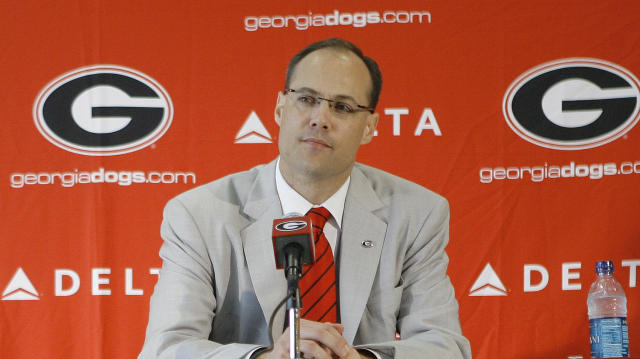
Mark Fox was introduced as Georgia’s newest men’s basketball coach at a Friday morning press conference, and my impressions were favorable. He spoke well of the opportunity, knew what made Georgia an attractive option to him as a coach and to prospective recruits, and looked at ease in his first appearance in Athens. The hard work starts now, but it was a good first impression. The key points:
Contract. Fox’s contract is a 6-year deal worth $1.3 million per year.
Staff. Fox will being at least one assistant, Kwanza Johnson. It’s expected that Associate Head Coach David Carter will be promoted to replace Fox at Nevada.
Fox was clear that he places a high priority on hiring an assistant familiar with the area. It’s an obvious need, and he didn’t shy away from it. Fox’s contract is about a full million dollars less than the rumored deal put together for Mike Anderson. Fox might or might not have access to all of that extra cash to build his staff, but at least we know that the funds are there to put some very attractive offers out to some impact assistants.
Friday April 3, 2009
I have to be honest…as much as I convinced myself that yesterday’s
story was a meaningless plant, part of me was wondering how I’d come to
terms with Frank Haith as Georgia’s next coach. No matter how I spun it, the
thought was depressing.
Fortunately we don’t have to worry about making such a mistake. Mark
Fox is the guy, and I have
to agree with Paul here: I like it. He’s maintained a strong
mid-major program, recruited well at that level, won NCAA Tournament games,
and has beaten several major programs along the way.
Fox is hardly a no-name. He might be unfamiliar in these parts because, let’s
face it, who in this part of the country knows anything about West Coast hoops
much beyond UCLA and Gonzaga? But he’s been a candidate before for other major
positions (Nebraska,
for example), and he was even mentioned
as a possible candidate at Arizona this week. We can’t let our own provincialism
keep us from recognizing a decent coach.
The main knock against Fox seems to be recruiting – specifically, will a guy
whose roots and experience don’t go much further east than Kansas be able to
hit the ground running in the talent-rich state of Georgia? This is a valid
concern since missing out on key in-state prospects has been a problem plaguing
Georgia basketball for decades. Still, I think the concern might be overblown
to some extent. Why?
- First, Fox – as an assistant and head coach – has been able to attract quality,
even NBA-level, talent from several states to a mid-major program in Reno,
Nevada. The conference, location, resources, and local talent base are all
comparative advantages for Georgia. It will take time getting up to speed
and making the connections in the area, but the skills are there.
- Second, and this is a key point many are overlooking, is that Fox won’t
be the only one recruiting. Fox likely will not command the $2+ million dangled
in front of Mike Anderson, so there should be more than enough room in the
budget to bring on at least one proven assistant with experience and connections
in this area. It couldn’t hurt to call someone
like this.
Rough edges
Fox’s reputation unfortunately includes incidents where his temper has gotten
the better of him.
It’s true that Fox’s Nevada team beat Anthony Grant and VCU head-to-head just
a few months ago. It’s also true that Fox
missed the last eight minutes of the game after getting tossed with his
team down 60-51.
No big deal, coaches get tossed all the time. But more disturbing was a
March 2007 incident in which Fox "yelled profanities and appeared ready
to use force toward a police officer and game officials" after losing in
the WAC tournament. Fox admitted fault and added that "I’ve got to realize
when the game ends, it ends."
If you’re winning and your coach is intense, emotional, and confrontational,
fans love it. He’s a fighter and driven out of his mind to win. If you’re losing,
the same coach is out of control, reckless, and an embarrassment. If the coach
is Bobby Knight, he’s all of those things. Fox doesn’t have Knight’s win total
yet, and both Georgia and the SEC won’t have much tolerance for an explosive
coach who can’t control himself. With Damon Evans’ vision of a "CEO
of basketball", those rough edges are going to have to get polished
up quickly.
The Process
With all but the introduction left, people are beginning to look back at the
process and ask did Damon Evans accomplish what he set out to do?
I keep seeing
the claim that Damon Evans vowed to "make a splash" with this
hire. I’ve read Hale’s
interview with Evans. I’ve seen what Evans had
to say to Jeff Schultz. I definitely see evidence of Evans’ lofty goals
for the program ("I want to win championships," he said. "I
think we have to awake the sleeping giant."). I also see some specific
things he was looking for in this coach.
Evans
said he wants a coach who has experience running a major program. He wants
someone who understands how athletics and academics work together. Finally,
he wants someone "who can get out there and recruit players and bring
some talent to the university."
So
I’m looking for a CEO of basketball, someone who possesses outstanding
leadership, understands the role of athletics as it relates to being at an
institution of higher learning the academic component someone who is going
to help our young men grow and develop athletically and academically, and
someone who has a great knowledge of basketball, someone who can recruit players
to this institution and, just as important, someone who can gauge the Bulldog
Nation.
What I don’t see is evidence of Evans promising to make a flashy, big-name
hire that makes a splash. If you can point me to it, I’d appreciate it because
it seems as if everyone but me heard him say it. Of course such a hire would
have been nice. A big, recognizable name would have been a clear success (as
far as the process goes), but the lack of one doesn’t necessarily mean failure.
If you go by what Evans actually said, we’re not that far away. One can quibble
whether Fox has "experience running a major program," but you’d have
that same discussion with someone like Anthony Grant.
I have a real problem with lumping Grant into the "big name" category
which includes others like Capel and Anderson. Grant, though successful within
his conference and respected as a recruiter for his job at Florida, is no more
accomplished as a head coach (and perhaps even less so) than Fox. Grant’s advantage
is his aforementioned experience recruiting in the SEC which is no small thing
but also not enough to call him an obvious missed opportunity.
Regardless, Fox won’t be able to escape comparisons to Grant as long as both
coach in the SEC. Fox’s performance, recruiting, and accomplishments will be
measured out of the gate against Grant. Georgia’s not exactly short on rivals,
but now even the Alabama game is going to carry a little extra significance.
Did Evans and those involved with the search aim high and miss? Sure. There
was nothing wrong with that, and, given the outcome, it didn’t hurt to try.
The commitment to the program is there, and we ended up with a quality coach.
Expectations
While I agree with Evans’ goals for the program, I have my own expectations
for Fox and the program. Some are longer-term, some are not. With the talent
in place and only a short recruiting period left before next season, it could
be another long year. I realize that. There are opportunities though for some
immediate results. We eventually want Georgia men’s basketball to be a championship-level
program and perform at the level of many other Georgia programs, but these are
some milestones along the way.
- Assemble a staff that can recruit the state of Georgia out of the gate.
With major holes at both shooting guard and small forward/wing, filling those
holes is job #1 just to be competitive next season.
- Beat Tech. Let’s not forget the most important thing for a coach of any
sport at Georgia. The Dawgs haven’t lost to Tech in Athens since the series
went home-and-home in 1995, and I don’t plan on that changing next season.
- Embrace Georgia. Dennis Felton, right or wrong, was criticized early on
for being flippant with and even standoffish to the fan base. Silly things
like the lack of red in his wardrobe were pointed out. While these were trivial
things (and the death of Kevin Brophy cemented him as part of the Georgia
family), they served as footholds for future complaints and negativity as
Felton struggled to build his program.
- Improve performance on the road. Paul’s done extensive
work showing just how bad Dennis Felton’s road record was. He also points
out a glimmer of hoepe by highlighting
some of Fox’s bigger road wins at Nevada. The ability to win on the road
is the mark of a successful and disciplined program that doesn’t need its
own crowd in order to be motivated for a game.
- Drastically reduce attrition. You can’t build a program by starting over
every few years. As important as recruiting is, keeping the student-athletes
in school, out of trouble, and on track to graduating is just as important.
- Sustain a winning SEC record. The competition might have increased with
the addition of Calipari and Grant to the league, but the SEC still offers
plenty of opportunities to win games. Look…we’re not even asking for a conference
title (yet). Just get us above .500 in the league and keep us there.
- Finally…make the NCAA selection show must-see TV for Georgia fans.
Thursday April 2, 2009
Chip Towers is reporting in the AJC that Damon Evans will meet with Clemson’s Oliver Purnell and Miami’s Frank Haith in Detroit.
That does not mean we plan to offer the job to either.
This is the kind of thing I was talking about the other day. Georgia and Evans have no motive to leak anything about their candidates or even those with whom they’d like to chat up for advice. Evans wasn’t even a source for anything having to do with Mike Anderson. Purnell is in the process of negotiating an increase with Clemson, and Haith is just trying to defend himself after failing to make the NCAA Tournament. Each has a motive for appearing to be a candidate for other jobs.
As Roger Clarkson of the ABH reminds us, the Final Four is always the annual meeting of the National Association of Basketball Coaches. Just about every coach in the nation will be there. Evans is likely to speak with dozens of coaches in Detroit, not just Purnell and Haith. He’s not going to offer the job to all of them. And not every one of them are going to leak the fact that they’re meeting with Evans to the press.
Just keep in mind that “talking with”, especially at an event like this, is not necessarily related to “interview”, “candidate”, or “offer forthcoming.”
If you wonder why Frank Haith’s name keeps coming up (a coach who has never finished better than .500 in his conference), consider that he shares an agent with none other than Dennis Felton. Joseph “Ricky” Lefft also represents Tubby Smith.
|

 Landers adds 3 to an already-strong class
 Comments
 Dawg Media
 RSS 2.0