Ward recently agreed to a contract extension that not only sets the table for him to finish his career as a Steeler; it also helps the team create some salary cap room to sign other key players. He’ll make less per season to help the team, but the difference will be made up with a signing bonus.
Ward is on track to eclipse 10,000 career receiving yards and 75 career touchdown receptions in the 2009 season.
And even thinking about the end of Ward’s NFL career makes me officially old.
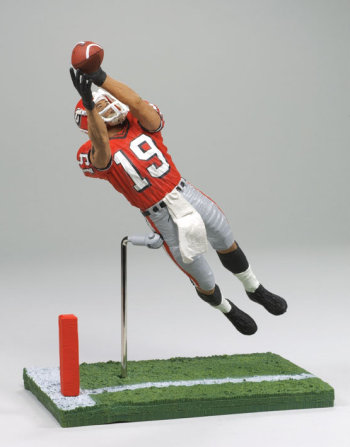
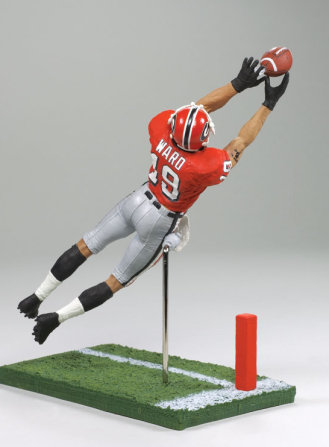
McFarlane Toys is known for their incredibly detailed action figures. They have action figures for everything from The Godfather to Elvis.
They also have an extensive catalog of professional sports action figures, and they’ve just announced a line of six-inch figures portraying only six NFL stars in their college uniforms. Hines Ward is one of the six.
Going by the promo pictures (a couple are below…visit the site for more), it’s a winner and is pretty damn accurate – right down to the infamous black stripe. Though to be complete, they’d have to have another figure of Ward throwing a pass and still another running the ball. The figures should be available around August. Pricing isn’t set yet, but their other sports figures go for about $10.
Georgia was thin in the backcourt to begin with, and offseason attrition hasn’t helped. The first signee for new coach Mark Fox is at least a start towards shoring up the guard position.
UGASports.com and Jerry Meyer of Rivals.com are reporting that Vincent Williams, a PG from Homestead (Fla.) South Dade high school, has committed to Georgia and signed his letter of intent. He’s a scorer (26 PPG / 6 APG) who should at least be able to provide decent depth behind likely starters Dustin Ware and DeMario Mayfield.
Williams didn’t attract a ton of attention until he earned his qualifying test scores, and then teams from Oklahoma to Florida to N.C. State to Kentucky began to show interest. Georgia made a big push with an Easter weekend visit to south Florida. The Bulldogs were one of the first big-name programs to offer Williams, and he jumped on it.
Elsewhere on the hoops front, JUCO combo guard Derrio Green will sign with Charlotte. Green and Williams were being recruited for virtually the same role, so 1 out of 2 isn’t bad in this case.
It’s Georgia’s best draft since the group that left with the 2005 SEC title.
Dannell Ellerbe, Brannan Southerland, Kenneth Harris, and Demiko Goodman all
signed
free agent deals. As they say every year as the draft closes, it’s often
better not to be drafted in the later rounds and instead pursue a free
agent deal. A late-round draft pick isn’t assured a spot on the roster, and
a free agent can shop around to find a situation in which he might be a better
fit.
Did you know the Jets traded up for Mark Sanchez?
Although he was the first pick, it seems as if there is less pressure
on Matthew Stafford than on Mark Sanchez. Not much is expected of the Lions
any time soon, and when you’re coming from 0-16 even improving to St. Louis
Rams-bad is a positive step. Sanchez on the other hand is looked to as the solution
for a team on the cusp of a playoff berth. The nation’s most intense media market
will have its spotlight on him from the start. I don’t suggest that he’ll flop
– he’s a very impressive quarterback and has succeeded at one of college football’s
most scrutinized programs. But the situation for Sanchez is very much sink-or-swim
right out of the gate. If Sanchez gets it done in that environment, he’ll be
a legend.
I can’t say that I’m excited about the situation facing any of Georgia’s top
three draft picks. Stafford’s enormous challenge in Detroit is well-documented.
Moreno heads into a dysfunctional situation in Denver with a shaky quarterback
and a glut of running backs. Massaquoi also won’t have a strong quarterback
in Cleveland, and we’ll have to see what impact a new coach has on the dismal
culture of the Browns. Of the three, it seems as if Moreno is in the position
to have the quickest impact on a winning team.
It’s inevitable with five of the first hundred picks that some have asked this
weekend if all of this talent was essentially wasted last season. I don’t buy
into that. The guys headed to the NFL are just a small percentage of the team.
Most top ten teams had some high draft picks. The difference is often in the
quality of the rest of the roster. You might be set with NFL talent at certain
positions, but they can’t overcome holes and weaknesses at other positions.
One area that is worth talking about is the defensive line. The injury to Jeff
Owens and the never-healthy defensive end position were frequently-cited reasons
why Georgia’s pass rush was ineffective in 2007. Yet two of its top contributors
were drafted, and Geno Atkins is one of the top returning linemen in the SEC.
A pass rushing specialist seems to have been the only missing piece (albeit
a significant one). The decision to dip into the junior college pool in 2007
turned out to be very wise. I can’t imagine the 2008 line after the injuries
hit without the contributions of Irvin and Wynn. That’s the risk with JUCOs
though – by the time they start making the kind of contributions you hoped for
when they signed, they’re gone. A good player like Jarius Wynn wasn’t even a
regular starter until the Tennessee game midway through the year, and now he
has an NFL contract.
This can’t be true, can it? Georgia’s last linebacker drafted was Odell Thurman?
Most of us were expecting Ellerbe to go at some point, and Tony Taylor found
a spot in Atlanta as a free agent, so it’s not as if there has been a complete
lack of talent at the position. It’s also a near-certainty that Rennie Curran
will be drafted when his days in Athens are over. Still, after the linebackers
that came out of Georgia in the first half of this decade, it’s a noteworthy
drought. The safety position hasn’t been much better – Greg Blue was the most
recent draftee back there.
Through 2004 Georgia had only two players – John Rauch and Lindsay Scott –
ever drafted as a quarterback or receiver in the draft’s first two rounds. Reggie
Brown was a second round pick in 2005, and of course Stafford and Massaquoi
were added to the total this weekend. It’s not crazy to project A.J. Green as
a possible high-round draft pick as soon as 2011, and top quarterbacking and
receiving talent continues to sign with Georgia. Mark Richt’s role in the evolution
of Georgia’s passing game can’t be more clear.
The SEC once again led the way with 37 draft picks. The ACC (33) and Pac 10
(32) were the only other conference with more than 30 players drafted. Mississippi
State was the only SEC team without at least one player drafted.
…and did anyone happen to catch what the Jets did in the first round? I couldn’t
find anything on it.
“This is an overwhelming tribute, and I am honored to be selected to this group of outstanding and accomplished professionals,†said Munson. “To be elected to any Hall of Fame is quite humbling, but to be chosen to the National Sportscasters and Sportswriters Hall of Fame is the ultimate honor.â€
Even with the future of print journalism in the air, the University of Georgia’s
Grady College of Journalism and Mass Communication is proposing a new program
focusing
on a very specific discipline.
The Grady College of Journalism and Mass Communication is proposing the development
of a sports writing program, marrying the University’s outstanding athletic
program with the nationally-recognized journalism school. … The program
will teach students how to cover sports for a range of mediums, including
television, newspapers and the Internet.
Citing huge student demand, Grady professor Conrad Fink says that the program
would likely start small as a "certificate program."
Details are a bit sketchy. Would the focus be on basic journalism enhanced
by courses dealing with specific sports? Would students learning from and working
with athletic department resources still be able to practice their skills on
the Bulldog program independently?
Closing the loop on an earlier post from today…
Mark Richt said at Wednesday evening’s Roswell Bulldog Club meeting that a waiver has been requested from the NCAA which would clear Richt to attend the high school graduation of incoming offensive lineman Chris Burnette if Burnette finishes as his class’s valedictorian.
In bowl subdivision football, the head coach shall not engage in off-campus recruiting activities, participate in an off-campus coaching clinic, visit a prospective student-athlete’s educational institution for any reason, or meet with a prospective student-athlete’s coach at an off-campus location during the April 15 through May 31 evaluation period.
Of course Burnette’s status as valedictorian won’t be cemented until the end of the academic year, so the need for the waiver is still up in the air. Richt did not comment further about the status of the waiver request or its likelihood of being granted, but the process has at least been started.
Football’s rubber chicken circuit gets underway this evening with the first of nine stops on the Bulldog Club Road Tour. Roswell will host the first meeting at the Atlanta Athletic Club in John’s Creek (program begins at 7:00, free admission), and the tour headlined by football coach Mark Richt will continue through April and May before the final Atlanta meeting in July.
The bad news is that Coach Fox won’t be attending the Roswell meeting. I was personally looking forward to my first chance to meet the new coach, but there’s something much more important on his plate. The spring signing period is still ongoing, and the current contact period runs through today. The good news is that Fox is scheduled to attend the rest of the Road Tour stops starting with tomorrow night’s visit to Greenville, and there will be plenty of other opportunities for fans interested in meeting the new basketball coach.
You can’t blame Fox for making the most of every hour allowed by the recruiting calendar. He was already under the gun to find some late additions to the 2009 class, and the release of Daniel Miller opens up another scholarship.
One of AJC recruiting writer Michael Carvell’s final online posts last week
was
a suggestion for Mark Richt to thumb his nose at an NCAA bylaw that would
force Richt to miss the graduation ceremony of incoming freshman lineman and
Troup County valedictorian Chris Burnette. The story of Richt and his promise
to attend Burnette’s graduation isn’t new in these parts, but Carvell’s recommendation
that Richt should accept a minor violation and go anyway breathed a little bit
of new life into the story.
David Pickle, the NCAA’s managing director of publishing, responds
to Carvell’s suggestion and provides the NCAA’s perspective as well as clarification
on the rules and processes involved. Once you get past the insitutional defensiveness,
the response makes several key points:
The decision for Richt not to attend was not an edict handed down from the
NCAA; it was an (apparently correct) application of the rules by the UGA compliance
office.
As Carvell noted, Georgia could ask the NCAA for a waiver. They had not
asked for a waiver at the time of Carvell’s post.
The NCAA isn’t completely rigid when it comes to the application of its
rules. To quote, "One of the hallmarks of Myles Brand’s administration
as NCAA president has been to provide flexibility to schools when the circumstances
of a situation appear to fall outside of the intended scope of a rule."
At least in the opinion of the author, it would be entirely "appropriate"
for a waiver to be granted in this case.
So it’s not exactly correct that an NCAA bylaw is forcing Richt to break his
promise. The ball seems to be in Georgia’s court. A waiver would allow Richt
to attend the graduation, and it would be with the NCAA’s blessing instead of
in defiance of the bylaws. Academics gets its time in the spotlight, there’s
no violation, and everyone’s happy. A waiver at least deserves the effort.
On one hand, I wish nothing but the best for genuinely good people like Michael Carvell and Chip Towers who have been affected by the recent changes at the AJC. Carvell didn’t just do a solid job on the competitive recruiting beat; he also reached out to the blogs and in a short time developed a go-to relationship with those in the link-peddling business. Towers, in addition to his beat work, made the most of his online presence and was also generous with the links. We’ll always have a contentious relationship with the columnists – that’s their job – but these two guys doing the reporting work were at the top of their game.
So I echo David Hale’s comments when it comes to those two. Change isn’t always bad – Hale himself is an example of that – but I’ve got to agree that the shakeup on the Georgia beat makes very little sense.
On the other hand, there’s this. The AJC’s Mike Morris recycles a week-old story from Chicago about Tony Cole, a basketball player whose 16 games in a Georgia uniform proved to be some of the costliest in program history. There are precious few new details added to an April 10th story from the Chicago Sun-Times, but that’s as good a reason as any to go through the entire litany of Harrick, assault charges, and – of course – academic fraud.
Even now Cole proves to be the cockroach that survives the nuclear war. Two coaches and seven years later, Georgia just can’t break its association with Cole. Only in the eyes of an AJC headline writer can a guy who played in 16 games, started 3, and averaged 5.6 PPG be considered an “Ex-UGA hoops star.”
It’s obviously a loaded question. So many people in so many sports over so
many years. To even begin to make a claim like that, you’d have to consider
her place as…
The best Georgia gymnast. You’re talking about the sport’s
most dominant program over the last 20 years. The list of All-Americans, national
champions, and former Olympians is miles long. Still, it only took one year
for her to match the Georgia record of three individual national titles in
one year. She broke that record this year with four titles.
The best collegiate gymnast. Georgia might have the best
program, but there have been incredible individual performers at many other
programs. Kentucky’s Jenny Hansen was named the NCAA’s
top gymnast over the past 25 years in 2006 after winning eight individual
titles during her career. Kupets matched and then topped that mark this weekend
with nine career individual titles and also matched Hansen’s three career
all-around titles. Without her season-ending injury in 2008, Kupets might
have walked away with double-digit individual national titles and as the sport’s
first four-time all-around champion.
The best Georgia athlete in any sport. Names like Walker
and Wilkins come to mind when you think about Bulldog greats, but you have
to dig deeper when you’re looking for the most accomplished Bulldog athletes.
There are swimmers like Kristy Kowal and Courtney Shealy. Few had the impact
that Vicki Goetze had on Georgia golf. John Isner is just the most recent
legend cranked out by Georgia tennis. Teresa Edwards is one of the most recognized women’s basketball players in the world.
Still, when you look at team and individual accomplishments, it’s hard to come
up with a better choice than Kupets. She’s done all she can do. Even more, she
came back from a Achilles tear as a junior to have her best season as a senior.
When it comes to the best college athlete ever, the question becomes muddier.
It’s hard to top someone like Cael
Sanderson who never lost a wrestling match in college. There have also been
dominant individuals in team sports – Mia Hamm was a standout on a team of standouts
that won four national titles. For all I know, there might be some Stanford
water polo player who was better. There’s no question though that Kupets at
least belongs in the discussion.
When the Top 10 baseball team taking 2 of 3 from Arkansas to move into sole
possession of first place in the SEC is considered one of the lesser stories
from a weekend of Bulldog athletics, you know it was a good few days.
It was just another weekend for Georgia athletics. In case you missed a couple
of them, here are the highlights:
National championship in gymnastics: the 5th consecutive national title
for the program and 10th overall
National championship in equestrian: the 2nd consecutive national title
for the program and 4th overall in the 5-year history of the program
National all-around gymnastics championship for Courtney Kupets as well
as three out of four individual event titles
SEC championship in men’s golf
SEC championship in women’s tennis
SEC individual championship for women’s golfer Marta Silva Zamora
#6-ranked softball team swept Auburn
Baseball opened up a two-game SEC lead with a series win over Arkansas
After all that, I still have the feeling I’m missing something. Over the past
decade Georgia athletics have been at their strongest in spring sports, but
this is shaping up to be one of the stronger years.
With the economy and a recently-implemented ticket priority system to blame, South Carolina “is not likely to sell all of its football season tickets” for the 2009 season. It would be the first time since Lou Holtz arrived a decade ago that the Gamecocks have not sold out of their approximately 57,000 season tickets.
In response, the program has retooled its advertising budget to promote season tickets, and they are also targeting younger alumni and loyal fans who didn’t have access to season tickets before.
For years whenever the topic of the Internet and forms of communication more
advanced than a rotary phone came up, coaches frequently reverted to playing
the dumb jock.
Gawrsh, I cain’t even program a VCR…what’s this"e-mail"
thing ?
To be fair, this kind of response was mostly a defense mechanism and usually
not exactly honest. If a coach admitted he surfed the message boards or read
e-mail, he might be pressured to validate and respond to some of the ridiculous
criticism and rumors that float out here. Every message board hero would think
he had a direct line to the ol’ coach. Most coaches were at least briefed about
the online chatter.
So, yeah, it’s kind of strange (and amusing) to see the coaches
follow each other into the world of tweets and pokes. A decade ago these
guys would be cracking jokes about not being able to turn a computer on.
Of course in reality many of these Twitter pages and Facebook accounts are
manned by some intern or other ghostwriter. I don’t know and don’t really care
if Mark Richt even knows how to sign on to Twitter or post something on
his blog. The change is that coaches are at least starting to become more
open about lending their names if not outright participating in the online world.
The transition of cutting-edge technology and social networks from something
used by fans on the fringe to a strategic opportunity to build the program is
just about complete.
And why not? The costs are negligable. It’s where your recruits and an increasing
number of your fans with disposable income are. It’s to the point now that if
your program and coach doesn’t have some sort of online presence beyond the
cookie-cutter official Web site, you’re at a competitive disadvantage.
Now it’s time for the NCAA and the sideline to catch up. The New
York Times had a great piece last fall outlining the organization’s resistance
to certain technologies, especially those which might give a team an advantage
during the game. Laptops upstairs in the box are verboten. Texting with prospects
is outlawed. The reasoning ranged from the absurd…
"(A game is) like going into a test," said Ty Halpin, the N.C.A.A.’s
associate director of playing rules administration. We don’t let you bring
in a computer and an iPod when you take an exam."
…to the practical…
There is a concern that an onslaught of technology might give richer colleges
a competitive advantage over schools that cannot afford the latest equipment,
further driving a wedge between the haves and have-nots in the sport.
I definitely understand that concern. The software and hardware for instant
video analysis and real-time collaboration isn’t cheap. At the same time, an
initial investment in technology can give smaller programs tools and expert
systems which might make their lower-paid and less-experienced coaches more
effective and competitive against the big programs. It’s not like the big programs
don’t already leverage technology to their own advantage; as the Times
points out, most big programs have advanced video systems that help them with
preparation. Teams can bring to the box unlimited analysis, charts, and scouting
on paper (something that’s also typically not allowed in an exam, Mr. Halpin),
but they can’t bring the same information in on a laptop.
Mike Bellotti told the Times he planned to raise the issue in front
of the rules committee, but it seems as if no action was taken during the committee’s
February meeting.
How long will it be before a tablet PC replaces the clipboard on our college
football and basketball sidelines?
Matthew Stafford was on Late Night with Jimmy Fallon, and he got to do a little skeet shooting with a football. (And prepare yourself to see Stafford in a suit.)

 Speaking of Hines Ward…

 Comments
 Dawg Media
 RSS 2.0