With the recent announcement of three verbal commitments from the Jacksonville area, Georgia’s recruiting success in the state of Florida is getting some notice. They’re not just finding recruiting success in Jacksonville; the incoming Bulldog class contains three high-profile prospects from further down the peninsula, and two more from the Orlando area have pledged to sign in 2010.
Is it the Georgia-Florida game’s proximity to Jacksonville? Proponents of keeping the game in Jacksonville (of which I am one) sometimes claim that a game in the area helps the program stay on the mind of prospects and high schools in south Georgia and north Florida. I don’t think that’s what’s going on here. As the Times-Union points out, these three recent commitments are more than Georgia’s landed from the Jacksonville area in seven years (Chapas and Evans). Besides, it’s not as if the WLOCP has been the best advertisement for Georgia football lately.
There’s a simpler explanation.
“You look at Georgia’s staff, and they have strong connections here,” Sullivan said. “Assistant coach John Lilly was at Florida State for 13 years, so he’s recruited here for a long time. Coach Stacy Searels recruited this area when he was at Auburn. Their recruiting coordinator, Rodney Gardner, also has strong ties here.”
That’s just the start. Defensive coordinator Willie Martinez grew up in, played college football in, and coached in the state. Even John Jancek has coaching experience in Florida and was just this year offered the chance to join the Univ. of South Florida staff. Lilly wasn’t only an assistant at FSU; he also served as recruiting coordinator with impressive results.
Under Lilly’s direction, four of FSU’s recruiting classes between 2002 and 2007 were ranked in the top four in the nation. The Seminoles’ 2001 and 2005 classes were ranked number one nationally in some polls.
There have also been shifts in the college football landscape. Those of us with a little gray in our hair likely have a much different perspective about the in-state choices for the Florida prospects. They weren’t alive during Miami’s glory years in the 1980s. Current recruits were in the second grade when Steve Spurrier won his last SEC title and FSU last finished in the AP top 10. Urban Meyer has guaranteed Florida’s relevance for the near future, but what about the other programs?
Since the arrival of Mark Richt (and the third grade for current prospects), Georgia has won 10 more games than Miami and 15 more games than FSU. Since these recruits entered high school in the fall of 2006, FSU has gone just 23-16. Miami is just 19-19. Georgia is 30-9. South Florida, Wake Forest, and even troubled programs like Michigan, Tennessee, and Auburn have won more games than FSU and Miami during the high school careers of the current class of rising high school seniors. Certainly most of these recruits aren’t without a sense of history, and they’re not oblivious to the legacies of success at FSU and Miami, but those schools’ relative performance during these formative years has opened the door not only for in-state competition at Florida but also for schools like Georgia.
It’s natural that some will question whether too much emphasis is being placed on out-of-state prospects especially after so much talk about “closing the borders” earlier in Richt’s career. But offering top out-of-state targets early is a pretty common tactic, and sometimes you have to go where the talent is if a certain position is a little soft in the home state. Both Florida and Georgia currently have five out-of-state commitments (though Florida has six more pledges overall). Make no mistake – Georgia’s top in-state prospects know who they are and are getting plenty of attention from the staff.
“This is a proven broadcast team,†said Evans. “Scott is a Bulldog calling Georgia Bulldog games. He’s been one of our radio personalities going on 20 years and has done an exceptional job with all the Bulldog sports he has broadcast over a long period of time. Eric gives us not only a former Bulldog player but the special analysis that a former quarterback can bring to the table.”
I think this was the best possible outcome. Short of someone like Brad Nessler, I wasn’t too keen on someone with few ties to the Dawgs coming into the broadcast booth. People might have stylistic issues with Howard, but he’s a comfortable and familiar voice to guide us through Saturdays. Zeier’s taken to the role of analyst quickly and definitely adds something to the broadcast that had been missing.
Evans’ announcement still leaves some questions unanswered. The personnel for the pregame and postgame shows, sideline reporting, and crews for other sports are still unannounced.
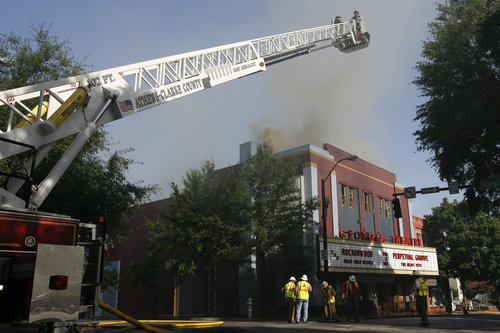
There has been a major fire at the landmark Georgia Theatre in Athens this morning. No UGA alum or even casual acquaintance of the city has to be told of the punch in the stomach that comes with that news. Too many concerts, crush parties, and games watched there to recount them all, but my highlight had to be seeing Wynton Marsalis many years ago. The night ended with a New Orleans-style parade out the door – one of those things that can only happen when you mix a legendary artist with the wide-eyed joy of a college town crowd soaking it all in, and it happened all the time at the Georgia Theatre.
Hopefully it can rebuilt soon, though the roof has collapsed and the damage inside is surely devastating. Selfishly, I can’t (and don’t want to) imagine what a football fall would be like without the Theatre.
Make no mistake, ISP is going to make their money back somehow. If you haven’t become numb to the barrage of advertising at Sanford Stadium yet, you won’t like what’s ahead. At least with Cingular becoming AT&T, there should be less orange and blue around. The additional time (possibly 9+ hours of total broadcast time on a football game day) added to the pregame and postgame shows will surely be advertising-heavy. I’d also expect the enhancements to online and mobile content to come with a price tag. If they can make it more reliable than G-Xtra, it might be worth it.
For many fans, the most interesting development to watch will be this one:
With the ISP deal in place, Georgia expects to announce its radio broadcast teams for the coming season soon.
Scott Howard called the football and men’s basketball play-by-play last season. Eric Zeier provided football color commentary.
“Certainly we look forward to working with the stable of folks that have been working with us before and potentially adding others into the fold,” Thomas said. “You will continue to see a lot of those that you’ve seen involved in the broadcast.”
The last line gives us a bit of hope, but I’m a little apprehensive at the direction this could take. Howard and Zeier were never going to be a permanent arrangement, but I’d be just fine leaving that intact. No one is going to replace Munson, but Howard is at least competent and, most important (to me at least), a homer and comfortable bit of continuity from the Munson days. I dread the day when some polished outsider is brought in who is bland and detatched or, worse, from the cheeseball Mick Huber mold. There are so many ways it could go bad and so many people who would be worse for the job than Scott Howard. It could have a silver lining – the broadcast team could end up being bad enough to force fans to leave the headphones at home for once and actually get into the game.
Of course there’s more to it than the guys in the booth. Sideline reporters and pregame and postgame hosts will have to be sorted out, so we’ll have to see what the announcement brings and where the changes will be made. Basketball and baseball could also see a shakeup – will Jeff Dantzler still be a part of the picture?
I also wonder about Hondo and the guys managing the broadcast network for WSB. WSB will still be the Atlanta broadcast affiliate, but the network is managed by ISP now instead of Cox/WSB. Hopefully they’ll still have a role in the new arrangement after the great work they’ve done.
Atlanta and Nashville were the big winners when the SEC announced upcoming sites for the men’s and women’s basketball tournaments. Through 2014, the 2012 men’s tournament is the only event that won’t take place in the Nashville or Atlanta areas. It’s great news for Georgia fans – Atlanta and Duluth are obviously convenient, and Nashville is a 4-hour drive and an enjoyable place to spend a March weekend. If Mark Fox can build a competitive team, traveling to follow the Dawgs into the first stages of the postseason isn’t going to break the bank.
The Georgia Dome was the (initial) site of the legendary 2008 SEC men’s tournament, and the conference will tempt fate (and weather) by bringing the tournament back in 2011 and 2014.
The news is even better for Lady Dogs fans: the women’s SEC Tournament will return to Duluth’s Arena at Gwinnett Center for 2010, 2013, and 2014. Though the SEC is typically the strongest women’s basketball conference, Atlanta is the only SEC-area city with a WNBA franchise. The SEC has to hope that an increased awareness of women’s basketball in Atlanta (not to mention the short drive from Tennessee) will help to fill the seats.
I’m not exactly sure what constitutes “football revenue”. Bowl money surely counts. Hartman Fund donations were less than $30 million, and ticket sales can’t account for more than a couple million dollars per game. Is the SEC distribution figured in? It would be interesting to see the breakdown…I’ll have to check the Hartman Fund annual report.
Though football revenue is among the best in the nation, overall revenue is “only” 13th among all programs. Football revenue accounts for 80% of what the Athletic Association brings in. Football at a school like Georgia is always going to lead the way, but it also demonstrates the problems with and potential for the other men’s sports.
Basketball is a big moneymaker for a lot of schools, but Georgia hasn’t been in a position to do much with its hoops programs lately. Demand is barely palpable, the Coliseum doesn’t offer much in the way of generating revenue (suites, sponsorship, etc.), and no postseason money is coming in. Hopefully Mark Fox will begin to change all of that; it’s certainly an expectation that’s implied by any major college coaching job. Even baseball has potential. The product is quality, but the media deal is negligible (a single local AM station), and the facility is among the smallest in the conference and becoming more outdated by the year.
It’s great that football is doing so well, but any business person knows the dangers of relying too much on a single product, vendor, or customer. In addition to increasing revenue from the other sports that have been poor performers, the Athletic Association is looking at other ways to bring in more cash.
Georgia is nearing a lucrative deal with North Carolina-based ISP Sports, which currently holds the school’s marketing and sponsorship rights. Contracts have been drawn up for the extended rights deal. The deal would include radio, TV, Internet and digital content.
Under the deal with ISP, the pregame show would increase to four hours in length, and, including the game and postgame show, “the broadcast programming window would grow to at least nine hours.” That might sound like great news to those who tune in to the pregame show, but that deal’s going to have to be paid for somehow. If you think the current broadcasts and Sanford Stadium experience have become commercialized, ISP has a reputation for making that seem like an interruption-free PBS broadcast by comparison.
Congratulations to Georgia sophomore basketball player Trey Thompkins who was one of 17 players invited to the 2009 USA U19 National Team Trials. Following the trials this week, the group will be pared down to a roster of 12 for the 2009 FIBA U19 World Championship in New Zealand this July.
We should also learn in the next few weeks whether Ashley Houts will make the U.S. National team headed to the World University Games in Serbia. International experience and training with some of the top college players in the nation is invaluable, and we hope that both of these Georgia stars will get that opportunity.
cocknfire over at Team Speed Kills has a look at the 2002 Sugar Bowl – an improbable matchup that turned into a high-scoring track meet. cocknfire’s post focuses on the Big Ten / SEC Sugar Bowl, but that 2001 SEC championship game he mentions might have been one of the bigger turning points in the conference this decade. It was a huge stamp of legitimacy for Nick Saban’s LSU program and was also the last time a Phil Fulmer Tennessee team would play a part in the national title picture.
It’s hard to imagine Nick Saban’s LSU program “on the brink”, but that’s where they were midway through 2001 after a loss to Ole Miss. They recovered (read the link at TSK for more), got back on track with an impressive upset win over Alabama, and went on a run to win their last six games of the season. Within the span of about six weeks, Saban went from 4-3 and still unproven as an SEC coach to the head coach of the SEC champions.
Tennessee, despite the upset home loss to Georgia early in October, had risen to #2 in the nation. They had survived trips to Tuscaloosa, South Bend, and Gainesville. The game with Florida, delayed until the end of the season by the 9/11 terrorist attacks, was a thrilling 34-32 win that wasn’t just a showdown for the SEC East title; the winner would also become the presumptive favorite to earn the #2 spot in the BCS rankings. That game in itself was a bit of a turning point – instead of playing for another SEC and national title, Steve Spurrier’s Gators had to settle for an at-large bid to the Orange Bowl. Spurrier announced his decision to leave for the NFL a few months later, and it was the beginning of a few lean years for Florida fans.
After surviving those road tests and Spurrier’s last stand, a win over #20 LSU was supposed to be a formality for Tennessee, and Vol fans were making plans to head to Pasadena for a Rose Bowl clash with #1 Miami.
The 2001 SEC championship game opened with a first quarter LSU touchdown, but the Vols exploded for 17 points in the second quarter to take a 17-10 lead into the locker room. LSU inched closer with a pair of third quarter field goals but still trailed by a point entering the final period. Freshman quarterback Matt Mauck’s second rushing touchdown of the day put the Tigers up for good less than a minute into the fourth quarter following a critical Travis Stephens fumble. Domanick Davis sealed the win a one-yard touchdown run with just over two minutes left after a long six-minute drive.
The story of the game, other than Mauck’s just-good-enough relief of injured starter Rohan Davey, was LSU holding the SEC’s top rusher, Travis Stephens, to just 37 yards on the ground. The Vols did some damage through the air, but the inability to convert on the ground cost them when they missed out on a chance to answer LSU’s go-ahead score. Tennessee drove down the field and set up a 1st-and-goal at the LSU 4. No longer trusting the ground game, Tennessee’s coaches called three passes, and quarterback Casey Clausen threw three straight incompletions. Instead of tying the game with a touchdown, the Vols had to settle for a short field goal and still trailed.
The game remains the only instance out of eight opportunities since 1992 where an SEC team in line to play for the national title lost the SEC championship game. Since that pivotal game, LSU went on to win three more SEC West titles, two more SEC championships, and two national titles. They even survived a coaching change along the way. Tennessee managed to return to the SEC championship game in 2004 and 2007, but they were clear underdogs each time and couldn’t upset the 2004 undefeated Auburn team or the 2007 national champion LSU team. The Vols never again finished in the top 10 under Fulmer and were even left out of the final poll in three of the next seven years.
Can you think of many other games in recent SEC history that sent the two teams in such different directions? The 2006 Florida “jump pass” win over LSU was certainly a key moment in the rise of Urban Meyer’s Florida program, but LSU rebounded to beat Florida and win the national title the following year.
Anthony Dasher of UGASports.com reports on a new SEC ruling “that will no longer permit media or scouting services to attend summer sports camps.” The NCAA is expected “in the near future” to “issue an interpretation dealing with NCAA Bylaw 13.10.5 and the concept of the media taking pictures of and/or filming PSAs at institutional camps,” according to SEC Associate Commissioner for Compliance Greg Sankey. Sankey continues,
“An institution has an obligation to preclude the presence of media (including scouting services) at its institutional camps for the purpose of writing stories, filming and/or taking pictures of PSAs, as those actions are contrary to bylaw 13.10.5. This would include the aforementioned activities taking place from a location that is open to the general public and on any occasion, regardless of whether the institution invited the media to attend.
…we advise you to immediately notify media outlets they are not permitted to be present at institutional camps. Otherwise, media activity around camps may result in a rules violation and penalties that could limit recruiting opportunities with involved prospects.”
At first glance, this ruling might just appear to be aimed at recruiting services and their notoriously zealous coverage. But stepping back, why would the SEC in particular care to be proactive about keeping the media away from on-campus events where coaches and prospects mingle? After all, the NCAA hasn’t even finalized its interpretation yet. Sankey’s statement concludes,
“While this is a “mid-course correction” to application of Bylaw 13.10.5, keep in mind that camps were never intended to be promotional and/or publicity opportunities related to prospective student-athletes. Camps are intended to be instructional opportunities. However, it has become clear that media activity around camps has overshadowed the camps’ purpose, which is the reason for this modification.”
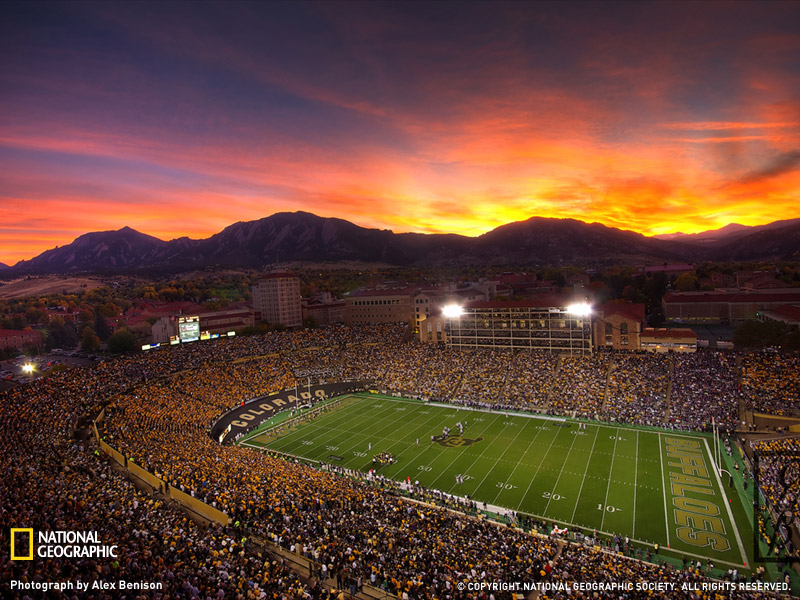
The 2010 game at Colorado might be standing in the way of Georgia opening the season at the Georgia Dome (not necessarily a bad thing), but I’m looking forward to seeing a game in a setting like this:
HP’s site is valuable and his analysis (of the Heisman landscape) typically accurate because, as he frequently must explain to critics, “I analyze the Heisman race in the context of how it is, not how it should be.” Fair enough, right? You might not like that the Heisman more or less ignores defense or favors certain schools, but you have to accept those realities if you hope to follow the Heisman race with any kind of perspective, insight, and accuracy.
With that maxim guiding his site, you’d expect him to recognize that Johnson’s comments are cut from the same cloth. It’s not the job of Johnson and his peers to schedule in a way that would sit well with fans of the game. The incentive system for major college football programs – as it is – values wins (or, more correctly, lack of losses) far more than strength of schedule. It’s one of the tradeoffs of making the regular season count for so much. Teams schedule accordingly.
If scheduling reform is necessary, it’s because incentives are out of balance. When you look at what gets rewarded, Johnson’s approach is completely rational. Strength of schedule *is* overrated. Even when it’s a question of deciding who plays for the national title, other factors like conference championships or poll position often come in to play before strength of schedule. Additional wins for major conference teams mean higher rankings, bowl games, TV appearances, and money. If you can do it at home and collect the gate receipts, all the better. That the Pac-10 would consider dropping its round-robin schedule in the pursuit of more bowl-eligible teams shows how strong the pull of the financial incentives are.
Bringing about more attractive or aggressive schedules means either changing the incentives or compelling teams through top-down rules to schedule in ways that are contrary to the current incentives. Unfortunately, the same conference-based organizational structure that works so well as a money-making machine would surely be as resistant to further scheduling restrictions as it was to the idea of Congress meddling with the BCS.
As an aside, Johnson’s best comment was this:
You’d love to have a national name [opponent] that’s in a valley one of these years. It still looks great. You just don’t know when people are going to be up and down.
It’s so true. How much credit is Georgia getting for scheduling mediocre Arizona State and Colorado teams?
Since we’re in off-season if-I-were-king mode…if you really want the best regular season schedule, take HP’s 10-team conference model and use relegation to determine membership instead of geography. You’d have nine conference games and can use the other three on regional rivals in other divisions or however else you’d like. Scheduling wouldn’t matter – winning the first division (or earning promotion) would be what it’s all about. And what matchups every week…
“Helps the teams that are playing in it, no question,” Johnson said. “Doesn’t do anything for us or Georgia. When you bring in teams in your own conference to showcase them every year in a kickoff game, it’s got to help them recruit the area.”
The quick reaction is to point out that Georgia or Georgia Tech could just as well participate, but doing so would still be less optimal than simply hosting a quality home game at which either program could actually host area prospects.
If you’ve dipped your toe into the waters of the 2010 recruiting pool, you’ve heard of Nick Montana. Yes, son of that Montana. Montana is rated the #12 pro-style passer in the nation by Rivals.com and had offers from, among others, LSU, Alabama, Ohio State, Georgia, Notre Dame, and several schools closer to his home in California.
It’s no surprise when a prospect decides to stay within his own time zone, but Montana’s Tuesday commitment to the Washington Huskies is definitely getting a few double-takes. The Huskies were 0-12 last year and haven’t had a winning season since 2002. New Washington coach Steve Sarkisian brings a resume that includes work at Southern Cal with Carson Palmer, Matt Leinart, and Mark Sanchez, and Montana explained, “You just have to look at all the guys he’s put into the pros.” The Montanas are taking the gamble that Sarkisian will bring that same Midas touch with him as he starts to rebuild the reeling Washington program.

 What’s with all of the Sunshine State commitments?
 Comments
 Dawg Media
 RSS 2.0