Monday October 9, 2006
Like most, I spent most of the weekend trying to make sense of the Tennessee
game. For the impartial observer, it had to be a hell of a show. Huge point
swings, lots of scoring, big plays in special teams and the passing games…just
a roller coaster ride. You can imagine how it was for those of us in the stands.
Obviously Tennessee’s touchdown at the end of the first half was crucial. They
ate up nearly the final four minutes of the first half and turned a 24-7 deficit
into a manageable 24-14 score while draining much of the momentum Georgia had
built up.
From there, we entered the perfect storm of a meltdown. For a collapse this
complete, everyone had to contribute. First, there were the kickoff returns
to the 5. Then there were the interceptions on Georgia’s own doorstep. Top it
off with a complete inability to pressure the quarterback, add in a blocked
punt in then endzone, and you have a recipe for a 37-point second half.
Ching
thinks Georgia got suckered into a "land war in Asia" strategy.
"They let themselves get caught up in a game they had no business trying
to play and it caught up with them in the second half." That is, they decided
to get into a shootout with Tennessee. I don’t mean to come off like I’m sniping
at Ching. He’s one of the few pros who puts something opinionated out there
that’s worth commenting on, so he’s often going to be referenced here. I see
where he’s going, but I didn’t see things quite that way for a couple of reasons:
- We did throw quite a bit more in the second half as he says, but many (at
least eight) of those pass attempts came when it was panic time late in the
fourth quarter.
- Though we were in a shootout in terms of the score, the Dawgs generally
drove the ball with patience. They only had three (four if you count take-a-knee
time at the end of the first half) drives in the first half. That’s chewing
up some clock. The exception of course was the first TD drive where Tereshinski
threw completions of 46 and 34 yards and nearly half of his 164-yard total.
(aside…that 34-yard drive-saving pass to Massaquoi from the 15 might have
eclipsed Cox’s strike against Colorado as Georgia’s best pass of the season.)
- While the game was still in doubt in the second half, Georgia relied heavily
on the effective twin-tight formation. They still threw from that formation,
but the attempt to play power football was still there right up to the point
of the blocked punt.
- Poor field position (inside our own 20) makes defenses quite a bit more
aggressive, especially against the run.
That said, I think it’s a valid point that Georgia might have believed a bit
too much in their passing game. Tereshinski got 107 of his 164 yards on three
fist-half passes, and putting the game on his shoulders in the second half led
to four fatal turnovers. The rest of his nine completions only netted 57 yards
– just 35 in the second half. 12-of-20 for 164 was a career night for him, but
let’s never use intangible phrases like "leader who manages the game well"
again. Georgia’s leadership and production on offense came almost solely from
the running game in the second half when they badly needed to stop the bleeding.
Most disappointing was the lack of pressure on Ainge. Any coverage scheme,
zone or man, will break down when the quarterback has all day to throw. Moses
and Johnson weren’t much of a factor. If they were double-teamed, then the tackles
and linebackers did nothing with the openings caused by the double-teams. Georgia’s
defensive players and staff should have to see this quote from Eric Ainge until
it is seared onto their eyeballs: "I can’t say that I ever felt the pressure.
Football is easy when you have that much time."
I’ll stop there. Every area of the team can be torn a new one over this game.
I don’t want to be the guy at your tailgate who got back into the Budweiser
after the game and held court for an hour whether anyone was listening or not
about who should be fired, who should never suit up again, and why we’ll never
be competitive in the SEC so long as Richt does things the same way. I’ll bet
we all had one of those at our tailgates. I hope for your sake it wasn’t you.
This has to be how Tennessee fans felt in 2003 after Sean Jones’ fumble return
started a string of 28 Georgia points in little more than 15 minutes.
I’d say the Dawgs have two games ahead to get ready for the stretch run at
the end of the season, but we know now that we can’t take Vandy or Mississippi
State as sure wins. Times like this are when Richt earns his money. Tennessee
showed us with the hiring of David Cutcliffe and this season’s improvement in
the Tennessee offense that coaching does matter. Richt said on Sunday that "there
are an awful lot of things that can happen in this race, and the race is on,
and it has really just begun." That’s very true just halfway into the season,
but some adjustments and improvements are called for if the Dawgs are going
to be able to compete in this race.
Friday October 6, 2006
I don’t get the people who are treating LSU as a mortal lock
against Florida. Though LSU has steamrolled the weaker teams on its schedule
to this point, they looked very familiar against Auburn: no running game and
no playmakers in the passing game. Florida’s offense has put up over 20 points
against both Tennessee and Alabama – quality defenses. I’m not so sure that
Florida wins. The biggest key will be their start. They will find it much tougher
playing from behind against LSU. I think the Florida defense is getting overlooked.
They have as much ability to shut down LSU as Auburn did, and the LSU offense
hasn’t looked particularly effective in their last two games against better
SEC competition (Georgia last year and Auburn this year).
It’s Friday, and I’m still trying to figure out the reasoning
behind naming Tereshinski the starter. A few separate thoughts:
- He hasn’t faced game action in a month. He hasn’t faced SEC-quality pressure
in nearly a year except for a single series against SC. There is more to being
ready than having a pain-free ankle.
- Even if he knows the playbook better than anyone and can make perfect reads
and checks, there is still the question of executing those reads and checks.
The same delivery problems will still be there.
- I’ve seen it said dozens of times that Tereshinski "manages the game."
What am I not seeing here? What, from his body of work, has been exceptional
in the area of managing game situations?
- I also don’t buy the "loyalty" or "nepotism" reasons
some have grasped at in an attempt to explain the move. There much be some
solid football reasoning behind it. There must be something JT3 is expected
to do or bring that gives us a better chance against Tennessee than one of
the other quarterbacks. I’m just not seeing what it is.
- I’m really hoping he performs well because I want the Dawgs to win.
So a bunch of students want to organize and wear black to
the game. Instead of "blackout", we’ll call it "wearing shirts
of color". I’ll be happy if the students are just in the stadium before
the Alma Mater. Aside from the utter Gamecockishness of it, I have to appeal
to the superstitious nature of sports fans. Why on earth someone would wear
a shirt that hasn’t had its good luck thoroughly vetted in prior games to a
game of this magnitude is foreign to me. I believe the majority of "(color)outs"
fail not because they’re cheesy or a sign of an inferior team putting all their
eggs in one basket (OK, those work too) but because thousands of fans willingly
leave proven good luck garments at home in order to participate.
Some students we’ve talked to this week with their finger on the pulse defend
the plan as 1) a show of "unity" and 2) what’s wrong with students
showing some excitement for the game? First, there’s not much more unity than
the sea of red at most home games. Black is a move in the opposite direction
from unity. Second, if students can’t be at a frenzy for a night nationally-televised
SEC game between two top 15 programs without a fresh wardrobe, stay out of the
ticket lottery next year and let some serious football fans get the student
tickets.
Friday October 6, 2006
PK Brandon Coutu is out for the Tennessee game – and perhaps longer. He’s one of Georgia’s more powerful and reliable offensive weapons, so his absence tilts the kicking advantage to Tennessee.
Junior Andy Bailey will do the placekicking. Bailey hit 14 of 20 FGs in 2004 before a slump at the end of the season (including a whiff at Auburn) made way for Coutu to take over. Bailey has a big leg, but accuracy has always been a problem. The kid from Athens, Tennessee has a big opportunity on Saturday.
Thursday October 5, 2006
A stat that has been thrown out a lot when talking about the Georgia offense’s
struggles is the SEC-worst 29.8 third down conversion rate. That’s awful. As
Buck Belue pointed out on Tuesday and others have mentioned, what you do on
first and second down has a lot to do with your ability to convert third downs
and sustain drives. The stats from the Ole Miss game are an ideal case study
on that point.
Georgia had 25 first down plays in the Ole Miss game.
- Three of those plays were either at the goal line or taking a knee at the
end of the game, so we’re talking about 22 first-and-tens.
- 12 of 22 first-and-tens were runs. Five were complete passes, five were
incomplete passes. Three of those first down incompletions came on consecutive
drives in the first half. All resulted in three-and-outs.
- Penalties gave Georgia two 1st-and-15+ situations. They converted neither.
- Georgia gained first down yardage (ten or more yards) on three 1st-and-10
opportunities. All were in the second half. Two runs, one pass.
- Georgia had ten offensive drives in the game. They did not get two first
downs in a series until the last drive of the first half. They had at least
two first downs in four out of five second half drives. Nice improvement at
sustaining things (and no small reason why Georgia took over the game).
Here are the keys:
- The Dawgs gained at least four yards on nine of those plays (41% of first-and-ten
opportunities).
When the Dawgs gained at least four yards on first down, they always
sustained the drive with another first down.
This point applies regardless of run or pass. Georgia had two first down
completions (both to Southerland) that led to 2nd-and-7+ situations. They
converted neither.
- On the 13 occasions where Georgia faced 2nd and 7 or longer, they ended
up with a first down on only four occasions. That’s less than
25%.
Thursday October 5, 2006
The brilliant spotlight on the quarterback situation is keeping another position
shakeup somewhat in the dark. What’s interesting is how open and direct the
criticism of a particular player is and how well that player has taken it.
Ole Miss was successful in gashing the Dawgs straight up the middle with the
running game. Danny Verdun-Wheeler was starting at middle linebacker in place
of the injured Jarvis Jackson, and it just wasn’t his night. Several times he
was the first guy in the gap and even had a chance to stop the back in the backfield,
but he couldn’t finish the tackle or gave up several yards before he could bring
the runner down. Coach Richt saw what we did.
"I think Danny Verdun understood what to do pretty much, but when it came
to the moment of truth, the human equation, linebacker versus running back,
we didn’t knock him back, he knocked us back. It wasn’t just Danny,
but Danny was at the point maybe more than some of the other guys were. We’ve
got to be more physical tacklers."
He was right. Danny often got himself in the right place to make a play. He’s
a good experienced linebacker, and the coaches will tell you that he is the
most versatile of any of the LBs. But he’s not the physical presence that we’re
used to in the middle. That’s what Richt is hoping for as Jackson returns this
weekend. "Jarvis has been the guy I think can really run through ballcarriers,"
he said. "He tends to really be the big-hit guy for us. I’m thankful
he’ll get the opportunity to get back in."
To his credit, Danny responds as you’d hope a veteran would. Ching
quotes him, "I was in position, I just missed the tackle. I’ve
just got to work hard this week and prepare a whole lot better this week."
You hope that the young receivers, who don’t have the benefit of that experience,
can take the same approach with all the heat they’re getting this week.
Part of the reason why Verdun-Wheeler is coming off the bench instead of moving
back to an OLB position is the play of Brandon Miller. Miller had one of his
best games at Ole Miss and was a big factor as the Dawgs eventually limited
the success of the Rebel running game. Tony Taylor has been great most of the
year. Other than getting frozen in place on a long run by the Colorado QB, Taylor
has been a tackle machine.
The linebackers will be a big part of the story on Saturday. Tennessee has
had mixed success running the ball. They struggled against Florida, but they’ve
rebounded nicely in their past two games. There have been a series of injuries
to the backs and the line. Georgia must have the advantage in the running game
as they did last year. If Tennessee can run the ball well on the Dawgs, that
means less pressure on Ainge, and Ainge with time to throw can be particularly
effective. Georgia’s linebackers will also have to be sure tacklers as the Vols
have shown a strong ability to turn short-yardage plays into big ones.
The Vols present a different kind of challenge for Georgia. It’s really the
first quality passing game Georgia has seen. There have been good players like
the Western Kentucky quarterback or Rice at South Carolina, but Georgia’s defense
hasn’t seen anything like the combination of Ainge, Swain, and Meachem. That’s
why controlling the running game is so high of a priority – defense will be
somewhat easier if the Vol offense can be made more one-dimensional. If Coker
and/or Foster can have some of the success that Colorado and Ole Miss had running
the ball in the first half, it could be a bad day for the Georgia defense. With
Colorado and Ole Miss, we didn’t especially have to worry about a potent passing
attack.
Wednesday October 4, 2006
Justin Young of Rivals.com is reporting ($) that 6’1″ PG Zac Swansey has committed to play for the Georgia basketball team. He had offers from Ole Miss, UMass, and Saint Louis among others.
Swansey seems to be Georgia’s answer at the point guard position after Keegan Bell switched his commitment from Georgia to Vanderbilt. He transferred to Dunwoody from Flowery Branch High School for his junior and senior years, and as a junior he was part of a repeat state AAA championship at Dunwoody.
He is rated the #16 prospect in the state of Georgia by Rivals.com.
Welcome Zac!
Wednesday October 4, 2006
The zone on South Campus had already been reduced, and just in time for the Tennessee game the zone on North Campus has also been carved up. According to the revised map on the GamedayGameplan.com site, the North Campus zone is now limited to a space in front of Old College, New College, and the Administration building. The space in front of Terrell Hall, the Chapel, Demosthenian, and the Arch is returned to tailgaters.
Hopefully those who do tailgate in the “reclaimed land” will treat it responsibly and not cause the kind of scene that brought about the restrictions in the first place. Just clean it up!

Tuesday October 3, 2006
Nearly halfway into the season, it’s time to borrow some words from that great basketball coach Norman
Dale.
"This is your team."
That’s not to suggest complacency or even resignation. It’s just time to recognize
and deal with what the Dawgs do and don’t have, and it’s time to put notions
built on preseason daydreams aside. The defense is solid if not dominant, but
there are questions of speed and tackling. The offense has some promise but
seems to have emerged from this early season cocoon as a moth rather than a
butterfly. I suppose some kind of major transformation is possible, but it’s
more likely that improvements from here on out will be in small pieces and adjustments.
So with that in mind, our outlook has to be how this team – this team – can
win and have a successful season.
Yes, after all of the hand-wringing, it’s still possible for this team to have
a very successful season. They’re already 5-0. Winning ugly but still winning.
It’s much too soon to cash in the chips on the season, and it’s absurd to start
talking as if this team were already out of the SEC race.
Along those lines, I have to take issue with the usually-solid analysis of
David Ching. He suggests that it might
be best to have Tereshinski in place for the Tennessee game in order to
insulate the freshmen from a potentially bad experience. "If the offense
continued to play this weekend the way it has for the last three weeks, the
beating Georgia would likely take against Tennessee would be a big shot for
the freshmen’s confidence." Ignoring the impact on the freshmen’s confidence
of yanking them around and relegating them back to the bench, I can’t imagine
that the quarterback for the Tennessee game would be anyone other than the guy
with the best shot to win the Tennessee game.
If there is one area of concern for me, it’s this lack of direction. The offense
in particular seems to be frozen over decisions that seem much more appropriate
for August than October. Kregg Lumpkin, on limited carries, has the first 100-yard
game since early 2005, and we still can’t commit to him without the hemming
and hawing. The quarterback situation is no less settled than it was six weeks
ago. Name the top two receiving targets. If it were Tennessee, that would be
simple: Meachem and Swain. Florida – Caldwell and Baker. Georgia? Goodman and
Milner? Or Bryant? Harris might be in there one week. Massaquoi was supposed
to be the main threat, how about him? Durham?
Ideally, the Dawgs would have taken the last three games after surviving South
Carolina to build an identity and go into the Tennessee game with a head of
steam. That opportunity has been lost now. This is not an instance where a multitude
of options is a good thing – so many options actually mean that you have no
options when it comes to a dependable set of performers. With what we’ve seen
so far, we know that all of the pieces have been there in some form. The OL
played well at South Carolina. Lumpkin played well at Ole Miss. Stafford, Cox,
JT3, and most of the receivers have had their moments. Very little of it has
come close to happening in the same game – I think South Carolina might be the
best effort from the offense.
Friday September 29, 2006
Sure, they gave Auburn a scare.
But note which way they were headed on the final drive of the game. Yep…right into the Endzone of Death. There was simply no way they were getting into that endzone, and history tells us that they would come agonizingly close to scoring.
Sure enough, a certain touchdown pass fell through the hands of tight end Jared Cook.
Thursday September 28, 2006
Via the Vol blog Loser with Socks…
Can’t disagree with many of them. The miserable failure that is the South Carolina “blackout” should be somewhere on there, but you’ve gotta choose five.
We’ll see his #1 choice up close and personal this weekend. Been a while since I’ve been to Oxford, so I’ll have to see how the Grove and everything else has changed. I do have to wonder though…any place where portable generators aren’t welcome is a bit suspect. I couldn’t imagine a tailgate now without a few TVs going.
Thursday September 28, 2006
It’s not quite the seven seasons that elapsed between games against Mississippi
State, but it has been a while since Georgia has played Ole Miss. For several
years, Ole Miss was Georgia’s other "permanent" opponent from the
SEC West (along with Auburn of course). When the SEC switched to two rotating
opponents from the opposite division in 2003, the Ole Miss game was the casualty.
The Dawgs played the Rebels every year from 1966 through 2002, but they haven’t
faced off since.
The Dawgs took the last three games in the series by a comfortable 98-46 margin,
but the last meeting in 2002 was a back-and-forth game until the end. A young
Eli Manning was held to 12-of-25 passing and was intercepted twice, one of which
was returned for a touchdown by Tim Jennings. The teams traded scores until
a Terrence Edwards touchdown gave the Dawgs some breathing room at 31-17 in
the third quarter. Musa Smith carried the ball 37 times for 148 yards (yes!
in the Mark Richt era!) and the game ended with a 19-play Georgia drive that
took over eleven minutes before the clock ran out with the ball inside the Ole
Miss ten yard line.
Though the Dawgs won fairly easily from 2000-2002, the 1990s were a different
story. From 1993 to 1999, the Dawgs were just 4-3 against Ole Miss, and the
Rebels owned the mid-90s. It began with a 31-14 drubbing in 1993 where the Rebel
defense teed off on Eric Zeier all night. Ole Miss won consecutive games in
1995 and 1996. In the 1995 game, Georgia (already minus tailback Robert Edwards)
lost quarterback Mike Bobo for the season. In 1996, the Rebels caught the Dawgs
coming off that dramatic four-overtime win at Auburn. The Dawgs even led 27-17
before collapsing and losing the game 31-27. Georgia rebounded to win from 1997-1999,
but no win was by more than seven points.
No game during that stretch was more gut-wrenching than the 1999 trip to Oxford.
Ole Miss had the one-two punch of Joe Gunn and future NFL star Deuce McAllister
in the backfield. Georgia was in the middle of a wild season that would see
escapes against Central Florida, LSU, and Vanderbilt, a circus finish at Tech,
a thorough beating by Auburn, and an historic bowl comeback. So in the scheme
of the 1999 season, the turn of events in the 1999 Georgia – Ole Miss game in
Oxford was just another chapter in an inexplicable season.
The story of the game was Georgia’s inability to convert yardage into points.
Though the Dawgs generated over 450 yards of offense on the night, early in
the fourth quarter they only had nine points on three Hap Hines field goals.
Ole Miss was on the short end of yardage and possession all night, but they
took control of the game late when McAllister went 84 yards to put the Rebels
up 17-9. Georgia responded with a 12-play, 80-yard drive that ended with a 4th-and-goal
touchdown pass from the 3 and a subsequent two-point conversion to tie the game.
Hines kicked a 48-yard field goal, his fourth of the night, with about five
minutes left to give Georgia the 20-17 lead. Two big plays put the Rebels inside
the Georgia 20 with a chance to tie or take the lead, but Terreal Bierria made
an incredible catch for an intereception to seal the win. Par for the course
in 1999.
The running game has been a big part of the story in recent seasons. In that
1999 game, McAllister and Gunn each rushed for over 100 yards. In 2001, the
Ole Miss game was the start of the brief but incredibly productive experiment
of Verron Haynes at tailback. Haynes’ 192 yards in Oxford was the start of a
four-game stretch to end the season with at least 100 yards in each game. Musa
Smith also used the Ole Miss game in 2002 (37 carries for 148 yards) as the
starting point for a strong finish to his Georgia career.
The running game is once again front and center as the two teams resume the
series. As QB Brent Schaeffer struggles, the burden of Ole Miss’s offense falls
on tailback BenJarvus Green-Ellis. Green-Ellis had a nice debut with 127 yards
and two touchdowns in the season opener against Memphis. He’s kept it up even
as the passing game struggles, rushing for 4.6 yards per carry on the season.
On the other side, Georgia’s running game gets a chance to show something –
anything – against a poor defense. The Rebels are giving up nearly 175 yards
per game on the ground. So long as the Dawgs steer clear of talented linebacker
Patrick Willis, Georgia won’t get a much better chance this season for a productive
day on the ground. The Dawgs have shaken things up by moving Kregg Lumpkin into
the starting tailback role, but we’ll have to see what that will mean in terms
of carries and the rotation of the other backs. Richt had no problem letting
a productive back run early and often on Ole Miss in 2001 and 2002. In 2006,
will Lumpkin be the next Georgia back to emerge against the Rebels, and will
Richt (and the offensive line) present him with that opportunity?
Thursday September 28, 2006
Also be sure not to miss Jody Yarbrough’s weekly Information Overload segment over at UGASports.com – it’s everything you need to become familiar with Georgia’s next opponent.
Thursday September 28, 2006
Rivals.com has put together a nice recap of Saturday’s game-winning drive engineered by Joe Cox. Good commentary and emphasis given to MoMass’s ability to get a first down and out of bounds on the same key play.
Tuesday September 26, 2006
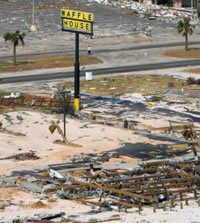 |
| North Campus or Gulf Coast? |
The Red & Black has a lighthearted
editorial today about yesterday’s news of a 7:45 p.m. kickoff for the Tennessee
game. They introduce a theme we’ll start hearing a lot as soon as the Ole Miss
game is digested:
The combination of an SEC rivalry and a late start time will serve as a true
test for the new gameday regulations and intramural field parking situation.
While we hope things will run as smoothly for University police as they have
for the past three games, history has shown that evening games are more debauched.
While the administration should prepare for the worst, fans should accept
personal responsibility for their actions and those of their fellow tailgaters.
That’s pretty mild for what I think we can expect next week. This "prepare
for the worst" stuff will stop just short of some columnist calling for
FEMA to stand ready for – get this – a "night football game".
Yes, night football games have been a part of the Sanford Stadium experience
since 1940, but now the whole process will be put under intense scrutiny.
This reminds me of the current hysteria over drinking on campus. It wasn’t
too long ago that they drove beer trucks right up on the lawn, but
now all of a sudden it’s a major crisis. It also wasn’t too long ago when fans
would begin arriving on Thursday or even earlier for big football games (ask
around about the 1976 Alabama game), but now we’ve got a powder keg brewing
over a few extra hours of tailgating.
If anything, this is much more about the University than it is the fans. Football
fans haven’t changed much. There might be more of them, but that’s about it.
They’re fairly predictable. We know what a night game is like and what the tailgating
scene is likely to be. It’s not as if we haven’t had a few of these before.
The University has time to plan for trash and can even encourage local law enforcement
enforce littering laws as diligently as they do open container laws.
Let the needless hype begin. Fear the night game!!!
Tuesday September 26, 2006
This was also in the Banner-Herald on Saturday, but it deserves its own mention.
The athletic association’s revenues were nearly $20 million more than operating expenses in the fiscal year that ended June 30, according to figures released at Friday’s meeting. Income was about $74 million, while operating expenses amounted to about $53.1 million.
Georgia made headlines this summer for having the nation’s “most profitable” athletic department in the 2005 fiscal year. These new data show that the financial health of the program remains strong. Revenue was up yet again, and expenses topped the $50 million mark. Keep in mind that this is just operating income and expenses and doesn’t represent cash flow or assets and liabilities.
FYE June 30, 2006:
- Revenues: ~$74 million
- Expenses: $53.1 million
- Surplus: > $20 million
FYE June 30, 2005:
- Revenues: $68.8 million
- Expenses: $44.9 million
- Surplus: $23.9 million
|

 I don’t want to talk about it.
 Comments
 Dawg Media
 RSS 2.0