The backlash over Georgia’s 2012 schedule is well underway. I don’t deny that the schedule opens up some great opportunities, but let’s win them first and worry about impressing the critics later.
If Georgia does have a big year in 2012, it’s going to have to come with wins:
at a jacked-up Missouri hosting their first-ever SEC game. Missouri will likely finish 2011 ranked, is well-coached, and should have another competitive team in 2012.
at South Carolina to play a program that returns a lot of talent in a stadium where Georgia usually doesn’t win easily. Georgia has lost two straight to the Gamecocks, and South Carolina will likely see Georgia as their primary obstacle to winning the East.
in Jacksonville where, Florida down or not, the Dawgs haven’t put together consecutive wins since the Reagan-Bush years.
against a very good, likely top 5, team in the SEC Championship if the Dawgs are able to return to the Dome.
And all of that says nothing of traditional rivalries with Tennessee, Auburn, and Georgia Tech – teams that would give a lot to ruin our season, and teams that have spoiled some Georgia seasons in recent years.
“There’s no denying that a schedule that didn’t include the toughest teams from the SEC West probably was the biggest factor in Georgia’s 2011 turnaround. “
There is a bit of truth to the “Georgia is better because of a lighter schedule” angle, but it’s not because the teams on the schedule changed.
The 2010 schedule also “didn’t include the toughest teams from the SEC West,” with the exception of Arkansas. The 2011 schedule traded the Hogs for Ole Miss, and that certainly was a step down in class. The rest of the conference slate was identical. If there was a difference, it was that several of those teams weren’t what they were in 2010. Auburn is the obvious example. Mississippi State might not have been as strong as they were in 2010, but they were still good enough to win a bowl, and I’d say that their drop-off had as much to do with expectations than anything else. Of course Florida was down in 2011, but they were also vulnerable in 2010 until Georgia helped them find an offense. Georgia can control many things, but the quality of their conference – and especially their divisional – opponents isn’t one of them.
Georgia’s nonconference slate was much tougher in 2011 thanks to the replacement of Colorado with Boise State. Two of Georgia’s four nonconference games were away from home against bowl-bound teams.
The 2010 schedule gave Georgia just about the same opportunities that the 2011 schedule did. The difference was that the 2011 Dawgs were improved enough to take advantage of those games against weaker or average opponents.
Aside from the obvious “Mark Richt conservative BAD” conclusion about Georgia’s first overtime possession, it’s the consistency that puzzles me. In perfect hindsight, you would have preferred the chip shot in the first quarter, but you understand why that decision was made – especially in light of the outcry after last season’s bowl game and the tone that was set by laying up early. This was the same coach that traded mid-range field goals for risky passes into the endzone in Jacksonville because that was what it was going to take to beat Florida. The same coach called a gutsy third-down pass to a true freshman that all but ended that Florida game – again, because that’s what it was going to take.
So why in a game with so little on the line, especially when contrasted with a game like Florida, would Richt have played it so close to the vest? He had a similar third down opportunity with just over two minutes remaining where a pass would have all but ended it. Even that decision to run can be defended – you put your top-notch defense in to defend an 85-yard field. But to cash in and not even try to gain yards in overtime? “I felt like my man would make the kick,” Richt explained. Is that what it was? No strategy – just a question of faith?
Was the field goal itself a bad idea? Short of the occasional deep pass, Georgia struggled to move the ball at all. The overtime playcalling will be criticized until September, but Georgia couldn’t run nor pass in overtime. They couldn’t even gain positive yardage in overtime when they were trying to score. This would be Walsh’s closest attempt of all three overtime kicks. I don’t have nearly as much of a problem with the notion of “playing for the field goal” as I do with the second down call.
On first down, Carlton Thomas gained two yards around the left edge. Not great, but forward progress to the 23. Move the pile twice more against a gassed defense (everyone is tired in overtime), and you’re on or inside the 20. You face a 37-yard FG which, while only five yards closer than the one that was attempted, is psychologically much different from one over 40 yards out. The kick didn’t miss by much, and I think that the same kick from five yards closer in would have snuck inside the right upright.
Instead, the call was to have Murray center the ball on second down. Worse than an empty play, it cost yardage. Georgia surrendered field position – and the opportunity to better its field position – in exchange for centering the ball on the field. (Kevin Butler made an interesting observation postgame that a placement between the hashmarks might not even be the ideal position for Walsh given his tendency to push his misses right. The original placement on the left hashmark might have been better.*) Georgia went from having a kick no worse than 40 yards out to intentionally lengthening the distance for a kicker who had struggled mightily beyond 40 yards this year.
I’ve also never liked the idea of kicking on third down. I know why you do it – Tech beat Georgia in such a situation in 1999 in the aftermath of the Jasper Sanks incident. But going back 12 years for an example of why you kick on 3rd down leaves me with the conclusion that this is one of the by-the-book decisions, like centering the ball, that’s done without much consideration for the situation or the personnel. The combination of Frix-Butler-Walsh has been consistent. Georgia gave up second down by trading yardage for an advantage that really wasn’t an advantage. They gave up third down to protect against a scenario that we haven’t seen in a decade. It wasn’t even so much the fear of a turnover – it was completely parking the bus, forgetting that this was 2011 Walsh rather than 2010, and going by the book for a generic field goal attempt as if you were Gene Chizik within a shadow of the goal line at the end of last season’s championship game.
* – I don’t expect Richt to have Walsh’s kicking tendencies at his fingertips for calls like this. It would be something you might expect someone like a special teams coach to know though.
The difference between really good teams and average teams are how well you finish. Do you make plays, big plays, at the end of the game? That’s going to define us, really I think.
For all of the gains made during the 2011 season, the whole point of the exercise and the entire reason for revamping the conditioning program could be summarized by the concept of “finishing.” Using that concept as a rubric, the final game showed that Georgia hadn’t mastered what it set out to focus on during the offseason. The game also showed that all areas of the team contributed to the problems in finishing. Offense, defense, special teams, and coaching all had roles in the evaporation of a 16-point halftime lead.
All of that is not to say that the focus on “finishing” was a failure when you zoom out and look at the season as a whole. Georgia was able to close out a good many games in 2011, and it’s a large part of why they won 10 games, won in Jacksonville, and won the East. We can conclude that the process is, at best, incomplete. That led to disappointment against better competition in 2011. If you want a silver lining, we shouldn’t have to worry about complacency heading into 2012 – all of that wasn’t going to be undone in one year, was it?
If there was a common thread among the teams that gave Georgia its four losses and biggest problems closing out games in 2011, it was superior defensive line play. Boise’s line is one of the best in the nation. South Carolina had a disruptive front that made game-changing plays. LSU…well. Michigan State offered one last test against a top defensive front. Worthy and Gholston were as good as it gets. In fact, Georgia’s offense against MSU reminded me a lot of the Boise game. You had a few big plays go for scores, but by and large it was a frustrating day getting anything going.
A lot of people asked where the tight ends were against Michigan State. Orson Charles had a single, insignificant reception. The (lack of) production from that position is a byproduct of the offensive line. Georgia couldn’t block MSU with five linemen plus a running back, so the tight end was more often than not a sixth offensive lineman. Watch Murray’s long touchdown pass to King: as the pocket moved right, Charles was protecting the backside of the play.
The Bulldog offensive line will and should receive a lot of scrutiny in the offseason. Georgia couldn’t stand up to the best defensive fronts it faced in 2011, and that’s a large part of what separates them from a higher class of teams. I don’t say that as an indictment of what Coach Friend did in 2011. He put together a decent line with what he had available, and it’s worth a closer look to see why he’ll have another big challenge in 2012.
To begin with, you had three senior starters. Not a bad start. Two of them were guards playing out of position at tackle. One of those was a guy who had sat out 2010 while training to play on the defensive line. Georgia’s other two starters, both guards, were relatively inexperienced. They had a single reserve, Dallas Lee, who could be counted on for significant playing time, and Lee was lost after the Florida game. All of that was good enough for much of the year, but it wasn’t when asked to stop or push high quality defensive lines.
Remove the three seniors, and you see why this is perhaps the central storyline heading into 2012. Georgia’s returning starters at guard are fair but won’t be preseason all-conference mentions. Save Lee, there won’t be much returning experience. Pencil David Andrews in at center. That leaves tackle.
Against elite defensive lines, you need quality tackles to deal with the speed and athleticism of the ends. If you think about it, the Dawgs haven’t really had a true left tackle in top form since Sturdivant in 2007. Georgia’s 2011 tackles were converted guards. The 2012 tackles – whoever they end up being – will be inexperienced. The Dawgs recently got a commitment from a very nice JUCO lineman, Mark Beard. Beard plays guard, but he’s told recruiting services that Georgia is interested in him as a possible tackle. Going to the JUCO well for another guard-turned-tackle might be an insight into the lack of depth at the position. If Long and Danztler aren’t ready to step in, the Dawgs might even have to turn to a true freshman like John Theus. The coaches are also hard after top tackle prospects Brandon Greene and Avery Young.
Georgia’s going to have a lot in their favor in 2012. Schedule, defense, experienced QB, nice receivers, and maybe even some quality depth at tailback. But without that line, they’re going to run into many of the same struggles against the type of team they’d likely meet in the postseason. It’ll be October before the 2012 Dawgs have to face their first strong test up front, at South Carolina. Before then, there’s an awful lot of work to do to develop a unit that can push the Dawgs past the defensive lines of the best teams on the schedule.
The Dawgs (and Spartans) arrived in Tampa today. Mark Richt had said before the break that he didn’t expect any surprises from fall semester grades, and it looks as if everyone is in good academic shape for the bowl game.
Mark Richt confirmed that everyone is eligible for the bowl. No academic casualties this year. Last year three players were out b/c of that.
Nice story in the Banner-Herald today about the progress in conditioning made by Andy Landers’ womens basketball program. With most of the players in reasonably good basketball shape to begin with, emphasis has been less about weight loss and more about the marginal improvements that can come from better conditioning and nutrition.
The conditioning program has less to do with losing weight than with hardening muscles. Most of the team has only lost between five and 10 pounds so much of the change has been in body composition.
In addition to running, the team stuck to some new dietary guidelines.
The diet component eliminated most of the goodies that almost every college student lives on. They couldn’t eat sweets, fried food, baked goods and soft drinks. Instead they’d eat salads, baked meat, vegetables and wash it down with water.
Georgia’s rotation isn’t terribly deep again this year, so any incremental gains in conditioning could begin to show up in February and March when many teams and players begin to hit the wall.
Is the fullback simply an anachronism who has no place in the revamped up-tempo Bulldog offense of 2011? Does the play-calling simply reflect the personnel present in the Classic City in the current day, given the talents of Aaron Murray and the multitude of pass-catching weapons (including Bruce Figgins) at Mike Bobo’s disposal? Is the need to use the fullback as a blocker rather than a ballcarrier reflective of the thinness of the offensive line and the inexperience of the tailback rotation, or is a potentially worthwhile element of the arsenal going unused?
I admit to wondering the same thing. It was a surprise (and a pleasant one at that) to see Ogletree rumble for over 20 yards at Tech. And of course Figgins has been almost a sure thing on the 344-Fullback pass play. But there’s no question that the productivity from the position in the running game has declined, and Kyle has all of the data behind that conclusion.
Why is that? In addition to the possible reasons Kyle offers, we also have to consider that they might just not be the best carriers of the ball. Ogletree’s long run was nice, but the ball popped out. Admittedly, that’s a small sample size from which to draw any kind of conclusions about his ability to hold on to the ball. Likewise, Figgins is a converted tight end. As you’d expect, he can catch the ball. But the exchange on a running play is an entirely new operation for Figgins, and it’s possible that the coaches just didn’t trust his lack of experience there. Figgins is a senior, but Ogletree will return in 2012 with a great deal of experience. Of course a backfield that could feature Crowell, Marshall, and Mike Davis won’t leave many carries to spare, but there is an important role for a fullback that can move the pile in short-yardage situations. Given Georgia’s success against Florida, it’s also possible that the coaches will be content with Richard Samuel in that role.
TSK opened up the topic of the top (5, 10, 31) stories of 2011 across the SEC. Here’s my stab:
1) Supremacy. Within the pages of the 2011 calendar, Auburn won a national title while Alabama and LSU set themselves up to play for the next one. The case for the Tide and Bayou Bengals as the nation’s two best teams was so compelling that it was enough to overcome distaste for a rematch and a serious case of SEC fatigue from the rest of the nation. It wasn’t just supremacy in football – South Carolina notched back-to-back College World Series titles for the conference.
2) Comings and goings. At the macro level, the conference welcomed two new member schools during 2011. The real impact of expansion won’t be felt until the coming years, but the move could eventually have an impact on everything from recruiting to the location of the SEC’s marquee events. (As the Georgia Dome clock kept malfunctioning at the SECCG, I couldn’t help but wonder how long it was until Jerry Jones made a bid to move the game to one of the SEC’s newest states.)
The SEC also said farewell to a number of individuals whose personalities made following the conference more interesting. Bruce Pearl, Houston Nutt, Stephen Garcia, Charlie Weis…it won’t be the same without you. We’re glad that Mark Richt wasn’t among them.
3) Pat Summitt. Summitt’s diagnosis of early-onset dementia reached beyond the world of women’s college basketball. In vowing to coach on, Summitt brings this little-understood condition into the public eye and will doubtlessly do much for awareness and fundraising in the campaign for research, knowledge, and ultimately a cure.
4) Oversigning. The action of the season has pushed this story to the back burner, but you couldn’t avoid it for the first half of the year. The league’s decision to limit football class sizes to 25 probably won’t do much to change many of the deeper issues related to the oversigning problem, but it did at least force a conference-wide conversation about the practice.
5) The Tuscaloosa tornado. Much of the SEC landscape – from Mississippi to Georgia to our newest territory in Missouri – was scarred by a series of spring tornado outbreaks. The tornado that devastated Tuscaloosa and just missed Bryant-Denny Stadium pushed the story on to the sports pages and, if temporarily, refocused the passions of SEC fans. When even Auburn fans, players, and coaches become a positive part of a tragedy involving Alabama, you know you have an exceptional story.
I had honestly forgotten about some of these. The cast of players catching touchdown passes is impressive – everyone from Wooten to Figgins to Boykin. By my count, 12 different Bulldogs caught a touchdown pass this year. By comparison, the Georgia defense only allowed 11 touchdowns total through the air in 2011.
The all-time ledger between Andy Landers’ Lady Dogs program and Georgia Tech is a lopsided 30-4 in favor of Georgia. Recent history hasn’t been nearly as one-sided. Since Georgia won the first 24 contests, the Lady Dogs have only enjoyed a 5-4 edge in the series entering Sunday’s annual meeting. In fact, the Lady Dogs had to win on Sunday for its senior class to avoid the ignominy of being the first at Georgia to finish with a losing record against their rival.
Georgia got the win. The 74-68 triumph moved the Lady Dogs to 7-1 on the year and preserved an umblemished home record in the series with Tech.
The game was every bit as close as you’d expect from two teams that have had a lot in common with each other lately. Tech has joined Georgia as a regular participant in the NCAA Tournament, and the Jackets have been just outside the upper tier of the ACC for several seasons. With a team featuring five seniors, you’d expect them to give Georgia a fight, and they did. A year after a poor showing in Atlanta, Georgia was up to the challenge this year.
Forward Jasmine Hassell led the way for Georgia with a career-high 24 points. Hassell was engaged in battle for most of the game with Tech’s
imposing 6’5″ center Sasha Goodlett. The Lady Dogs had good success double-teaming Goodlett in the high post, but the Tech senior still finished with 19 points. Jasmine James and Meredith Mitchell also scored in double-figures for Georgia, and James notched a game-high five steals.
Both teams built small first half advantages, and a little Georgia run at the end of the first half tied things at 33 going into halftime. The Lady Dogs built another small lead early in the second half and kept Tech at arm’s length before another spurt with about 7 minutes to go punctuated by a Khaalidah Miller three-pointer opened up a 12-point Georgia advantage. Some missed foul shots and timely outside shooting from the visitors got Tech back to within three points inside of a minute left, but Georgia rediscovered their free throw shooting and iced the game from the line.
If there was one thing that put Georgia over the top, it was Georgia’s ability to create more turnovers than they committed. The Jackets rely on full-court pressure and tight on-ball defense to create transition opportunites on offense. Georgia occasionally struggled with this pressure, especially when Anne Marie Armstrong had to sit during the first half with foul trouble. But much more often than not the Lady Dogs were able to work it up the court and get into their halfcourt offense. Thanks in large part to the successful traps of Goodlett, the Lady Dogs forced 20 Tech turnovers and created their own opportunities to run.
The remainder of Georgia’s nonconference slate is highlighted by a Las Vegas holiday tournament in a couple of weeks which includes a game against Gonzaga. The Zags were one of the surprises of last season’s NCAA Tournament and have another quality team this year. If they can get past that game, the Lady Dogs stand a good chance of entering conference play on January 1st with a 12-1 record.
We can dismiss any notion that LSU will be overlooking the game with their place in the BCS Championship a virtual lock. Despite the opinion that this game is now somehow without meaning, playing for an SEC title means quite a bit to anyone who puts on a uniform. Georgia’s absence from this game since 2005 has been noted, but LSU has experienced a lesser drought of their own. Few on the team were around in 2007, and everyone else has watched either Alabama or Auburn represent the West for the past three seasons. They’re about as likely to make light of their opportunity to be champions of the conference as Georgia was to overlook Tech last week.
In one of the more puzzling statements after the loss to Boise, the Dawgs claimed to have been rattled by the crowd noise in what was more or less a home game. Just so we’re all clear on this: LSU will have more fans on Saturday than Boise had. LSU fans are known for being a little loud. Hopefully the Dawgs will be more prepared this time.
We know both teams have a good defense. With that in mind, individual matchups are more interesting. Is Georgia well-seasoned enough up front to deal with LSU’s tailback rotation and pounding running game? Can they keep Jordan Jefferson’s mobility from being a factor? Rueben Randle is a beast, but only two LSU receivers have over 20 catches on the year. Can Georgia afford to cheat a little on Randle and Beckham?
When LSU gets into its power running game mode, they like to do it from one-back ace formations with two TE or from two-back sets. Against Arkansas it was noted that the Tigers often split out a third receiver instead of using that second tight end or blocking back. Because Arkansas wasn’t especially strong up front, LSU could get away with spreading the field without betraying their running game. The spread field opened up additional opportunities with the passing game and the occasional option play.
Georgia is certainly much stronger up front than Arkansas, so LSU will be faced with a few choices. The running game is still their bread and butter, so we could expect to see more power formations in order to establish the run against a good defensive front. At the same time, they’d forego the spread formation that made them more versatile and explosive against Arkansas. All of that depends on Georgia’s front playing as expected. If LSU can have early success running the ball, they’ll be able to spread out and put a lot of pressure on Georgia’s back seven or eight in pass coverage.
All sorts of things come to mind when Georgia has the ball. Can the Georgia offensive line that’s been so good in pass protection this month deal with a pure speed rusher like Mingo? Will the tight end be less of an option in the passing game if he’s needed to shore up the edge? Murray’s been much more efficient lately, but accuracy has never been his calling card. Can he get away with that against such a good secondary? Does that secondary lead Georgia to lean more on shorter passes, and can guys like Figgins or Charles be productive?
Can any tailback be counted on enough to develop a rushing strategy for this game? Will LSU’s Eric Reid be back? It looks that way. He’ll give them a more physical defensive backfield and make it tougher to run.
Will Georgia try their hurry-up? It was a train wreck in the season opener, but they’ve used it with more success during the year. It’s a reach to compare Georgia’s higher-tempo offense with Oregon, but the Ducks were able to put up yards on LSU. Just not points.
Turnovers and big special teams plays might seem like random events, but LSU has relied so consistently on them this year that they’re just about as reliable as 100 yards from a good tailback. We’ve seen everything from the fake punt against Florida to the kickoff return at West Virginia to a pivotal interception and punt at Alabama to the punt return against Arkansas. LSU can afford to get outgained in traditional yardage because it’s been so good at the margins. You don’t have to drive 80 yards when you’ve flipped field position with an interception or a long punt.
The challenge for Georgia isn’t just winning turnovers or avoiding special teams mistakes, though that matters. It’s doing those things in a way that create, if not points outright, an advantage that leads to points or changes how the opponent operates. That’s what LSU has done so well this year. Like a good defensive basketball team depends on a press to create easier transition chances, LSU effectively uses defense and special teams to score in spurts that bury an opponent.
Georgia has blocked a punt in both of Mark Richt’s SEC Championships. With Georgia retreating into a punt-safe shell after a couple of successful fakes, we’ll probably have to see if the Dawgs can win a title without a blocked kick. The Dawgs do at least look solid in the other areas of special teams. This is what I was just talking about though – it’s not enough to play neutral with few mistakes. Georgia needs those positive and point-producing plays from its defense and special teams to have success against an opponent of this quality.
If you look over the LSU schedule, the one game that gives more reason for hope than any other is the Mississippi State game. I don’t like comparisons using games from months ago – both Georgia and LSU are different and improved teams since then. That game though is the formula that gives Georgia its best chance to win. Play solid defense, don’t give up scores on big plays, make it a game of field goals, and do your best to get to the 4th quarter. Of course every other team has seen that film, and only Alabama was able to duplicate it.
If you’re looking for tickets or just want to see where the Georgia section is, here is the distribution of seats (pardon the horrible orange and blue scheme). Georgia’s allotment is shaded blue; LSU’s allotment is shaded orange. Georgia will be the visitors, so the team bench will be opposite of both blocks of fans. Since LSU wears white home and away, the Dawgs will still be in red jerseys.
It’s a bit unusual in that the teams’ allotments are next to each other rather than across from each other. With both schools getting only about 16,000 tickets each, most of the tickets went to sponsors and the general public. The north side of the Dome should be a pretty random jumble of fans who got tickets through the secondary ticket markets. None of the premium mezzanine seating went to either school.
The rubber-stamp nature of the 2011 SEC Championship game has been accepted since summer. The conventional wisdom has been correct to this point – the season was more or less a matter of seeing who of LSU or Alabama emerged and then which team from the East would serve as the sacrificial lamb in Atlanta. It’s no surprise then that this storyline continues on into championship week. CBSSports had a nice poll up last night asking whether LSU should rest its starters in the SEC Championship. Such is life when you’re a double-digit underdog in a championship game. Dawg fans are characteristically whining about respect and indignant about falling in the BCS standings, but that can all be taken care of this weekend.
By this point, we shouldn’t need anyone else’s validation. A ten-game winning streak against any schedule is impressive, and everyone in the Georgia camp has seen the improvement for themselves. They’ve pulled off wins against their top four rivals for the first time in nearly 20 years. I don’t really care in what state those programs are. There’s nothing about which to apologize or feel anything less than a sense of real accomplishment for the Georgia program.
Dawg fans are acutely aware of the schedule, and we’ve noted the possibilities opened up by such a schedule since it came out. Nothing new there. I’m fairly sure though that last year’s Georgia team would not have done as well against this schedule. Mississippi State and Auburn proved to be lesser than they were a year ago, but on whole this slate wasn’t much easier than the one that gave Georgia a losing record in 2010.
Same with the outcome of the SEC East. It played out pretty much as expected, only with Florida and Tennessee a little weaker and Vanderbilt a little stronger. If anything changed, it was the assumption that a relatively weaker division meant more margin for error for the team that emerged on top. Credit to South Carolina for keeping it together and producing a quality season by anyone’s standard. They survived the midseason loss of their starting quarterback and tailback and still won ten games, besting their rival and former national contender Clemson in impressive fashion.
South Carolina’s refusal to budge made Georgia’s job clear but tough: win. The Dawgs couldn’t afford to regress to 2010 quality even against the worst of their competition. They didn’t. Georgia and South Carolina both lost to the best SEC opponent they faced this year – Georgia to South Carolina and South Carolina to Arkansas. As both teams kept winning, their seasons and prospects in the SEC East came down to a single common opponent: Auburn.
As Saturday wound down, this was the question on my mind: was South Carolina’s 16-13 loss to Auburn the most shocking SEC regular season outcome in 2011? The Tigers lost to Alabama, LSU, Georgia, and Arkansas by a combined 170-45. None of those teams scored fewer than 38 points, none gave up more than 14 points, and none won by fewer than 24 points. South Carolina picked a bad time to have a poor game against a team that was a whipping boy for the rest of the top of the league. What’s more, they flopped at home and with Lattimore and Garcia in the lineup.
That Gamecock performance against Auburn is a good illustration why it’s so hard for any team to sustain winning over the course of a season. On any day, your starting quarterback can go 9-for-23, or your stout defense can give up 141 yards to a good tailback that didn’t manage but 67 YPG against the top four teams in the league. If Georgia had one of those games against, say, Florida, they were able to find a way to overcome it and still win. That’s why Georgia is representing the East this week, and they deserve to do so.
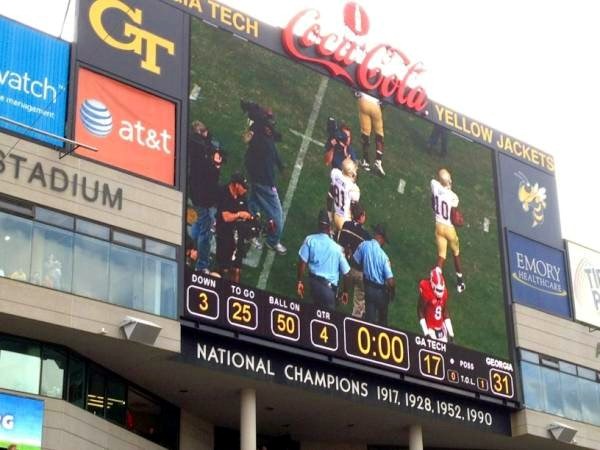
Though Georgia has won ten of the last eleven against Georgia Tech, relatively stress-free wins have been infrequent. Georgia hadn’t enjoyed a double-digit win over their rivals since 2007, and even that game was within six points in the fourth quarter. Saturday’s game certainly had its tense moments, but Georgia’s dominant third quarter made it increasingly clear that this would not be another nail-biter. Some more notes from a cheerful afternoon spent reasserting the natural order of things…
With only 128 rushing yards, "we run this state" might not be the best theme for the game. Maybe "we passed them by?"
After a frustrating outing against Kentucky, it was important for the offense to get off to a good start. Tech is always easier to handle if you can get up on them, and Georgia avoided the scenario that put Clemson in a hole in Tech’s only significant win of the season.
Aaron Murray’s typical game usually starts slowly, but he was on from the beginning of this one. His only first quarter incompletions were a catchable throw to Marlon Brown on a tightly-defended route and and interception off a throw on which Murray was hit. He was a perfect 4-of-4 on Georgia’s first scoring drive and 5-of-6 on Georgia’s next scoring drive in the second quarter. His 32 touchdowns in 2011 has obliterated the Georgia single-season record.
Murray’s fast start was made possible by outstanding pass protection. There was a breakdown on the intercepted pass, but generally Murray had as much time as he needed to pick apart a porous pass defense. It was a little more crowded on running plays, but that was a function of Tech’s decision to stuff the run and count on another shaky start by Murray. Fortunately both Murray and the playcaller were prepared to exploit those opportunities in the passing game.
Was that particularly smart strategy by Tech? Murray threw all over the Yellow Jackets a year ago. Taking away the run might seem like first principles in ordinary circumstances, but this was a Georgia running game without its top two options and little faith in its third. The Dawgs were putting cornerbacks in the backfield. If you’re going to overload resources to take away an element of the Georgia offense, is the running game really what you’d choose?
With the focus on the passing game, it was enjoyable to see the running game take over to ice the game. Any hope Tech had of a quick shift in momentum with six minutes remaining in the game disappeared as Georgia started to pound the ball. Though the Dawgs ended up with no points, the five-minute drive was a giant dimmer switch on Tech’s chances of a miracle comeback.
Speaking of that final drive, it was gratifying to see Ken Malcome contribute. His talent wasn’t so much the issue keeping him off the field. If he’s starting to put the issues that led to his near-transfer behind him and working to earn playing time, we see that he brings something to the table. With the status of Crowell, Samuel, and even Thomas changing on a week-to-week basis, the opportunity is there.
Moving to defense, Georgia had pretty good success stopping the dive play – the lynchpin of any option attack. They held David Sims to only 36 yards on 12 carries. Garrison Smith’s play in relief of Tyson was huge, but the entire defensive front did a great job holding down the middle.
With the dive covered, the next big job was avoiding the big play. Tech’s longest run was a 27-yard gain on a pitch, but they only had one more run longer than 20 yards. Workhorse backs Jones and Smith couldn’t manage anything longer than 14 and 16 yards.
Tech had some success with inside handoffs, but Grantham soon added that to the list of effective adjustments he’s made this year.
In another nod to coaching, the tendency for Tevin Washington to keep the ball on plays close to the goal line had to be noticed. Georgia was ready for the keeper on that early third down on their own two, and Washington was hit for a loss. Holding Tech to 3 instead of 7 there kept Georgia out in front and let them open up an 11-point lead on their next possession.
Special teams had a second straight quality performance. Georgia was bailed out on a poor field goal operation by Tech’s timeout, but otherwise it was a solid day. Both Walsh and Bogotay buried kickoffs. Butler is back. Boykin had one of his best kick returns of the year.
Watching LSU turn their Arkansas game on a punt return, it’s an unfortunate development this year that Georgia has all but abandoned the punt return or punt block as a strategic weapon. Some of Richt’s players (Gray / Flowers / Henderson) just about made their names returning punts. Being burned several times on fakes has led Richt to default to punt safe in all but the most extreme 4th down situations. With field position so important in LSU’s games this year, ceding 10 or so yards on each punt by choosing to defend the punt rather than return it is something to watch next week.
I love scores that bookend halftime. It’s the biggest payoff from winning the coin toss. Georgia turned a close 14-10 game into a more comfortable 24-10 margin without Tech’s offense touching the ball.

 Schedule backlash
 Comments

 Dawg Media
 RSS 2.0