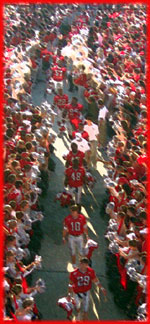
A stinger suffered in practice last week turned out to be a bit more serious than anyone had thought, and Jason Johnson’s football career is over according to Anthony Dasher of UGASports.com. Johnson stated that further participation would risk paralysis.
Johnson, a senior from Chicago, started out as a walk-on and through hard work earned a scholarship. He first made a splash as a standout in the 2006 G-Day game and was thrust into the public eye this season as injuries at tailback opened the door for a start and significant playing time against Florida. He has also become a fan favorite for his exuberance on the sideline.
It’s painful to see his career end with just a few games remaining, but he is a guy who really has lived the dream. He got out of inner-city Chicago, earned a Georgia football scholarship, and will graduate in December.
I usually don’t dwell too much on the previous game when we get into Tech Week,
but one of Georgia’s low points in the last game leads to some thoughts about
the Tech game.
Kentucky was the first game in a while where the offensive line was a problem.
As Coach Richt left the field for halftime, he admitted that Georgia was getting
its butt kicked on both sides of the line. Before the season we expected many
such games where the line would struggle, but they’ve played so well recently
that we’ve forgotten how thin the margin for error is up there.
Problems showed up in both the running and passing attacks. Penetration into
the backfield led to Knowshon Moreno’s fumble on the second play. While Matthew
Stafford made his share of mistakes against Kentucky, pressure was a factor
in several poor throws and decisions. The footwork to which coaches
pay so much attention suffered, and it’s no surprise that two interceptions
came of it. Certainly the injury to Sturdivant didn’t help, but fortunately he should be fine.
If you watched the Lincoln Financial broadcast, they showed Richt and Coach
Searels having a little chat with the offense and the line in particular before
Georgia’s final drive of the first half. Richt stated that he reminded the line
that it starts up front, and they responded. Georgia’s offense finally got on
the scoreboard, and they looked much better in the second half. The difference
wasn’t exactly night and day. Mistakes and turnovers continued throughout the
game, but the effort improved enough to hold off a good Kentucky team.
Stafford and the offensive line will be front and center in this weekend’s
game in Atlanta. Georgia Tech features an aggressive defense with an athletic
front seven and an attacking scheme that can bring pressure from a number of
places.
Stafford can make the throws that Matt Ryan and Sean Glennon did against the
Jackets, but they’ll require better accuracy and form from him as well as adequate
protection up front. Last year Stafford was a barely-adequate 16-of-29 for 171
yards, much of which came later in the game. Georgia didn’t manage a point on
offense until the gamewinning drive. If Stafford can open things up a bit, Georgia
behind Knowshon Moreno and Thomas Brown should be able to improve on the meager
2.3 yards per carry that Georgia had against Tech last year.
It seems a fait accompli that Les Miles will be the top choice for
the vacant Michigan coaching job. Michigan has to have a Michigan man. But is
getting a favorite son the path to success? Outside of Appalachia, it appears
not:
LSU: Miles (Michigan)
Kansas: Mangino (Youngstown State)
West Virginia: Rodriguez (WVa.)
Georgia: Richt (Miami)
Ohio State: Tressel (Baldwin-Wallace)
Arizona State: Erickson (Montana State)
Virginia Tech: Beamer (VPI)
Missouri: Pinkel (Kent State)
Oregon: Bellotti (UC Davis)
Oklahoma: Stoops (Iowa)
SoCal: Carroll (Pacific)
Florida: Meyer (Cincinnati)
On a related note, how do LSU fans feel about their program becoming a stepping
stone for job-hoppers? Will the next hire go again for the superstar who might
bolt in a few years, or is there someone out there to establish an LSU coaching
legacy?
Leading returning scorer (Takais Brown) dismissed after being suspended
for academic issues
Second-leading returning scorer (Mike Mercer) dismissed after being suspended
for academic issues
Guard Billy Humphrey facing felony charges after a dorm search
Forward Albert Jackson suspended for academic issues
Sundiata Gaines deserves better, but at this rate he’ll hit a moose on the
way home tonight. Only Rashad Wright knows how this feels.
Dismissing Brown and Mercer is probably perfectly justifiable, but someone
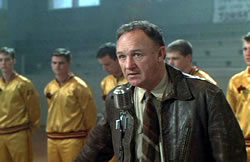
needs to remind Dennis Felton that 1) there’s no Jimmy Chitwood coming to quiet
the townspeople, and 2) Norman Dale did eventually, you know, win.
Welcome to Tech week…the biggest one of them all in my household. 51-7 is bordering on ancient history now; the past three games for the Governor’s Cup have been as tight as it gets.
Much more later but to get the week started properly, we’ll go back to last year’s game-winner, Stafford to Massaquoi. Stafford’s pump fake gets Tech’s 6’7″ DE Michael Johnson (a heck of a player actually) and makes the clutch throw.
Prior to Alabama’s game on Saturday against UL-Monroe:
Alabama leading receiver DJ Hall has been suspended for today’s game against Louisiana-Monroe.
Hall was benched by coach Nick Saban because of a violation of team policy, according to football SID Jeff Purinton.
With the score 14-14 at halftime…
Alabama leading receiver DJ Hall, who was said to have been suspended for today’s game, started the second half for the Tide.
One’s mind drifts back to the Sept. 22nd ESPN Gameday appearance in Tuscaloosa and all of the signs referencing Auburn’s 1-2 start. “Auburn : it could be worse, (signed) ND.” Bama’s going to have to have one hell of a bounceback just to reach “Saban”-and-five.
When I learned that the Silver Wings U.S. Army Infantry Command Exhibition Parachute Team was appearing at the Georgia-Kentucky game, my initial reaction wasn’t pleasant. We know the history here.
But you know what? Screw it. This season has been all about saying “screw it” to trends. We always lose to Florida? Screw it. We always lose to Auburn at home? Screw it. This is just one more trend to reverse. Welcome to these dedicated soldiers – omens of victory from above.
Engadget
HD reports today that nearly half of Americans would rather watch sports
in HD than attend the games.
(In) a recent survey
commissioned by Motorola, some 45-percent of Americans would prefer to
watch collegiate / professional football games on an HDTV rather than attending
— which certainly mirrors the conclusions drawn by a similar
survey conducted earlier this year. Furthermore, only 32-percent of those
questioned stated that they outright preferred live matches to those shown
in HD, while the other segment was apparently indifferent.
Nothing beats the gameday experience for me, but even a fanatic like me can
see the appeal of staying home. Football in HD is incredible. Ticket prices
keep rising, parking is increasingly difficult to find and more expensive, and
you’re out in the elements squeezed in next to God knows who. When you add up
the cost of a Hartman Fund donation, tickets, travel, and tailgate expenses
over a season, the price tag of a nice HDTV rig isn’t that unreasonable.
I don’t see myself missing any home games anytime soon, but the availability
of HD sure did make skipping a road game or two a lot less painful this year.
Tony
Barnhart gives voice to the idea going around that sooner or later Georgia
is going to have to forget about motivational gimmicks and just play football.
He writes of this weekend’s Kentucky game,
There will be no black jerseys. Mark Richt won’t send the team onto
the field after the first touchdown. It will just be 60 very important minutes
of football and a game Georgia must win to have any hope of getting to Atlanta.
Now I don’t disagree that these gimmicks gave Georgia a big shot in the arm.
Clearly they did in each game. For all of the positive that has come from the
attention given to Richt’s motivational tactics, the downside is that some pretty
impressive and gutsy fundamental football against quality opponents is getting
overshadowed. A lot of people seem to think that the Dawgs are riding on pure
emotion right now.
Georgia has already faced the situation of having to move past the gimmick
and just play football. Both Florida and Auburn pushed back and actually led
the Dawgs in each of those games. Georgia’s ability to regroup and answer in
those games has been as big, if not bigger, than any motivational ploy.
Against Florida, the Gators proved equal to the challenge and answered immediately.
While the celebration might have given Georgia the confidence to stand toe-to-toe
with the national champs, there was nothing gimmicky about the rest of the game
as each team threw punch after punch until Tebow’s fumble finally sealed the
game. Georgia’s infamous celebration only occurred because the Dawgs had the
attitude and the ability to run the ball nine consecutive times at one of the
SEC’s top rushing defenses.
The swing was even more dramatic in the Auburn game. Georgia led early thanks
to Kelin Johnson’s interception and a couple of big plays in the passing game.
Auburn’s control of the game from the late second quarter to the early third
quarter was so complete that Georgia had backs running into linemen, Stafford
throwing an interception, and defensive backs unable to stop tosses and screens
near the goalline. The enthusiastic crowd had been taken out of the game by
the turnaround and officiating. The answer sparked by Stafford’s long pass to
Bailey and capped off by Moreno’s touchdown run was just big-time football.
Richt’s "transformation"…or not
Ching
questions more conventional wisdom related to the whole "Evil Richt"
thing today. The perception is that we’re seeing a new and different side of
Richt. I
called it a "transformation" yesterday, but that wasn’t quite
the right word. Much of what we’ve seen from Coach Richt this year has always
been there, but it hasn’t always been so visible. Coach Van Halanger explains,
"if you really look, there really isn’t much difference (in Richt)."
If there is a difference, it’s that we’re seeing in public a few things that
had been mostly behind closed doors in previous seasons. "It just wasn’t
as up front," says Van Halanger. If you’ve seen the locker room scenes
on the Mark Richt show or on a highlight video, you’ve seen the same kind of
dancing and celebrating that we enjoy now, and Richt has always been in the
middle of it.
There is an acknowledgment that there has been at least some change.
One thing that Van Halanger and Kathryn Richt both touched on was that Mark
Richt did have to step on the gas after the Tennessee game. "After Tennessee,
we needed something," admitted Van Halanger. Kathryn added, "I just
think he maybe has more time to do things and think about them and maybe do
a little bit extra. And we’ve needed it."
Ching got a really good line from Kathryn Richt. "Now we’re having
parity, parity is here, and you have to find the edge and what it is that’s
gonna make you different than the other team." That’s a great point. There’s
not a lot separating Florida and Georgia or Georgia and Auburn. Those teams
all have talented players and capable coaches. All of them work year-round and
have extreme off-season conditioning programs. Mat drills don’t separate Georgia;
they simply keep the Dawgs competitive with other teams working just as hard.
Games that close can turn on the smallest edge or matchup or momentum change,
and Richt has found that edge over the past month.
If you, like half the people in my section on Saturday, have been looking for
a #24 jersey, good
news is on the way…just in time for Christmas.
Georgia fans have searched high and low for replica Knowshon Moreno No. 24
jerseys to buy, but to no avail. UGA did not approve that number for marketing
purposes before the season.
But that has changed. Alan Thomas, Georgia’s senior associate athletics director
for promotions and marketing, said Tuesday that the athletics department recently
approved the sale of No. 24 jerseys, and they should be showing up on retail
shelves soon.
I wonder whether the #24 or #7 will sell better next year or if Thomas would
even release that information.
While we’re talking about jerseys, which number should get the nod if they
selected a defensive jersey to replicate next year? #33? #2? #95? #35? #9?
This weekend’s final home game of the season (is it that time already?) is
our annual opportunity to recognize and honor the senior class. Since 2004,
Georgia is 37-11 with an SEC title. They have beaten every other SEC team. While
the 2002-2005 group still sets the standard these days, it’s still been a very
good and successful run for this senior class.
Coach Richt has requested that fans be in their seats 20 minutes before
the game on Saturday. It’s kind of sad to have to remind people to
be on time and in red, but this week’s Senior Day deserves the extra attention.
It’s our last time to enter the shrine until next year, and who doesn’t want
to stretch that experience out until the last postgame note from the Redcoats
echos around the stadium?
This has been a particularly interesting group of seniors. It’s relatively
small, numbers-wise. There aren’t many NFL draft picks among the class. Many
of the team’s stars are younger players. Some of the better seniors like Fernando
Velasco and Brandon Coutu play positions that are usually out of the spotlight.
On the other hand, you can’t tell the story of this season without acknowledging
some very big senior contributions. For some, like Thomas Brown and Sean Bailey,
it’s the story of potential and promise realized. For others like Marcus Howard,
Kelin Johnson, and Mikey Henderson, this season is about the payoff at the end
of a long career of hard work. Velasco’s stabilizing presence anchoring the
young offensive line hasn’t received nearly enough billing.
This season also provides some stark reminders that the journey isn’t always
smooth or linear with a Hollywood ending. Kregg Lumpkin played well since his
freshman season but has battled injuries right up to the end. Brandon Miller
was one of the nation’s top defensive prospects but has spent much of his career
fighting for playing time.
The senior class has stepped back into the public eye for their role in last
week’s black-out. They handled the tough job of keeping the secret with which
Richt trusted them back during the summer. Their request early last week got
the black-out rolling. But in a way, it might be something that the seniors
didn’t do that became one of the biggest developments during this season.
Fans can point to several factors in Georgia’s turnaround during the course
of this season, but most will agree with (in no particular order) 1) an improved
offensive line, 2) the emergence of Moreno, 3) Stafford becoming more consistent
down the field, and 4) Richt’s unprecedented dip into the motivational bag of
tricks.
On Oct. 6, in the closing seconds of a 35-14 loss at Tennessee, Richt stood
on the sideline at Neyland Stadium and said to himself, "Never again."
He never wanted to experience that lack of emotion and energy in a game. So
he made a conscious effort to emote those qualities himself from that point
forward.
Sensing a vacuum, Richt stepped into a role that had previously been the domain
of players. Jon
Stinchcomb’s tirade at halftime of the 2002 Auburn game is perhaps the clearest
example. D.J. Shockley was another player who exuded presence and was a natural
leader as a senior. This time, Richt took it upon himself to be the catalyst
for change, and now the team looks to him. As a
player said at halftime during the Florida game, "Coach, you are the
key. You have got to keep it going."
It’s no condemnation of the seniors to talk about a void of leadership. Many
of them were (and still are) individually fighting for places on the depth chart,
and that has to come before someone can worry about lifting up teammates. The
personality traits and presence it takes to push a team of highly-skilled peers
has nothing to do with football skills or quality of character. The point here
is that a coach has to play to his team’s strengths and adapt to its weaknesses.
As Richt’s role in the past month has shown, evaluating those strengths and
weaknesses goes far beyond athletic ability.
It would have been easy for Richt to stay the course, and many of us (myself
included) would have pulled out his resume to defend him and trust that somehow
things would work out. He could have also placed the burden on the players and
challenged one of them to be responsible for rallying the team. Instead he took
responsibility for becoming the motivational focus for the team.
It’s still a work in progress and a learning process for Richt. After a month
of "cutting loose," to use his term, the pendulum might be swinging
back in certain areas. For instance, Richt has
evaluated his approach to the officials:
Since I’ve kinda cut loose a little bit in some areas, I cut loose a little
bit in that area. I probably went a little overboard on that, so I’ve just
been convicted (?) that I don’t need to do that anymore, so I will be
strictly polite and gentlemanly from here on out….If I do talk to (the officials),
it’ll be in the proper tone and I’m just gonna calm down on the official thing.
As Richt refines his personal intensity and motivational approach, there will
also be the opportunity for players to take some of the responsibility back
on themselves. There is no shortage of young players who will be returning in
meaningful roles next year. Stafford will be an upperclassmen, and it will be
the third year in the program for players like Moreno and Rashad Jones.
But even if the load shifts back onto team leaders in the coming seasons, hopefully
the transformation of Richt will have some lasting effects. "It is just
a lot more enjoyable being around here," said Sean Bailey. That’s true
not only on the practice field but also in the stands. The Munson-driven worry
and negativity is loosening up, and Georgia games are fun. Recruits see Athens
as the place to be. I totally see Richt’s reasons for pulling back in certain
areas like officiating, but there have been a lot of things worth keeping from
this experience.
There was a letter in the ABH earlier this week complaining about conditions after
the Auburn game, and it’s the first I had heard of really bad post-game traffic
this year.
I’ll admit straight up that I’m rarely affected by traffic. We’re usually in
Athens before 9 a.m. and often leave several hours after the game or even later
in the evening. We’re also on the downtown side of things, so we’re never dealing
with the crowds on East Campus.
I usually gauge the traffic by the time it takes my wife to navigate from her
family over at the Georgia Center to our tailgate downtown. To be honest, it
hasn’t seemed that bad this year. Even last weekend after the Auburn game we
had clear sailing through and out of town just a couple of hours after the game
ended.
For those of you with a little more urgency getting in and out of town, how
has it been? I’m especially interested in feedback about East Campus and the
impact of the new direct on-ramp to the bypass.
Anthony Dasher of UGASports.com reports($) that Larry Munson will be on hand to call the Georgia-Georgia Tech game on Nov. 24th in Atlanta. Scott Howard’s obligations with the basketball broadcast team will have him in Wisconsin.
For the first time this season, the tandem of Munson and Zeier will call the game.
Earlier today I was reading Blutarsky’s comments about the whole Michigan/journalism/blogs flap. When you start thinking about some of the things that separate the pros from the unshaven masses, several things come to mind. Thoroughness when it comes to getting the story is one of them. For example…
Putting Out An APB For …
… Former Georgia quarterback Eric Zeier (37), who was the Bulldogs’ starting QB for approximately seven years in the 1990s. (Unfortunately none of it was done in the very cool black uniforms coach Mark Richt trotted out against Auburn Saturday. Props to that move from the suddenly motivation-stoked Richt.) Anyone with information on the whereabouts of the Bulldogs’ second-leading career passer, please apprise The Dash.
Now I don’t want to get on Forde’s case too hard because, after all, he’s giving props to the Dawgs, Mark Richt, and Eric Zeier, and we appreciate it.

 Thank you Jason Johnson
 Comments

 Dawg Media
 RSS 2.0